1. The Rise of Solvent-Free Self-Leveling Epoxy Flooring in Industrial Applications
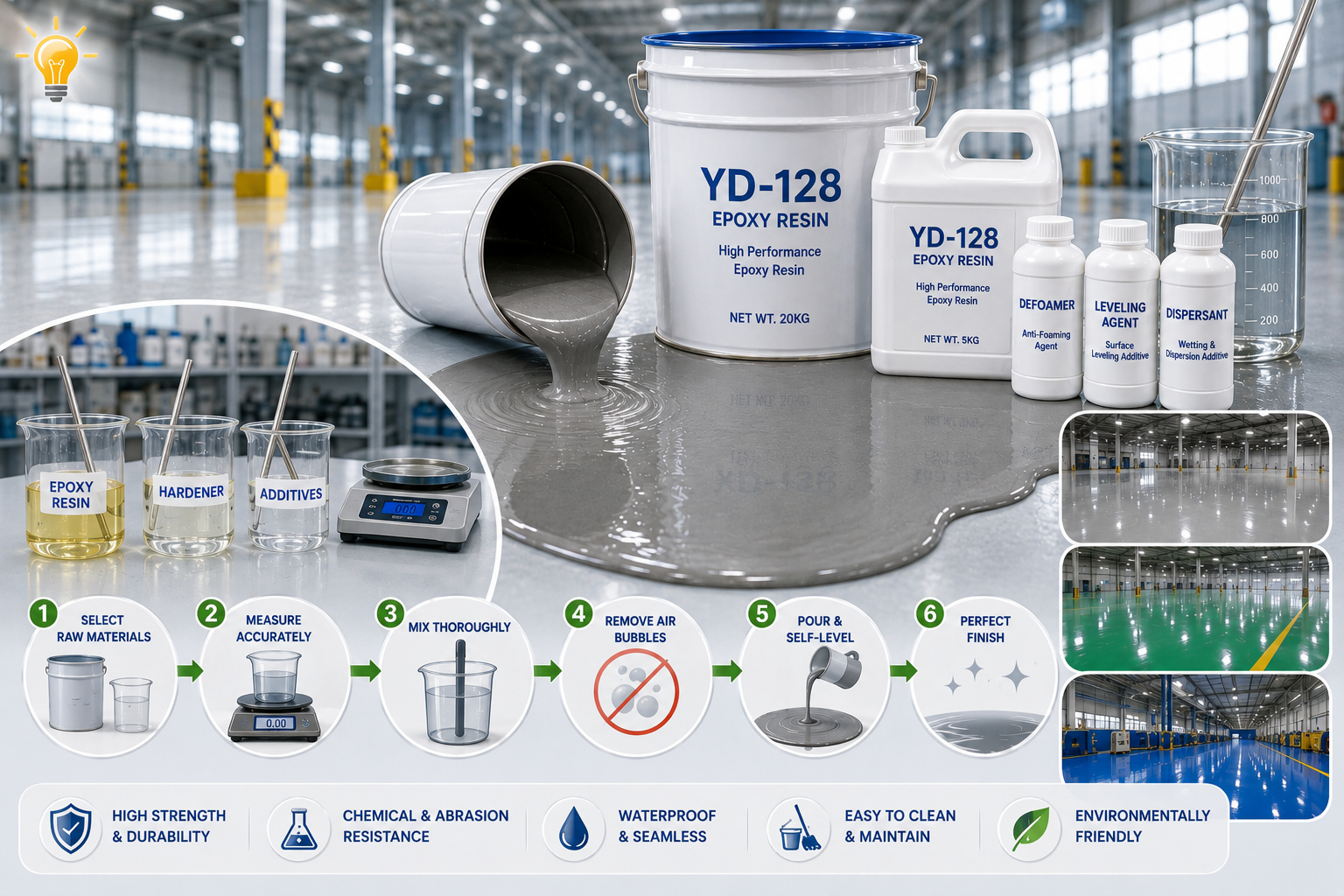
Self-leveling epoxy flooring (Self-Leveling Epoxy Systems) represents the mandatory protective coating standard for GMP-compliant pharmaceutical plants, electronics cleanrooms, hospitals, and heavy-duty logistics facilities. Unlike conventional roller-applied solvent-borne coatings, self-leveling systems require a high-gloss, seamlessly flat, pinhole-free finish with zero-to-low volatile organic compound (VOC) emissions.
Achieving these rigorous mechanical and aesthetic benchmarks relies heavily on selecting the ideal liquid epoxy base resin, balancing reactive diluents, and incorporating specialized deaeration additives during the formulation process.
This technical guide from our chemical application engineering team outlines the precise methodology for optimizing self-leveling epoxy floor formulations using Kukdo YD-128 resin as the core backbone.
2. Why Kukdo YD-128 is the Gold Standard Base Resin for Self-Leveling Systems
Kukdo YD-128 Epoxy Resin (manufactured by Kukdo Chemical Co., Ltd., South Korea) is a premier unmodified liquid Bisphenol-A epoxy resin widely recognized across the global coatings industry.
                   ┌────────────────────────────────────────┐
                   │    KUKDO YD-128 (KOREA) ADVANTAGES     │
                   └───────────────────┬────────────────────┘
                                       │
  [ Low EEW: 184 - 190 g/eq ] ────────► [ High Cross-Linking Density ]
                                       │
  [ Viscosity: 11,500-13,500 cps ] ───► [ Excellent Filler & Additive Loading ]
                                       │
  [ Hydrolysable Chlorine < 0.05% ] ──► [ Moisture Resistance & High Adhesion ]
Key Technical Specifications of Kukdo YD-128:
-
Epoxy Equivalent Weight (EEW): 184 - 190\ g/eq. A tight, low EEW range guarantees high cross-linking density upon curing, yielding high compressive strength (> 80 MPa}), elevated Shore D hardness, and robust chemical resistance.
-
Viscosity:11,500 - 13,500 cps Consistent viscosity enables predictable flow kinetics during application while preventing filler sedimentation during storage.
-
Hydrolysable Chlorine: Max 0.05%. Ultra-low hydrolysable chlorine minimizes sensitivity to moisture from concrete substrates, preventing film delamination and osmotic blistering.
3. Viscosity Reduction Engineering Using Reactive Diluents
The neat viscosity of YD-128 11,500 - 13,500 cps is too high to achieve natural self-leveling flow across concrete floor substrates. To lower the working mix viscosity down to an ideal application window (1,000 - 2,500cps), formulators incorporate Epoxy Reactive Diluents instead of volatile organic solvents.
┌───────────────────────────────┬────────────────────────────────────────────────────────┐
│ Reactive Diluent Type         │ Technical Function & Viscosity Lowering Efficiency     │
├───────────────────────────────┼────────────────────────────────────────────────────────┤
│ AGE (Allyl Glycidyl Ether)    │ High viscosity reduction; improves pigment wetting.   │
├───────────────────────────────┼────────────────────────────────────────────────────────┤
│ BGE (Butyl Glycidyl Ether)    │ Deep viscosity lowering; facilitates air release.      │
├───────────────────────────────┼────────────────────────────────────────────────────────┤
│ C12-C14 Alkyl Glycidyl Ether  │ Low odor, enhances flexibility, prevents brittleness.  │
└───────────────────────────────┴────────────────────────────────────────────────────────┘
Key Rules to Prevent Degradation of Mechanical Properties:
-
Safe Loading Range: Limit monofunctional reactive diluent content to 8% - 15% by weight relative to total YD-128 resin mass.
-
Stoichiometric Recalculation: Because reactive diluents contain epoxide groups (with their own distinct EEW value), formulators must recalculate the overall curing agent demand based on the combined blend EEW.
-
Preserving Chemical Resistance: Exceeding $15\%$ monofunctional diluent lowers matrix cross-link density, softening the film when exposed to aggressive solvents or acids.
4. Optimized 3-Component Formulation Structure for Self-Leveling Epoxy Flooring
A complete self-leveling formulation (Part A Resin Component) comprises the base resin, reactive diluent, pigments, functional mineral fillers, and performance additives:
                   ┌────────────────────────────────────────┐
                   │ SELF-LEVELING EPOXY FORMULATION LAYOUT │
                   └───────────────────┬────────────────────┘
                                       │
  [ Kukdo YD-128 Base Resin ] ────────► 35% - 45% (Mechanical Matrix Backbone)
                                       │
  [ Reactive Diluent (C12-C14 / AGE) ]► 5% - 8% (Viscosity Reduction)
                                       │
  [ Surface & Deaeration Additives ] ─► 0.5% - 1.5% (Bubble Release & Flow)
                                       │
  [ Functional Fillers (Baryte/Quartz)]► 40% - 50% (Hardness & Shrinkage Control)
                                       │
  [ Epoxy Color Paste / Pigments ] ───► 3% - 5% (Opaque Coloration)
Suggested Model Formulation Guide (Part A Component):
| Raw Material Component |
Mass Ratio (%) |
Technical Function |
| Kukdo YD-128 |
38.0% |
Standard liquid Bisphenol-A epoxy base resin |
| C12-C14 Glycidyl Ether |
6.0% |
Reactive diluent for flow control and viscosity reduction |
| Defoamer / Deaerator |
0.8% |
Ruptures micro-foam generated during high-shear mixing |
| Leveling Agent |
0.5% |
Reduces surface tension to prevent orange peel defects |
| Baryte ($\text{BaSO}_4$) / Quartz Filler |
48.0% |
Functional filler for abrasion resistance and anti-settling |
| Epoxy Pigment Paste |
6.7% |
Provides uniform color coverage |
5. Hardener Selection & Air Release Additive Chemistry
1. Hardener Selection (Part B Component)
-
Cycloaliphatic Amines: The preferred curing agent choice for self-leveling topcoats. Provides superior UV yellowing resistance, high surface gloss, outstanding blush resistance, and chemical durability.
-
Modified Polyamides: Primarily utilized in primers or heavy-duty industrial self-leveling floors where high film toughness, moisture tolerance, and extended pot-life are required.
2. Defoamers & Surface Additives
Air entrapped during mixing or pouring can lead to permanent pinholes, cratering, or surface micro-voids if bubbles fail to release prior to gelation.
-
Utilize a combination of silicone-free air release polymers and fluorocarbon-modified polyacrylates for balanced surface tension reduction.
-
Additives must drive micro-bubbles up from thick build layers ($1 - 3\text{ mm}$) while breaking surface foam before the system reaches its gel point.
Contact JM ENTERPRISE Today For Technical Support
Are you formulating self-leveling epoxy coatings, chemical-resistant industrial toppings, or looking to optimize your raw material costs with Kukdo YD-128 base resin?
Contact the application engineering team at JM ENTERPRISE today for specialized technical support, laboratory formulation guidance, and trial raw material samples: