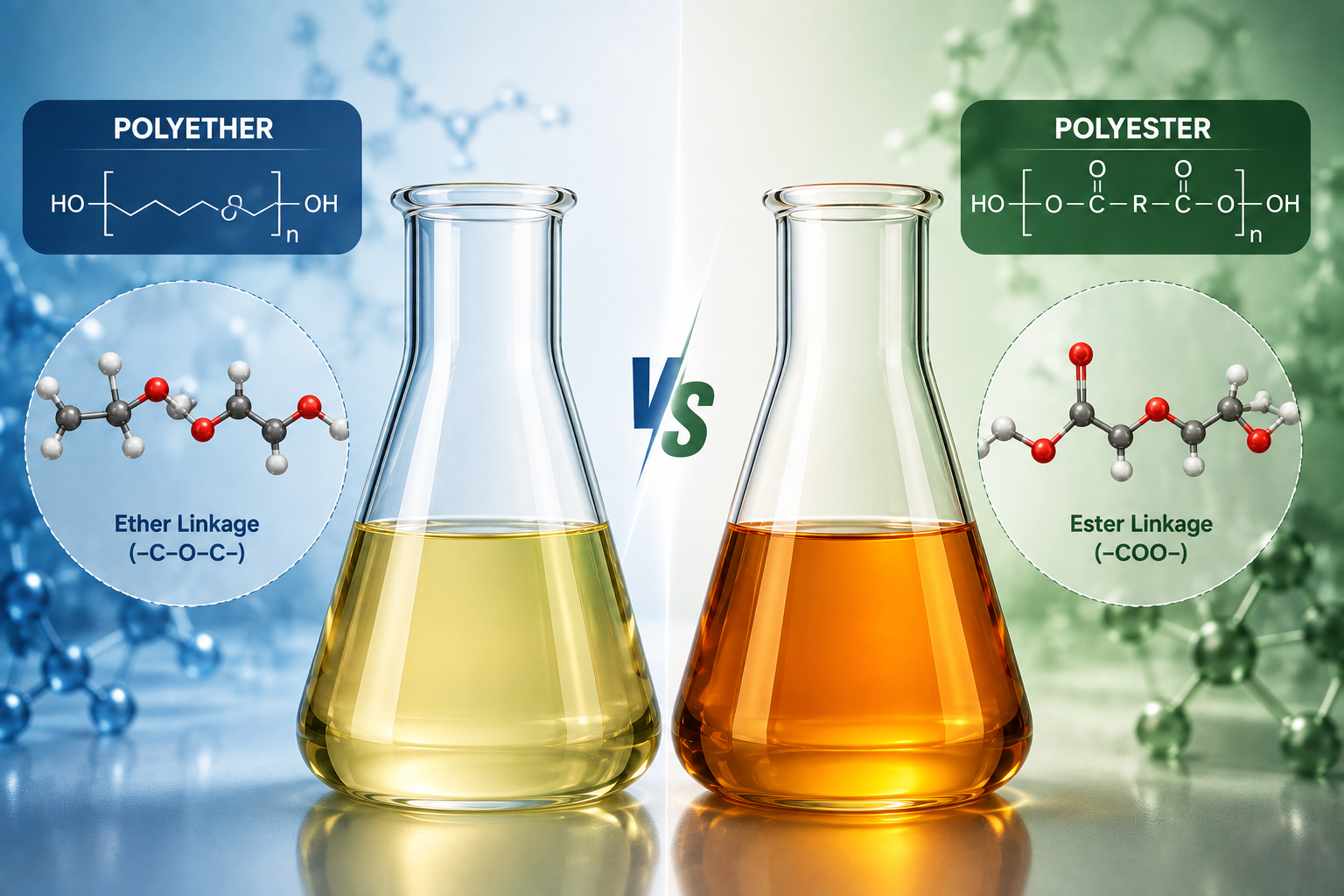
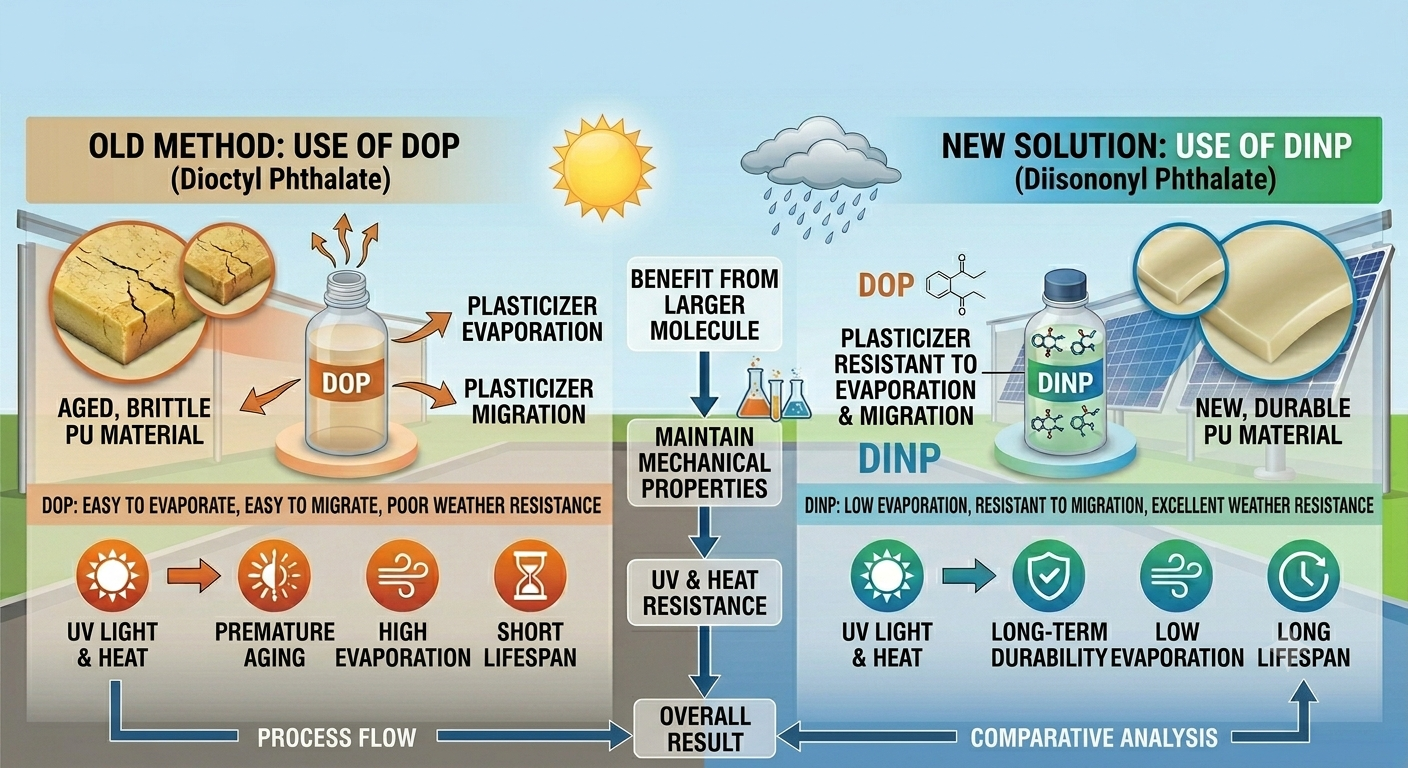
In the Polyurethane (PU) chemical industry, Isocyanates are essential raw materials that react with Polyols to form polymer chains. Among these, MDI (Methylene Diphenyl Diisocyanate) is the most widely utilized Isocyanate globally. However, commercial MDI is divided into two primary product categories with fundamentally different properties and end-use applications: Pure MDI (Monomeric MDI) and Polymeric MDI (PMDI).
Confusing these two Isocyanate grades during product formulation can lead to incomplete curing, incorrect hardness or elasticity, or total batch failure. This technical article clarifies what Pure MDI is and provides a comprehensive framework to distinguish Pure MDI from Polymeric MDI.
1. What is Pure MDI? (Monomeric MDI)
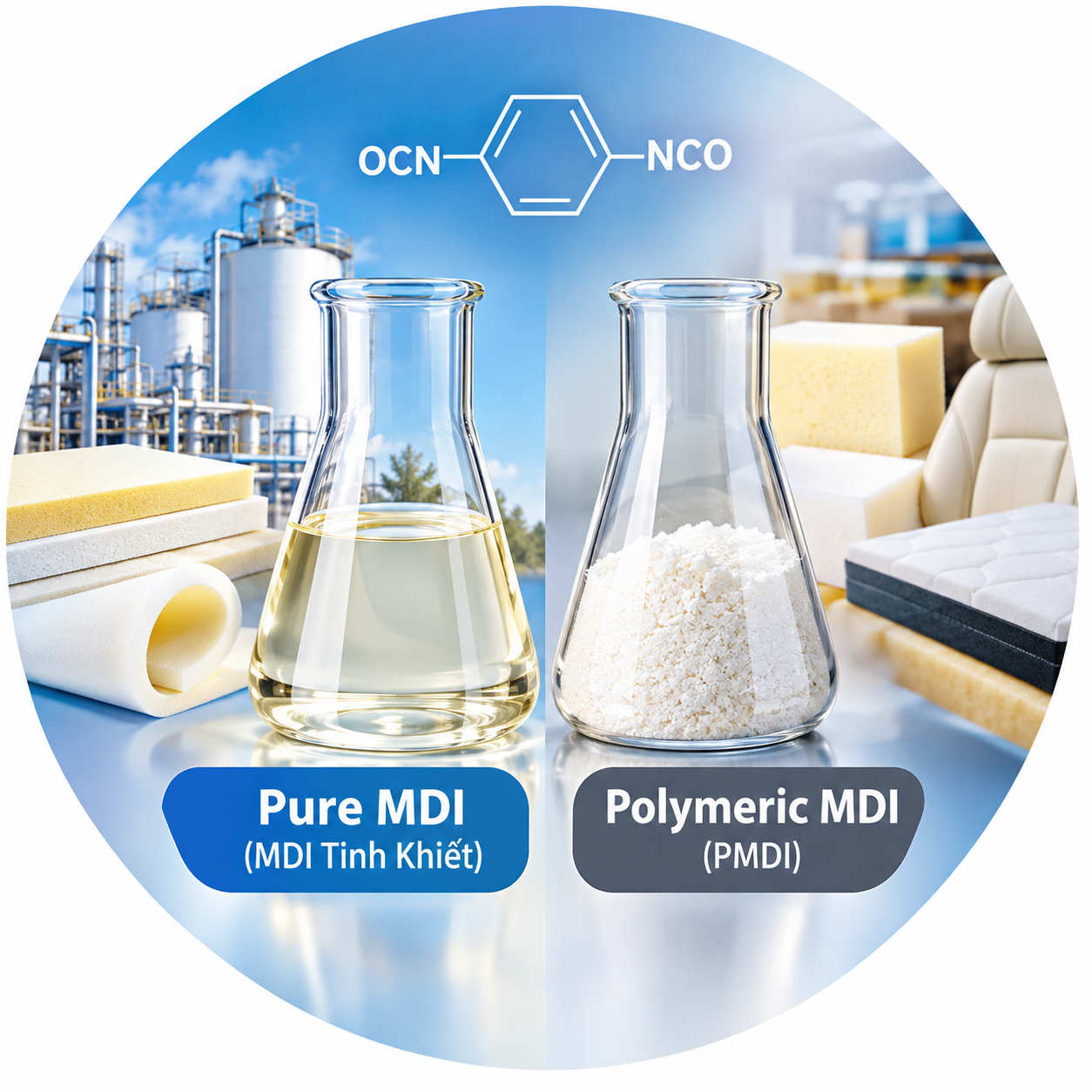
Pure MDI, also referred to as Monomeric MDI, is a pure single-molecule Isocyanate monomer. Its general chemical formula is C15H10N2O2 .
Chemically, Pure MDI contains a minimum of 98% 4,4'-MDI isomer content (with trace amounts of 2,4'-MDI and 2,2'-MDI isomers).
┌── Molecular Structure: Single monomer molecule
│
Key Features of Pure MDI ──┼── Physical State at 25°C: White/pale yellow solid (M.P. ≈ 38°C)
│
└── NCO Content: Theoretical ≈ 33.6%
At room temperature (25∘C ), Pure MDI exists as an opaque white to pale yellow solid with a melting point of approximately 38∘C
 to 40∘C
 . Prior to processing, Pure MDI must be melted into a clear liquid under strictly controlled temperatures (45∘C-50∘C
 ) to prevent self-polymerization into insoluble dimers (uretdione).
2. What is Polymeric MDI? (PMDI)
Polymeric MDI (PMDI) is a complex mixture of oligomeric MDI chains of varying molecular lengths (n=0,1,2,3,... ), combined with roughly 40%-50%
 Monomeric MDI.
Unlike Pure MDI, Polymeric MDI possesses a branched molecular structure with an average nominal functionality ranging from 2.6 to 2.9
 . Under standard conditions, PMDI exists as a dark brown liquid with low-to-medium viscosity (150-250 mPa⋅s
 at 25∘C) and remains liquid at room temperature.
3. Technical Comparison: Pure MDI vs. Polymeric MDI
To assist chemical engineers and plant managers in material selection, the table below outlines key technical parameters comparing both materials:
|
Technical Parameter
|
Pure MDI (Monomeric MDI)
|
Polymeric MDI (PMDI)
|
|
Chemical Nature
|
Monomeric Isomer (4,4'-MDI>98% )
|
Branched Oligomeric Mixture
|
|
Appearance (at 25∘C)
|
White / Pale Yellow Solid
|
Dark Brown Liquid
|
|
NCO Content (%NCO )
|
≈33.5%-33.6%
|
≈30.5%-32.5%
|
|
Functionality
|
Exactly 2.0 (Difunctional)
|
Average 2.6-2.9 (Polyfunctional)
|
|
Viscosity
|
Solid at 25∘C/ Liquid when melted
|
150-250 mPa⋅sat 25∘C
|
|
Post-Cure Polymer Network
|
Linear chains (High elasticity & toughness)
|
Rigid 3D Cross-Linked Network
|
|
Storage Requirements
|
Strict (<-20∘C solid / 45∘C  liquid)
|
Standard (15∘C-35∘C , moisture-sealed)
|
4. Molecular Structure & Industrial Applications
The variance in nominal functionality (2.0 vs. 2.6-2.9) and molecular architecture dictates the specific industrial applications for each MDI grade:
┌── 1. Thermoplastic Polyurethane Resin (TPU Granules)
│
Applications of Pure MDI ─┼── 2. Cast Elastomers (Industrial wheels, seals, rollers)
│
├── 3. Structural Adhesives & Synthetic Leather Coatings
│
└── 4. Elastic Apparel Fibers (Spandex / Elastane)
A. Application Profile of Pure MDI:
Because of its exact 2.0functionality and symmetrical molecular structure, Pure MDI reacts with long-chain polyols and short-chain diols to produce linear polymers. These linear chains readily undergo microphase separation and form strong intermolecular hydrogen bonds.
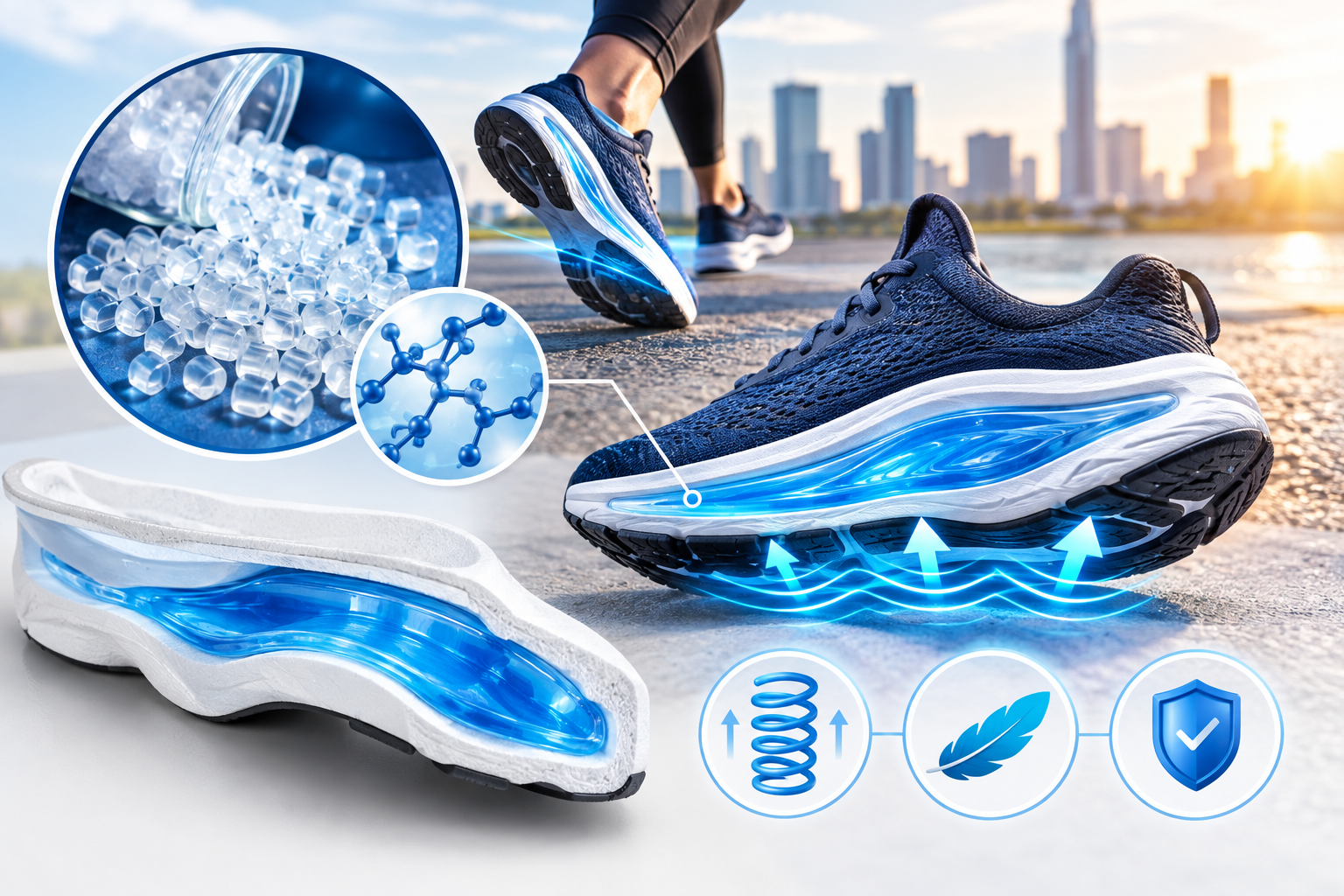
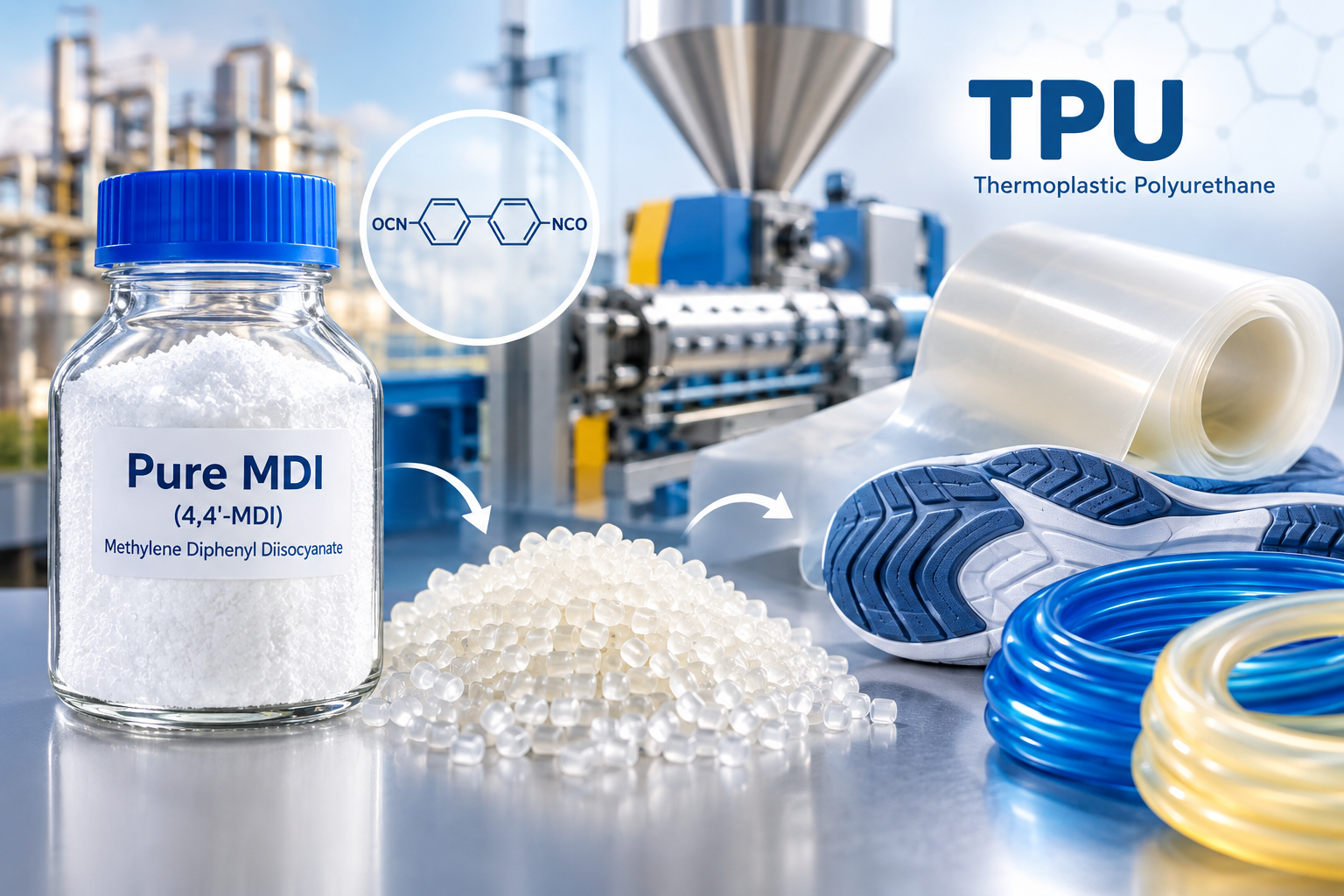
- TPU Resin Production: Serves as the essential hard segment builder for thermoplastic polyurethane resin.
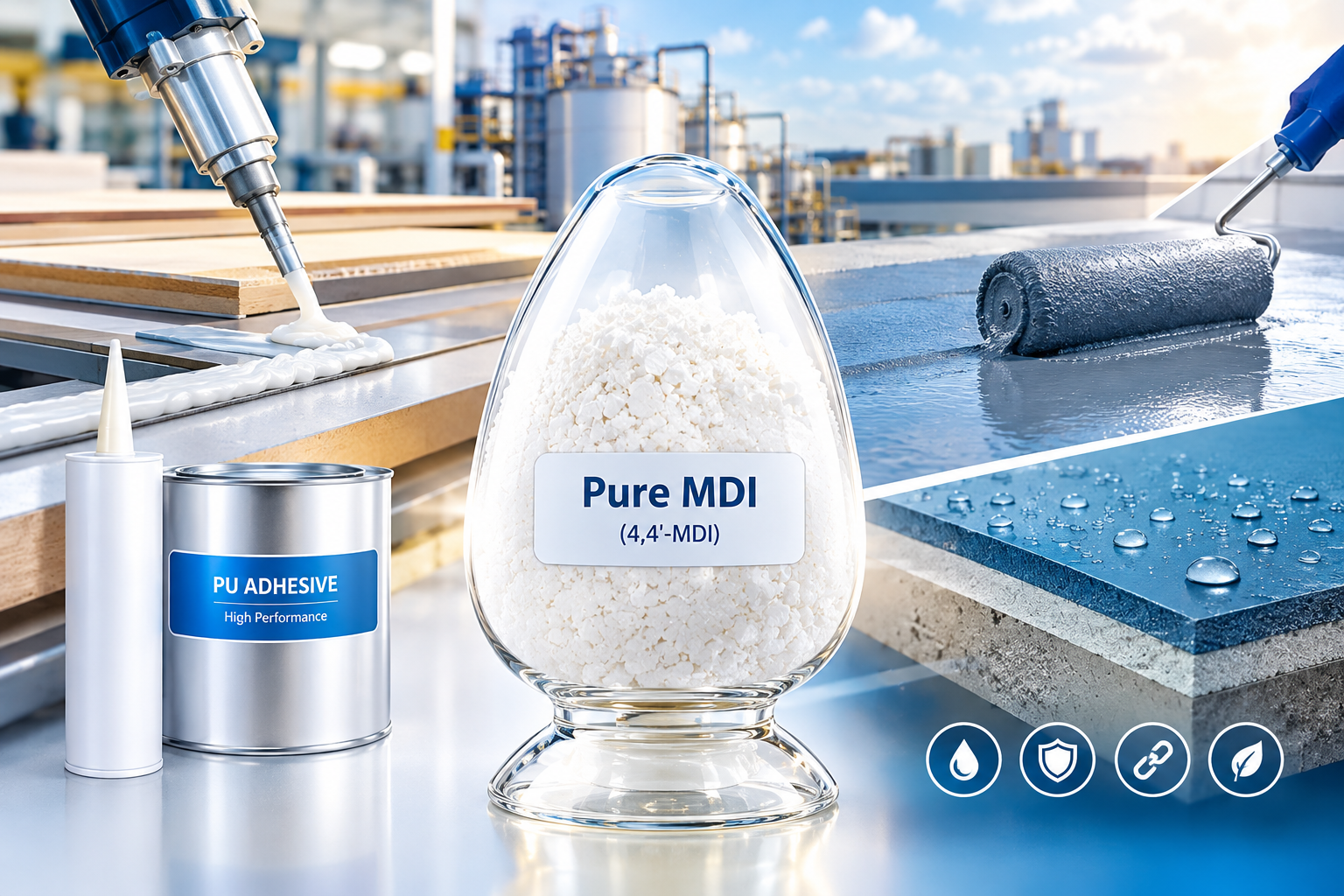
- Cast Elastomers & High-End Adhesives: Used to manufacture forklift tires, industrial rollers, hot-melt adhesives, and high-tear coatings.
- Spandex Fiber Synthesis: A key raw material in manufacturing elastic textiles.
┌── 1. Rigid Polyurethane Insulation Foam (Rigid PU Foam)
Applications of │
Polymeric MDI (PMDI) ──┼── 2. PIR / PUR Insulated Sandwich Panels (Cold storage, plants)
│
├── 3. In-Situ Spray Foam Insulation & Waterproofing
│
└── 4. Formaldehyde-Free Wood Binders (MDF, OSB Boards)
B. Application Profile of Polymeric MDI (PMDI):
Featuring a high average functionality (2.6-2.9), PMDI reacts with polyols to build a dense three-dimensional (3D) cross-linked network, imparting high compressive strength, thermal endurance, and dimensional stability.
- Rigid Thermal Insulation Foam: Serves as the Part A component in cold storage PIR/PUR panels, refrigerator insulation, and solar water heaters.
- Spray PU Foam: Used for direct thermal insulation spraying on factory metal roofs.
- Engineered Wood Binders: Functions as a formaldehyde-free binder for MDF and OSB board manufacturing.
5. Summary
Understanding what Pure MDI is and recognizing the fundamental differences between Pure MDI and Polymeric MDI provides the technical foundation needed to optimize Polyurethane formulations. Selecting the correct Isocyanate grade ensures material performance, processing stability, and cost efficiency in production.
Contact JM ENTERPRISE For Technical Support & MDI Supply
Is your facility manufacturing TPU resins, cast elastomers, industrial adhesives, or rigid PU/PIR insulation foam and seeking a reliable supply of imported Pure MDI (Monomeric MDI) or Polymeric MDI (PMDI)?
Contact the application engineering team at JM ENTERPRISE today for competitive pricing, formulation guidance, and to request direct on-site testing samples:
- Hotline / Zalo:
- +84 933 706 351 – Mr. Cha (English & Korean Support)
- +84 913 390 054 – Ms. Ngan (Vietnamese Support)
- Email: jhcha@jmentchemical.com
- Website: https://jmentchemical.com/