HCM HEAD OFFICE: Room S15, Saigon Pearl, 92C Nguyen Huu Canh, Thanh My Tay Ward, Ho Chi Minh City
HANOI BRANCH: N45-TT4 Do Dinh Thien Street, My Dinh – Song Da Urban Area, Tu Liem Ward, Hanoi
24/7
Call Now
+84 933 706 351
JMENTERPRISE CO., LTD.
Mail Now
jhcha@jmentchemical.com
PU Foam Production Process: A Step-by-Step Guide from A to Z

PU Foam Production Process: A Step-by-Step Guide from A to Z

Source Certified Raw Materials from JM ENTERPRISE – The Smart Solution for PU Foam Manufacturing

Polyurethane (PU) foam plays a vital role in industries such as furniture, bedding, insulation, and packaging. To ensure high-quality foam products, mastering the production process and sourcing standardized raw materials are crucial. Let JM ENTERPRISE guide you through every step of PU foam production and provide optimized material solutions for your business!

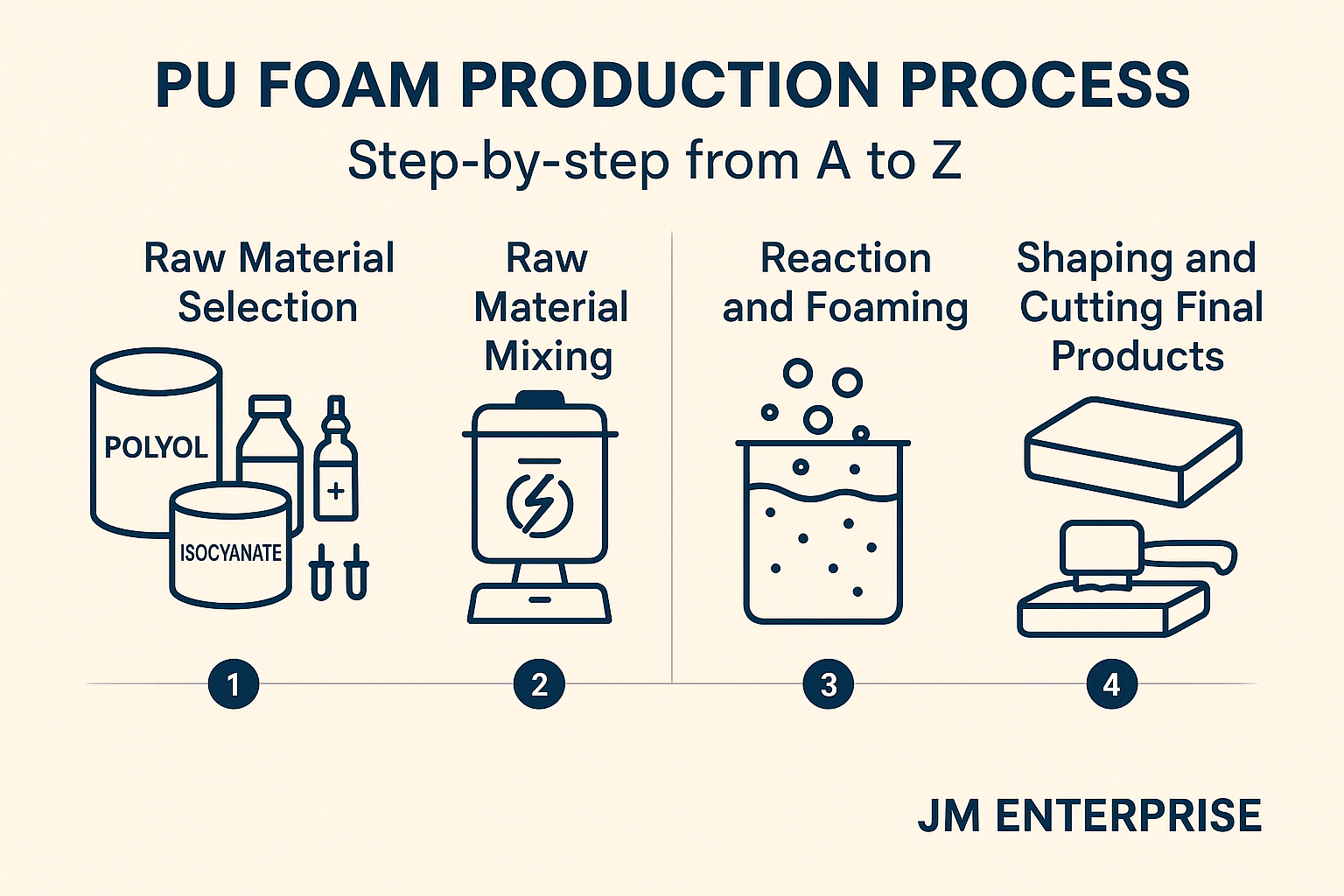
1. Selecting Raw Materials – The Foundation of PU Foam Quality

Key raw materials used in PU foam production include:

  • Polyol (PPG, POP) – the base component that determines softness and elasticity
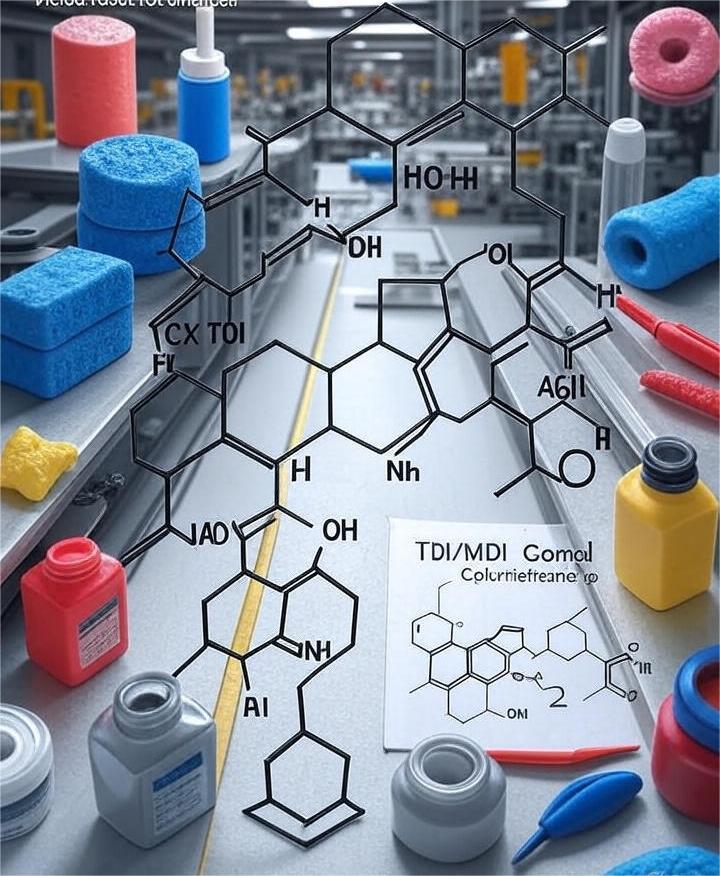
  • Isocyanates (TDI, MDI) – react with polyol to form polymer chains
  • Catalysts – accelerate chemical reactions
  • Blowing Agents – generate the foam’s cellular structure
  • Additives & Stabilizers – adjust foam properties: firmness, gel time, breathability...

JM ENTERPRISE supplies a full range of high-quality raw materials with clear origin and international certification, ensuring consistent quality and cost-efficiency.

2. Precise Mixing – Accuracy at Every Gram

Once prepared, raw materials are fed into specialized mixing equipment for:

  • Accurate dosing based on specific foam formulations (flexible, rigid, memory foam, etc.)
  • Controlled temperature and mixing speed, ensuring consistent and stable reactions

JM ENTERPRISE provides technical formulation support tailored to each application, saving you valuable R&D time.

3. Chemical Reaction & Foaming – The Core of PU Production

When polyol and isocyanates are mixed, a chemical reaction creates polymer chains and CO₂ gas, forming foam:

  • Cream Time – the start of foaming reaction
  • Gel Time – determines the structural integrity of the foam
  • Free-rise or Molded foam – depends on production method

🧪 With JM ENTERPRISE’s raw materials, the foaming reaction is controlled, consistent, and reliable, minimizing production variability.

4. Shaping & Cutting – Transforming Foam into Final Products

After foaming, the material is:

  • Molded or cut into specific sizes (for mattresses, seating, insulation panels, etc.)
  • Further processed – lamination, thermal pressing, fabric covering...

JM ENTERPRISE offers tailored material recommendations to ensure optimal performance for your end products.

5. Quality Testing – Ensuring Performance & Compliance

Final foam products undergo testing for:

  • Density, resilience, compression strength, thermal conductivity, breathability, tensile strength...
  • Compliance with safety standards (RoHS, REACH) for local and international markets

Every JM ENTERPRISE product is accompanied by complete COA & MSDS documentation, making compliance easy and reliable.

🔥 Why Choose JM ENTERPRISE as Your PU Raw Material Partner?

Consistent quality – Competitive pricing – Fast delivery
On-site technical support & formulation consulting
Comprehensive portfolio: PPG, POP, TDI, MDI, catalysts, additives...
Flexible supply: small trial batches, free sampling support

📞 Contact Us Now for Technical Consultation & Quotation:

☎️ Hotline/Zalo: 84 933 706 351 Mr Cha (speak English and Korean) 84 913390054 Ms Ngan ( speak Vietnamese)
📧 Email: jhcha@jmentchemical.com
🌐 Website: https://jmentchemical.com/

🌿 Choose sustainable packaging today — drive long-term business growth tomorrow.
Let your brand be part of the global green revolution!

Newest Blogs

Epoxy Resin vs Polyurethane Resin: Key Differences & Selection Guide

Compare Epoxy Resin vs Polyurethane Resin (PU) in detail. Explore key difference...

How to Choose the Right Epoxy Resin for Industrial Applications

Learn how to choose the right epoxy resin for industrial applications. Explore k...

Zero-Carbon Emission Reduction Solutions

Explore Zero-Carbon emission reduction solutions using PU foam insulation. Learn...

In-Depth Analysis of Epoxy vs Epoxy Resin: Chemical Nature, Technical Properties, and Industrial Applications

An in-depth technical analysis of Epoxy vs Epoxy Resin. Clarify terminology, che...

Low-VOC Trends: Comprehensive Guide to Odorless Catalysts & Additives for Export-Grade PU Foam

Discover Low-VOC additives & reactive catalysts for PU Foam: Eliminate amine odo...

Fixing PU Foam Post-Demold Shrinkage & Distortion: Technical Causes & Line Solutions

Troubleshoot PU Foam shrinkage and distortion post-demolding: Uncover closed-cel...

Most Viewed Blogs

Eco-Friendly PU Adhesive for Sustainable Packaging

Durable PU laminating adhesive – solvent resistant, internationally certified....

PU Foam Production Process: A Step-by-Step Guide from A to Z

Explore the complete PU foam production process from A to Z and discover how sou...

TPU and Sustainability: Is It an Eco-Friendly Material?

Discover whether TPU is truly eco-friendly, its recyclability, product life cycl...

Hydroxy and Oxygen Content in Polyol – The Key to High-Quality Polyurethane Production

How OH and oxygen content in polyol affect polyurethane performance. Learn how t...

TDI/MDI – Complete Solutions for Your PU Production Needs

JM Enterprise supplies high-quality MDI and TDI for PU production in Vietnam. Co...

Impact of Melt Flow Index (MFI) on HDPE/LDPE Extrusion & Film Blowing | JM ENTERPRISE

Understand how MFI affects the production of HDPE and LDPE. Expert technical ins...

Related Blogs

Hydroxy and Oxygen Content in Polyol – The Key to High-Quality Polyurethane Production

How OH and oxygen content in polyol affect polyurethane performance. Learn how t...

HDPE, LDPE, and LLDPE Comparison: Choosing the Right Grade for Optimal Mechanical Properties

Compare HDPE, LDPE, and LLDPE technical properties and applications. Learn how t...

Troubleshooting 5 Common Issues in Formulating Epoxy Coatings with YD-128 Resin: Air Trapping, Surface Tackiness, and Pinholes

Troubleshooting guide for 5 common formulation defects in YD-128 epoxy coatings:...

Effect of DBP on Polyurethane Adhesive Curing Time | JM Enterprise

In-depth study on how DBP plasticizer ratios affect the curing time of Polyureth...

Top 3 Foam Materials for Industrial Applications – PU, PE, EVA

Top 3 Foam Raw Materials for Modern Industry. Why PU Foam Leads the Market – Com...

Polyester Polyol & Formulating High-Performance PU Foam

Comprehensive A-Z guide on Polyether and Polyester Polyols: Chemical formulas, r...

Zalo Zalo