1. The Green Movement & Strict Indoor Air Quality Standards
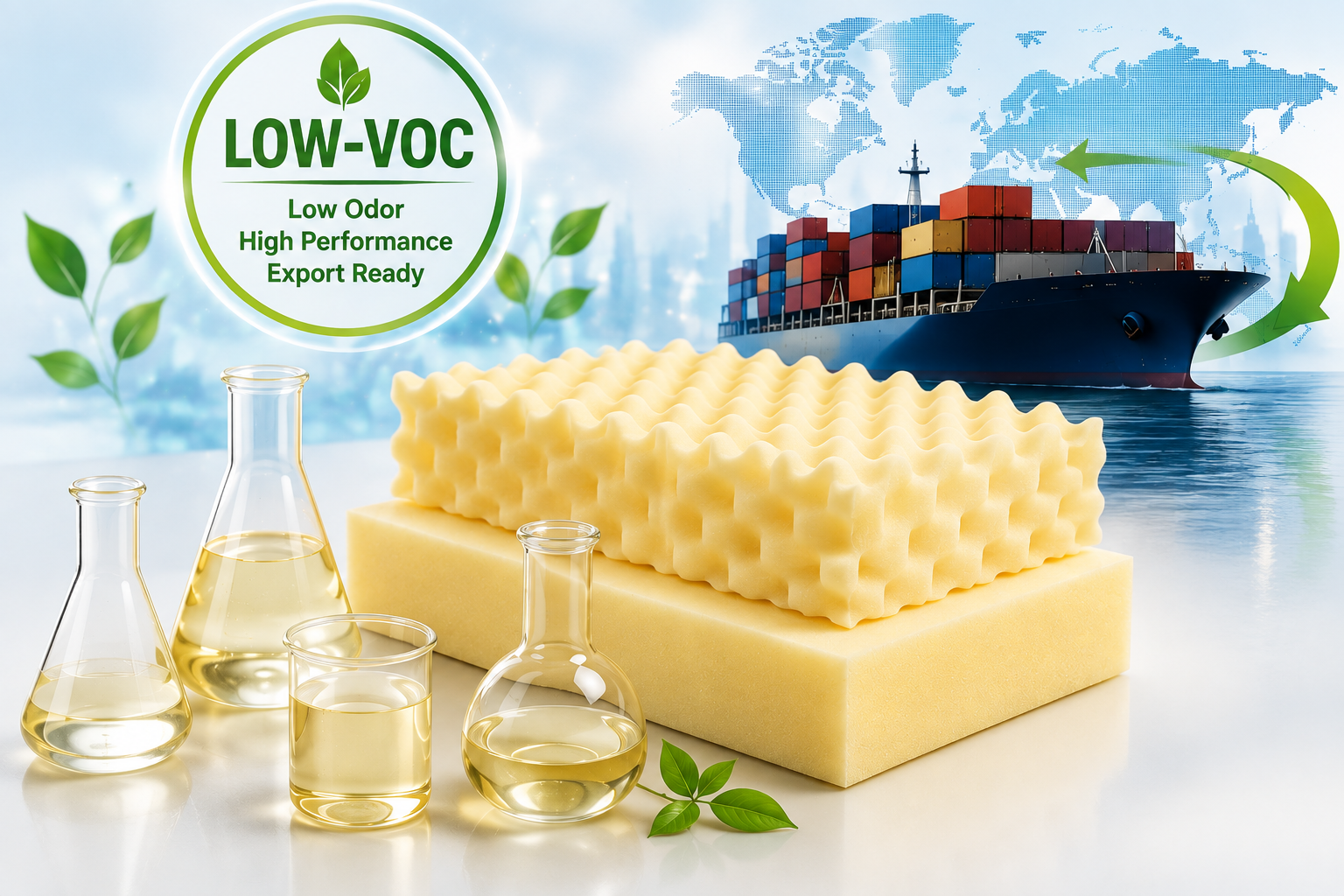
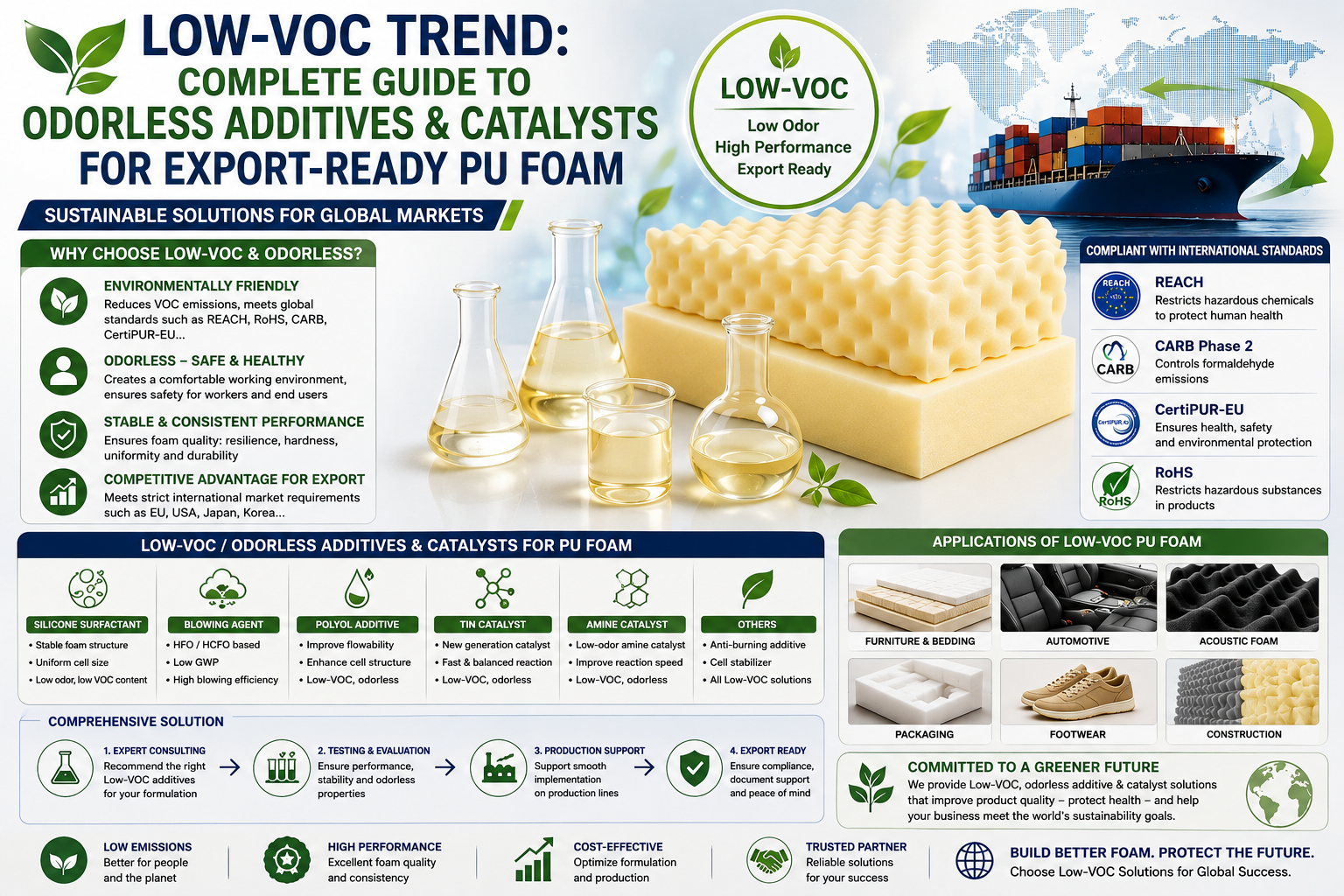
In the manufacturing of Polyurethane (PU) Foam for bedding mattresses, premium furniture, automotive seating, and baby products, product quality is no longer measured solely by resilience or density. Today, chemical odor and Volatile Organic Compound (VOC) emission levels determine whether a product qualifies for demanding export markets like the US, Europe, and Japan.
End-consumers are increasingly sensitive to new car smell or new foam odor. The presence of this harsh smell is a direct indicator of free amine compounds continuously outgassing into the ambient air, raising immediate consumer health concerns.
This guide from JM ENTERPRISE breaks down the hazards of amine emissions, the breakthrough mechanism of Reactive Catalysts (Non-Emissive Catalysts), and how to meet global regulatory certifications such as CertiPUR-US, OEKO-TEX, REACH, and GREENGUARD.
2. Hazards of VOC Emissions & Free Amines in Interior PU Foam
Traditional amine catalysts (such as Triethylenediamine - TEDA, BDMAEE, and DMCHA) consist of small, low-molecular-weight molecules that do not chemically bind into the polymer matrix.
┌────────────────────────────────────────┐
│ RISKS OF TRADITIONAL AMINE CATALYSTS│
└───────────────────┬────────────────────┘
│
[ Conventional Amine Catalyst ] ──► [ Fails to Bind to Polymer Matrix ]
│
[ Unbound Outgassing ] ────────────► [ Emits Toxic VOCs / Harsh Fishy Odor ]
│
[ Consequences ] ──────────────────► Fabric Staining, Respiratory Irritation, Export Rejection
Direct Health & Product Impacts:
- Respiratory Irritation & Harsh Odors: Free amine evaporation creates a pungent, fishy chemical smell, leading to headaches, dizziness, and eye or respiratory tract irritation for end-users.
- Windshield Fogging (Automotive): In vehicle cabins, volatile amine compounds evaporate under high temperatures and condense into an oily, blurry film on the interior windshield, compromising driving safety.
- Material Discoloration & Aging: Free amine migration to the foam surface causes yellowing of textile covers and cracking of laminated synthetic (PVC/PU) leathers.
3. Technology Breakthrough: Mechanism of Reactive Catalysts
To permanently eliminate odor and VOC emissions without compromising reaction kinetics or cycle times, the PU chemical industry developed Reactive (Non-Emissive) Catalysts.
┌────────────────────────────────────────┐
│ REACTIVE CATALYST REACTION MECHANISM │
└───────────────────┬────────────────────┘
│
[ Catalyst Molecule ] ── contains ─► [ Active Hydroxyl (-OH) / Amine (-NH2) ]
│
[ During Foam Expansion ] ─────────► [ Directly Reacts with Isocyanate (-NCO) ]
│
[ Final Result ] ───────────────────► [ Permanently Bound to Polymer Matrix ]
(Zero Outgassing / Odorless)
Core Technical Advantages:
- Active Hydrogen Functionality (-OH
 or -NH2
 ): Reactive catalyst molecules carry functional groups capable of reacting directly with Isocyanate (-NCO
 ) groups during foaming.
- Locked into the Polymer Network: After completing their catalytic role in promoting gelling or blowing reactions, the catalyst molecules become an integral part of the polymer chain.
- Zero Outgassing: Because they are chemically anchored within the foam matrix, reactive catalysts cannot evaporate into the environment—resulting in completely odorless foam with zero VOC emissions.
4. Meeting Rigorous International Export Standards
Adopting Low-VOC additives and reactive catalyst systems from JM ENTERPRISE is a strategic step toward overcoming strict technical trade barriers:
|
Regulatory Standard
|
Scope of Application
|
Mandatory Technical Requirements
|
|
CertiPUR-US®
|
Mattresses, memory foam pillows, US export furniture.
|
Prohibits Phthalates & PBDEs; enforces strict VOC limits (<0.5 ppm ). ).
|
|
REACH / SVHC (EU)
|
All PU consumer products sold in the European Union.
|
Must be free of Substances of Very High Concern (SVHC); strict free amine limits.
|
|
VDA 278 (Automotive)
|
Interior automotive foam parts (Seat pads, Headliners).
|
Sets extremely low limits for VOC (condensable volatile species) and FOG (fogging).
|
|
OEKO-TEX® Standard 100
|
Foam used in apparel, home textiles, and infant goods.
|
Ensures absolute safety for direct skin contact with zero toxic chemical residues.
|
5. Low-VOC Additives & Catalyst Portfolio at JM ENTERPRISE
JM ENTERPRISE provides a complete ecosystem of green additive solutions to help manufacturers upgrade formulations for export compliance:
- Reactive Amine Catalysts:
- Low-VOC Gelling Catalysts: Directly replace DABCO 33-LV / A-33 without leaving an amine odor.
- Low-VOC Blowing Catalysts: Directly replace Niax A-1, offering precise cream time control and fine, uniform cell structures.
- Low-Emission Silicone Surfactants:
- Minimizes low-molecular-weight siloxane species to help automotive foams pass VDA 278 testing.
- Aldehyde & Amine Scavengers:
- Chemically traps and neutralizes trace Formaldehyde and Acetaldehyde emissions generated during thermal curing.
Contact JM ENTERPRISE Today For Technical Support
Do you need to upgrade your foam formulations to meet CertiPUR-US or OEKO-TEX standards, or are you resolving issues with harsh amine odor and high VOC test results?
Contact the expert application team at JM ENTERPRISE today for specialized Low-VOC Catalyst & Additive solutions, complete SDS/TDS documentation, and trial samples for direct plant testing:
- Hotline / Zalo:
- +84 933 706 351 – Mr. Cha (English & Korean Support)
- +84 913 390 054 – Ms. Ngan (Vietnamese Support)
- Email: jhcha@jmentchemical.com
- Website: https://jmentchemical.com/