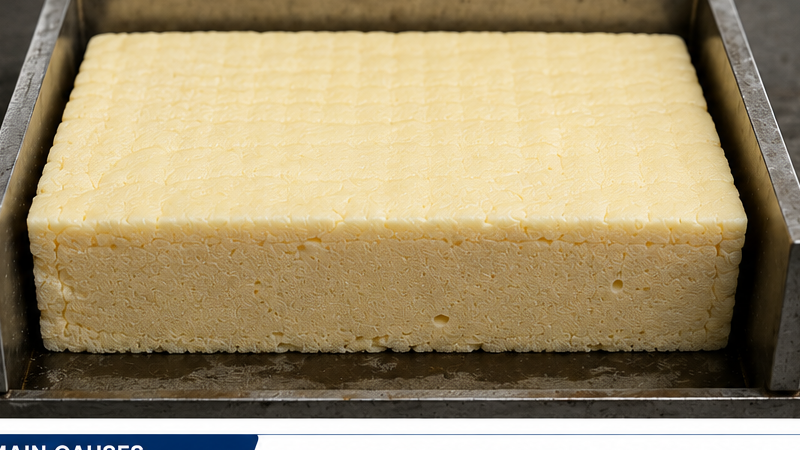
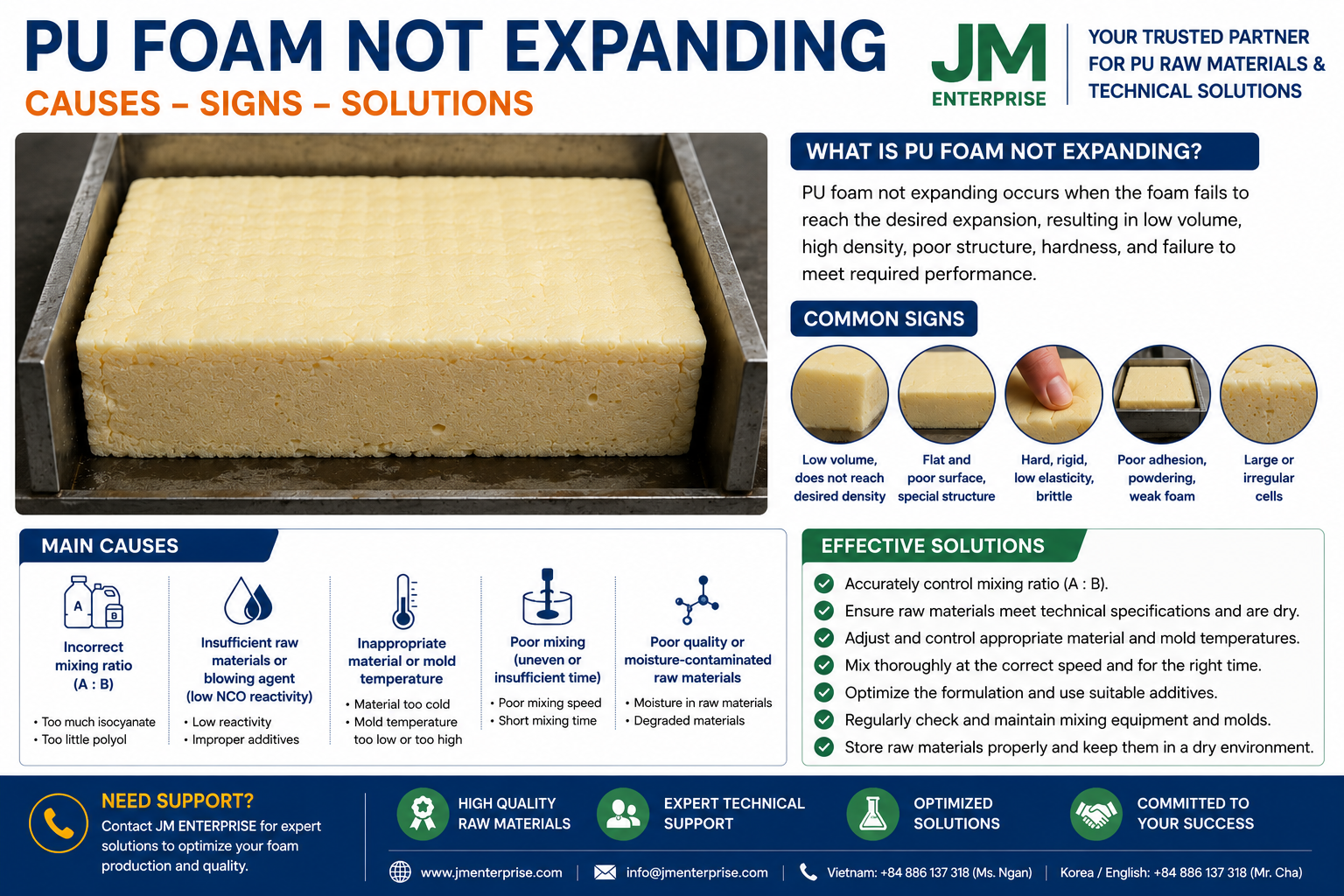
In the manufacturing process of Polyurethane (PU) products—such as thermal insulation panels, flexible foam mattresses, shoe soles, or automotive interior components—the phenomenon of PU foam failing to expand or under-expanding is a critical technical failure. This defect not only results in volumetric deficits and structural voiding inside the mold but also directly spikes reject rates, causing severe financial losses in raw material waste.
To permanently resolve under-expansion issues, production engineers must understand the underlying physics and chemistry of the gas evolution reaction. As a premier provider of raw materials and technical solutions, JM ENTERPRISE shares this comprehensive technical breakdown and actionable troubleshooting guide.
1. Advanced Technical Mechanisms: Why Does PU Foam Fail to Expand?
The expansion of PU foam is a highly synchronized chemical sequence where gas generation must perfectly match the growth of the polymer network. When a foam system fails to reach its targeted density or volume, it typically stems from a breakdown in one of the following mechanisms:
A. Depletion or Imbalance of the Blowing Agent
Blowing agents are the fundamental drivers of volumetric expansion. This occurs via two pathways:
- Chemical Blowing (Water-Blown System): Isocyanate reacts with water to generate CO2
 gas. If the water content in the Polyol formulation drops below the calibrated specification, the volume of gas released will be insufficient to push the foam to its required volume.
- Physical Blowing (Physical Blowing Agents - Cyclopentane, HFCs, HFOs): These volatile liquids vaporize utilizing the exothermic heat generated by the chemical reaction to expand the cells. If these agents escape or boil off prematurely due to improper raw material storage (e.g., high warehouse temperatures), the system loses its primary expansion force.
B. Kinetic Imbalance Between the Blowing and Gelling Reactions
For foam to achieve maximum stable rise, the rate of gas evolution must run in perfect lockstep with the polymer's gelation rate:
- If the Gelling Reaction proceeds too rapidly—often driven by an excess of metal catalysts or high temperatures—the polymer network crosslinks and locks the cell structure in place before the gas can fully expand. Consequently, the foam becomes choked and stalls mid-rise.
- Conversely, if the Blowing Reaction is too sluggish due to a deficiency in specialized amine blowing catalysts, the internal gas pressure builds too slowly to overcome the viscous surface tension of the MDI/Polyol liquid matrix.
C. Extreme Isocyanate Index Offsets
- When the stoichiometric mixing ratio between MDI and Polyol is severely misaligned (such as severe MDI starvation or excessive Polyol loading), the reaction exotherm fails to reach the critical threshold temperature required to vaporize physical blowing agents. As a result, the liquid system cannot transition into a uniform gaseous cell structure.
2. Definitive Correction Solutions by JM ENTERPRISE
To eliminate under-expansion defects at the root, JM ENTERPRISE delivers a systematic, data-driven technical framework calibrated on-site by veteran industry specialists.
[On-Site Audit] ➔ [Raw Material Activity Verification] ➔ [Catalyst/Surfactant System Tuning] ➔ [Process Temperature Standardization]
2.1. Tuning the Specialty Additive Package (Catalysts & Surfactants)
JM ENTERPRISE's highly active additive lines act as the control valves for reaction kinetics:
- Engineered Amine Catalysts: We recalibrate the ratio of blowing catalysts to stimulate aggressive, precisely-timed CO2 gas generation, ensuring maximum volumetric rise before the system hits its gel point.
- Advanced Silicone Surfactants: These reduce the interfacial surface tension of the chemical blend, optimizing emulsification and preventing internal bubble coalescence or cell rupture during the critical rise phase.
2.2. Formula and MDI / Polyol Ratio Optimization
- Our engineering team will re-calculate chemical water levels (chemical blowing) and compensate for physical blowing agent losses, factoring in seasonal ambient temperature and humidity shifts.
- We establish a precise Isocyanate Index sweet spot to ensure the core reaction exotherm effortlessly unleashes the full expansion potential of the system.
2.3. On-Site Process Engineering led by Korean Experts
Beyond chemical supply, our Managing Director and Korean Technical Team provide direct, hands-on production floor support:
- Equipment Diagnostics: Calibrating injection head pressures and pump flow rates to guarantee MDI and Polyol are completely homogenized at a micro-molecular level.
- Thermal Standardization: Tuning raw material stream temperatures and mold temperatures to prevent cold-mold quenching, which kills surface foam expansion.
3. Targeted Industry Applications Supported by JM ENTERPRISE
The field expertise of JM ENTERPRISE engineers spans a vast array of Polyurethane manufacturing sectors:
- Thermal Insulation: Rigid PU panels, insulated sandwich boards, and appliance insulation (ensuring flawless mold filling without internal voids or hollow corners).
- Footwear & Shoe Soles: Microcellular PU systems (achieving ultra-low density targets without sacrificing microstructural load bearing).
- Mattress & Furniture: Flexible slabs and memory foams that rise uniformly without collapsing or dense-core defects.
- Automotive Parts & Molded Foam: Complex geometries requiring high flowability and uniform density distribution.
Optimize Your Production Expansion with JM ENTERPRISE
If your production line is facing PU foam under-expansion, low yields, or density inconsistency, do not let it compromise your bottom line. Contact us today for direct engineering consults and to request advanced additive sample kits.
- Hotline / Zalo:
- +84 933 706 351 – Mr. Cha (English & Korean Support)
- +84 913 390 054 – Ms. Ngan (Vietnamese Support)
- Email: jhcha@jmentchemical.com
- Website: https://jmentchemical.com/