1. Introduction: The Core Formulation Challenge in Polyurethane Manufacturing
In Polyurethane (PU) manufacturing, developing a precise formulation requires a thorough understanding of the relationship between Chemical Structure → Physical/Mechanical Properties → Processing Parameters.
Whether producing high-resilience (HR) automotive seat pads, rigid insulation panels, or high-abrasion shoe soles, Polyols make up the largest volumetric component of the raw system, serving as the foundational backbone. Selecting the wrong type between Polyether Polyol and Polyester Polyol not only inflates scrap rates and material costs but also directly undermines brand reputation due to field failures after products hit the market.
2. Chemical Architecture & Reaction Mechanisms
The physical, mechanical, and thermal performance differences between these two polyol families stem entirely from the chemical bonding along their polymer backbones.
┌────────────────────────────────────────┐
│ MOLECULAR STRUCTURES │
└────────────────────────────────────────┘
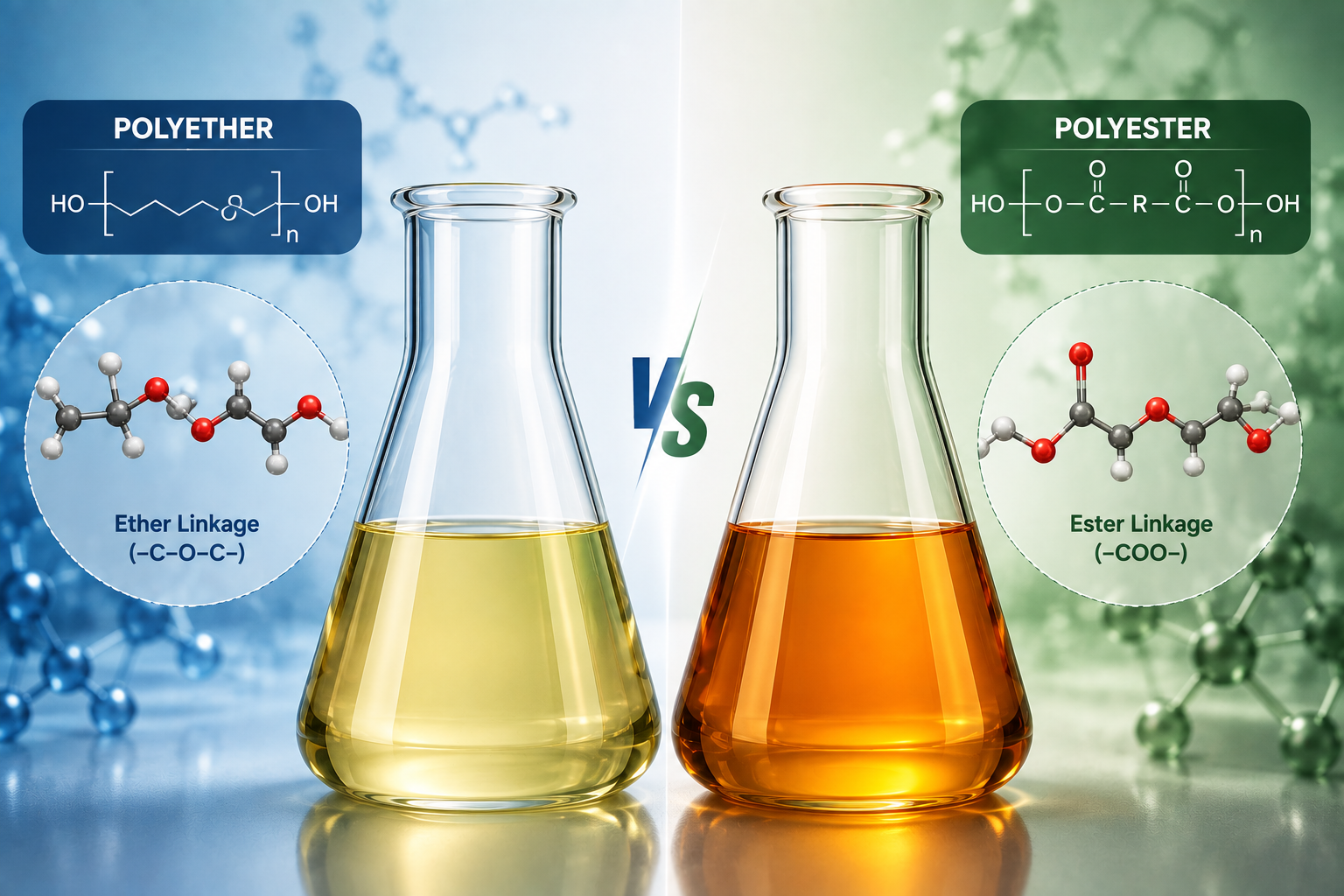
Polyether Polyol: HO ── [ R ── O ── R' ]n ── OH (Ether Linkage: -C-O-C-)
Polyester Polyol: HO ── [ R ── O ── C(=O) ── R' ]n ── OH (Ester Linkage: -C(=O)-O-)
2.1. Polyether Polyol
- Molecular Structure: Characterized by repeating Ether linkages (-C-O-C-
 ).
).
- Bond Energy & Properties: The -C-O-C- ether bond exhibits high chemical resistance against cleavage by water molecules (H2O
 ). The low rotational energy barrier of the ether linkage provides high chain flexibility, granting superior low-temperature elasticity and resilience.
- Synthesis Pathway: Synthesized via ring-opening polymerization (ROP) of alkylene oxides such as Propylene Oxide (PO) or Ethylene Oxide (EO) initiated by multi-functional active-hydrogen starters (e.g., Glycerin, Trimethylolpropane, or Propylene Glycol).
- Hydroxyl Value (OH Value): Tailored based on application:
- Polyether for Flexible Foam: Low OH value (∼28-56 mg KOH/g
 ), high molecular weight (3,000-6,000 g/mol
 ).
).
- Polyether for Rigid Foam: High OH value (∼300-800 mg KOH/g
 ), highly branched structure.
2.2. Polyester Polyol
- Molecular Structure: Characterized by repeating Ester linkages (-C=O-O-
 ).
).
- Bond Energy & Properties: The highly polar carbonyl group (C=O
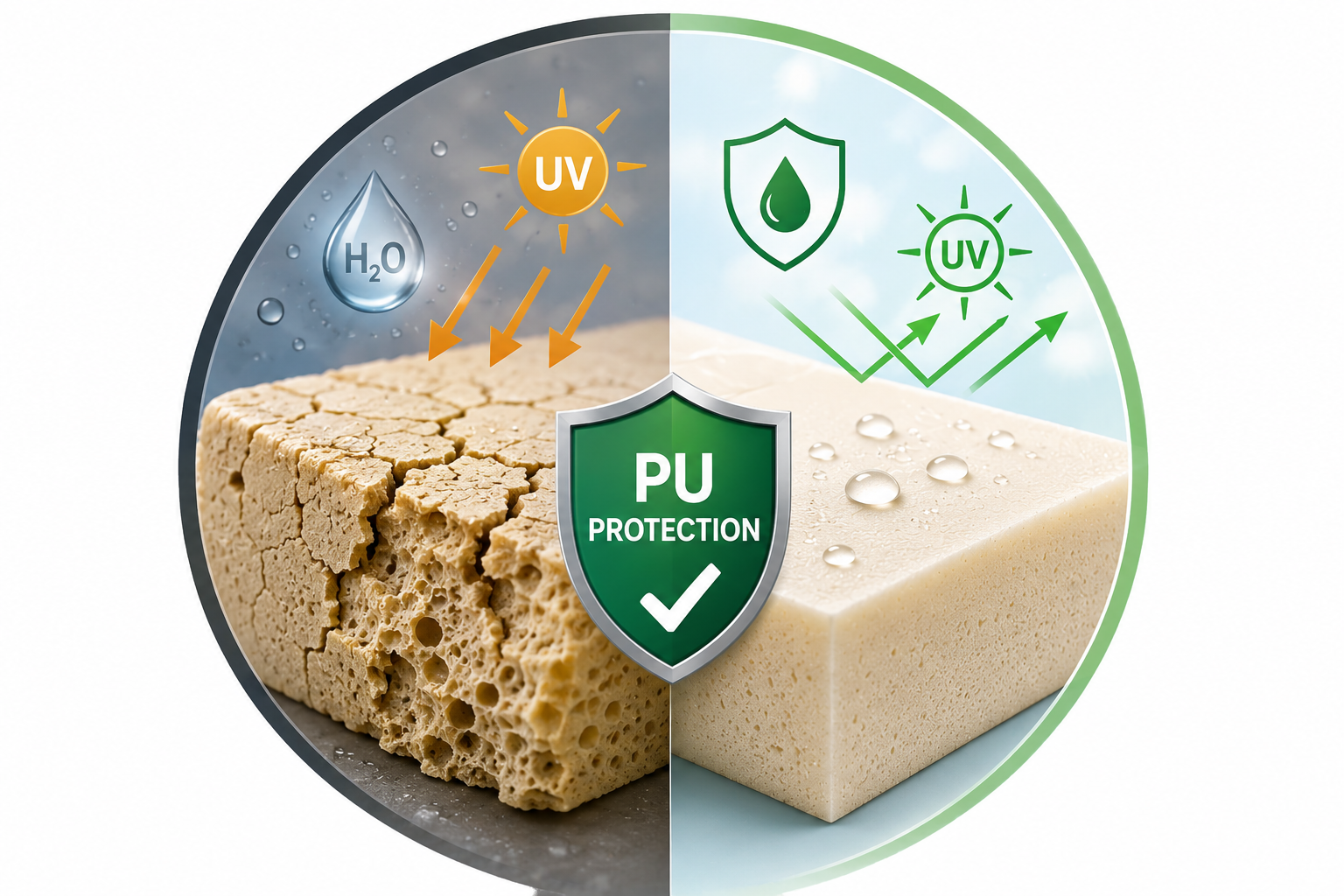
 ) within ester bonds promotes strong intermolecular attractive forces (Van der Waals forces and hydrogen bonding) between adjacent polymer chains. Consequently, it delivers outstanding tensile strength, tear resistance, and solvent/oil resistance. However, ester linkages contain an inherent vulnerability: susceptibility to hydrolytic cleavage (hydrolysis) when exposed to moisture and elevated temperatures.
- Synthesis Pathway: Produced via polycondensation reactions between Dicarboxylic acids (most commonly Adipic Acid or Phthalic Acid) and Diols/Polyols (such as Ethylene Glycol - EG, Diethylene Glycol - DEG, or 1,4-Butanediol - BDO).
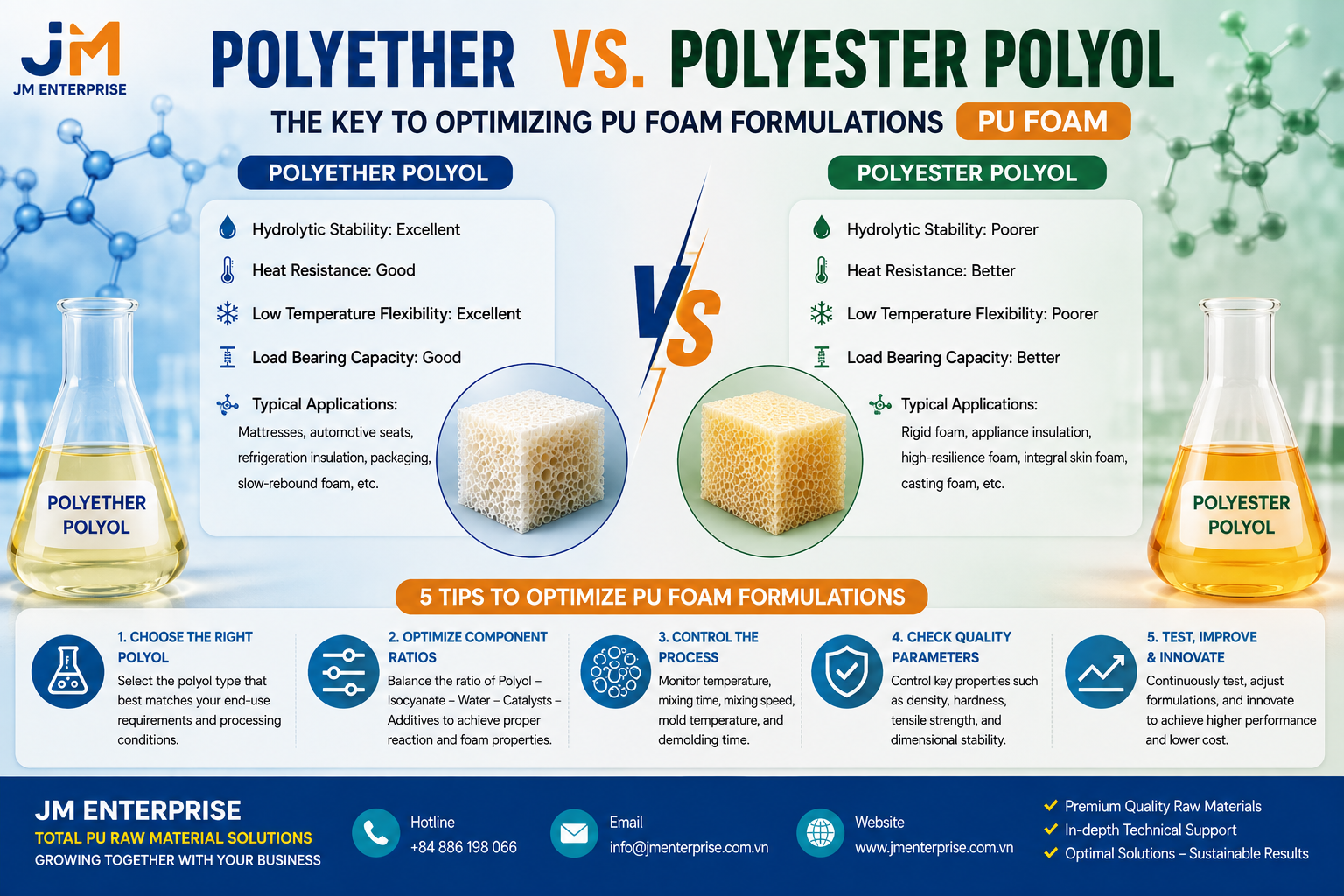
3. Comprehensive Technical Comparison: Polyether vs. Polyester Polyol
|
Technical Parameter
|
Polyether Polyol
|
Polyester Polyol
|
Manufacturing Impact
|
|
Hydrolytic Stability (Moisture Resistance)
|
Superior
|
Poor
|
Polyester foams degrade, soften, or become sticky in humid tropical environments.
|
|
Tensile & Tear Strength
|
Moderate to Good
|
Very High
|
Polyester handles high mechanical load, impact, and abrasion significantly better.
|
|
Oil & Solvent Resistance
|
Moderate
|
Outstanding
|
Polyester resists swelling when exposed to grease, fuel, and organic solvents.
|
|
System Viscosity
|
Low (200-1,500 cPs ) )
|
High (2,000-20,000+ cPs ) )
|
Polyether flows easier, mixes thoroughly, and reduces pump load.
|
|
Low-Temperature Flexibility
|
Excellent
|
Poor (Prone to stiffening)
|
Polyether retains flexibility under freezing conditions.
|
|
Thermal Aging Resistance
|
Good
|
Superior
|
Ester linkages offer higher continuous working temperature resistance.
|
4. Troubleshooting Common PU Foam Production Defects
Whether utilizing Polyether or Polyester Polyol, successful foam production requires a precise balance between Gelling reactions and Blowing reactions. Below are 3 common defects and expert solutions:
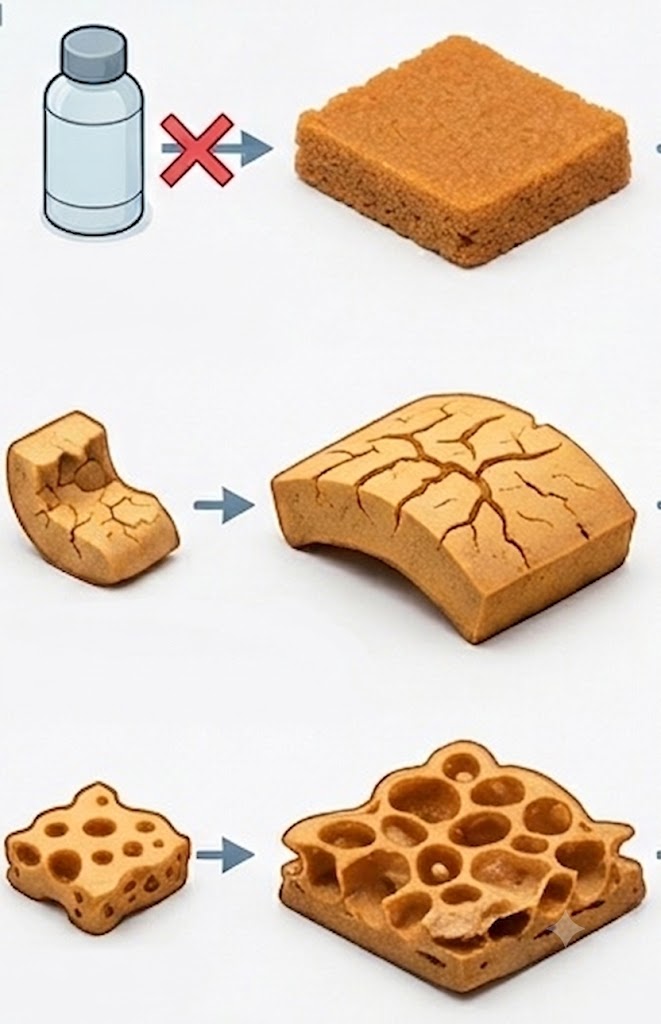
Defect 1: Expansion Failure or Poor Expansion
- Root Causes:
- Reaction Imbalance: The gelling reaction progresses too quickly, locking the polymer matrix before CO2
 gas can fully generate; or the blowing reaction escapes before the polymer network achieves sufficient green strength.
- Low Mold Temperature: Temperatures below 45∘C
 impede exothermic reaction kinetics.
- Insufficient or degraded blowing agents / tertiary amine catalysts.
- Solutions:
- Rebalance the tertiary amine catalyst system between gelation and blowing dynamics.
- Add high-performance Silicone Surfactants to lower surface tension and stabilize cell growth.
Defect 2: Product Density Deficit
- Root Causes:
- Cell coalescence leading to oversized, non-uniform cell structures.
- Poor mixing efficiency at the dispense head or insufficient mix pressure.
- Solutions: Introduce advanced cell stabilizers to maintain micro-cellular distribution and uniform density throughout the component.
Defect 3: Post-Demold Shrinkage & Deformation
- Root Causes: In flexible foams, a high percentage of closed cells causes an internal pressure drop upon cooling, leading to cell collapse and part shrinkage.
- Solutions: Perform Mechanical Crushing immediately after demolding (3-5 minutes
 ) to rupture closed cell windows and achieve a stable Open-Cell structure.
5. Application Selection Guide
┌───────────────────────────┐
│ APPLICATION SELECTION │
└─────────────┬─────────────┘
│
┌──────────────────────┴──────────────────────┐
▼ ▼
[ POLYETHER POLYOL ] [ POLYESTER POLYOL ]
* Automotive & Motorcycle Seat Pads * Heavy-duty PU Cast Rollers & Wheels
* HR Furniture & Mattress Foams * Industrial Safety Footwear Soles
* Refrigerators & Insulation Panels * Synthetic PU Leather Coatings
* Athletic Outerwear Footwear Soles * Solvent-Resistant Adhesives & Sealants
Contact JM ENTERPRISE Today For Technical Support
If your manufacturing line is encountering issues such as PU foam expansion failure, poor rise, part deformation, density deficit, or hydrolytic degradation, contact JM ENTERPRISE today.
We supply advanced additive solutions (Tertiary Amine Catalysts, Silicone Surfactants, Cell Openers) and offer direct technical consulting alongside free sample test batches tailored to your facility:
- Hotline / Zalo:
- +84 933 706 351 – Mr. Cha (English & Korean Support)
- +84 913 390 054 – Ms. Ngan (Vietnamese Support)
- Email: jhcha@jmentchemical.com
- Website: https://jmentchemical.com/