Epoxy resin is one of the most versatile and durable high-performance materials used across modern manufacturing and heavy industry. From protecting concrete factory floors against harsh chemicals to structural bonding in aerospace engineering, picking the correct formulation directly impacts performance, safety, and operational costs.
However, selecting the right industrial epoxy resin is not a one-size-fits-all decision. Choosing an incompatible epoxy resin can lead to premature failure, surface delamination, cracking, or costly downtime. This comprehensive guide outlines the key selection criteria, critical technical specifications, and industrial use cases to help you choose the ideal epoxy resin for your operational needs.
1. What is Industrial Epoxy Resin?
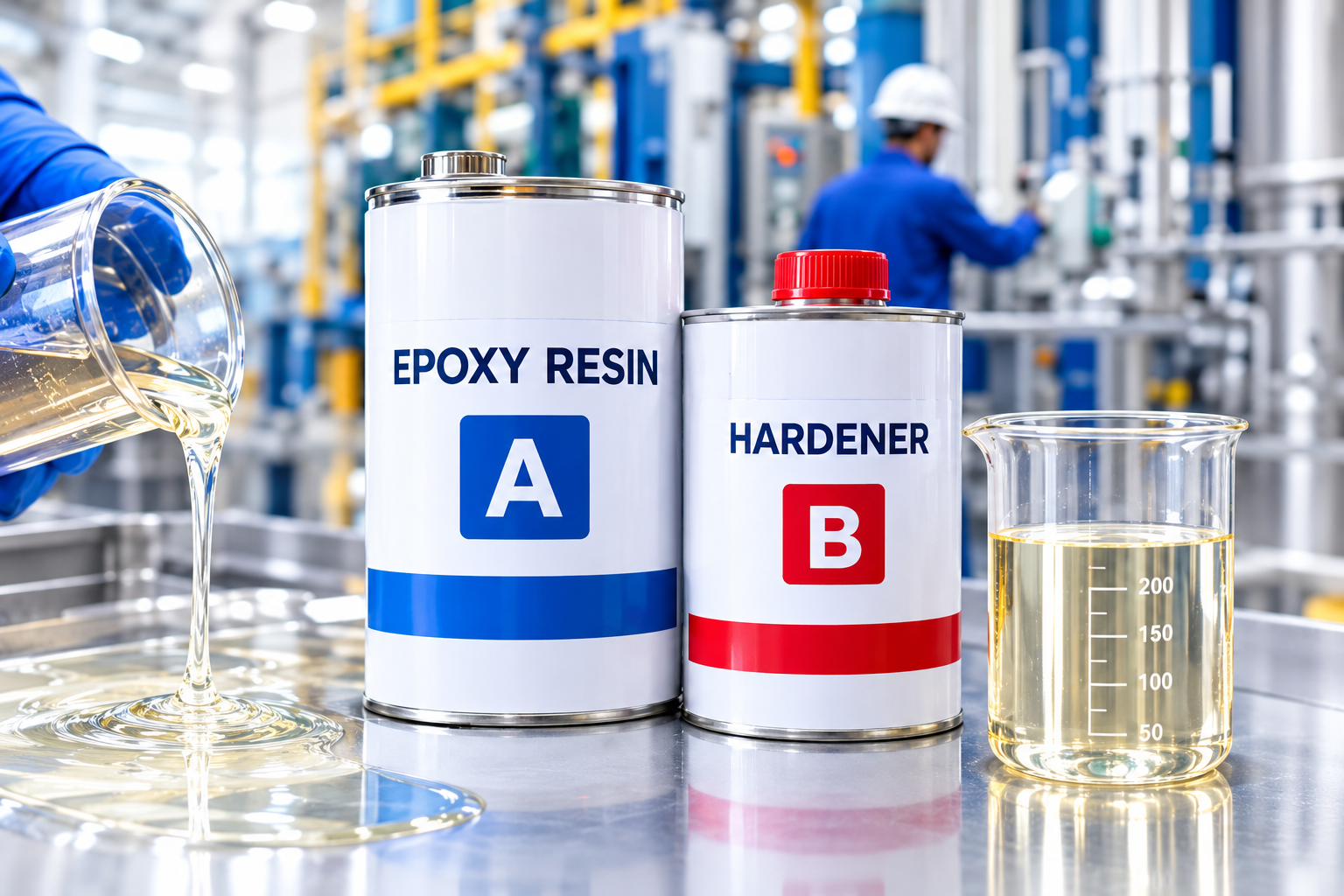
Industrial epoxy resin is a thermosetting polymer created by cross-linking an epoxy monomer (Part A) with a curing agent or hardener (Part B). Unlike consumer-grade epoxies designed for small DIY crafts, industrial-grade epoxy formulations are engineered to withstand extreme environmental, chemical, and mechanical stresses.
Key Characteristics of Industrial Epoxy Resins:
- High Tensile & Structural Strength: Transfers mechanical loads efficiently across bonded joints and surfaces.
- Chemical & Corrosion Resistance: Resists exposure to acids, solvents, alkalis, fuels, and harsh cleaning chemicals.
- Thermal Stability: Maintains structural integrity across wide operating temperature ranges.
- Low Shrinkage During Cure: Minimizes internal stresses and maintains tight dimensional tolerances.
- Superior Adhesion: Bonds strongly with metals, concrete, composites, ceramics, and fiberglass.
2. Main Types of Epoxy Resins Used in Industrial Environments
Understanding the chemical foundation of epoxy systems helps you narrow down the best options for your specific environment:
|
Epoxy Resin Type
|
Primary Characteristics
|
Common Industrial Applications
|
|
Bisphenol A (DGEBA)
|
Most common type; excellent mechanical strength, adhesion, and versatile curing profiles.
|
Industrial floor coatings, general structural adhesives, electrical encapsulants.
|
|
Bisphenol F (DGEBF)
|
Lower viscosity than Bisphenol A; higher solvent and chemical resistance.
|
High-solids coatings, secondary containment linings, chemical storage tanks.
|
|
Novolac Epoxy
|
Highly cross-linked structure; outstanding high-temperature and chemical resistance.
|
Chemical processing plants, pipe linings, high-temperature structural composites.
|
|
Cycloaliphatic Epoxy
|
Exceptional UV resistance, weatherability, and electrical tracking resistance.
|
Outdoor electrical insulators, weather-resistant structural coatings.
|
3. Key Factors to Consider When Choosing an Epoxy Resin
To choose the optimal epoxy system, evaluate your application based on these five technical parameters:
A. Operating Environment & Chemical Exposure
Identify every substance the epoxy will encounter during its lifecycle.
- Aggressive Acids & Solvents: Choose a Novolac epoxy resin or high-density cross-linked formulation.
- Moisture & Marine Environments: Opt for moisture-tolerant or underwater-curing epoxy systems.
- Outdoor UV Exposure: Standard Bisphenol epoxies yellow and chalk under UV light; pair them with a UV-stable topcoat (such as polyurethane or aliphatic polyurea) or choose a Cycloaliphatic epoxy.
B. Thermal Requirements & Temperature Limits
Evaluate both the continuous operating temperature and brief peak exposures:
- Glass Transition Temperature (Tg
 ): The temperature at which the polymer transitions from a rigid state to a rubbery state. Select an epoxy with a Tg significantly higher than your maximum operating environment.
- Heat Deflection Temperature (HDT): Critical for load-bearing structural components exposed to high heat.
C. Mechanical Load & Stress Conditions
Consider the physical forces the material will experience daily:
- Impact & Thermal Cycling: Requires flexible or toughened epoxy formulations to absorb vibration without cracking.
- Heavy Static Loads & Abrasion: Demands high compressive strength and hard-wearing fillers (such as quartz or ceramic powders).
D. Processing Requirements & Pot Life
The application process dictates the required physical properties of the uncured resin:
- Viscosity: Low viscosity is needed for deep infusion, crack injection, and potting; high viscosity (thixotropic pastes) is required for vertical bonding and gap filling.
- Pot Life & Gel Time: Ensure the working time matches your assembly scale. Rapid-cure systems suit automated manufacturing, while large-surface floor coatings require extended pot life.
E. Compliance & Environmental Regulations
- VOC Content: Indoor industrial facilities often mandate zero-VOC or low-odor waterborne/100% solids epoxy systems.
- Food & Potable Water Contact: Applications in food processing or water treatment plants require FDA (21 CFR 175.300) or NSF/ANSI 61 certified coatings.
4. Epoxy Resin Applications Across Major Industries
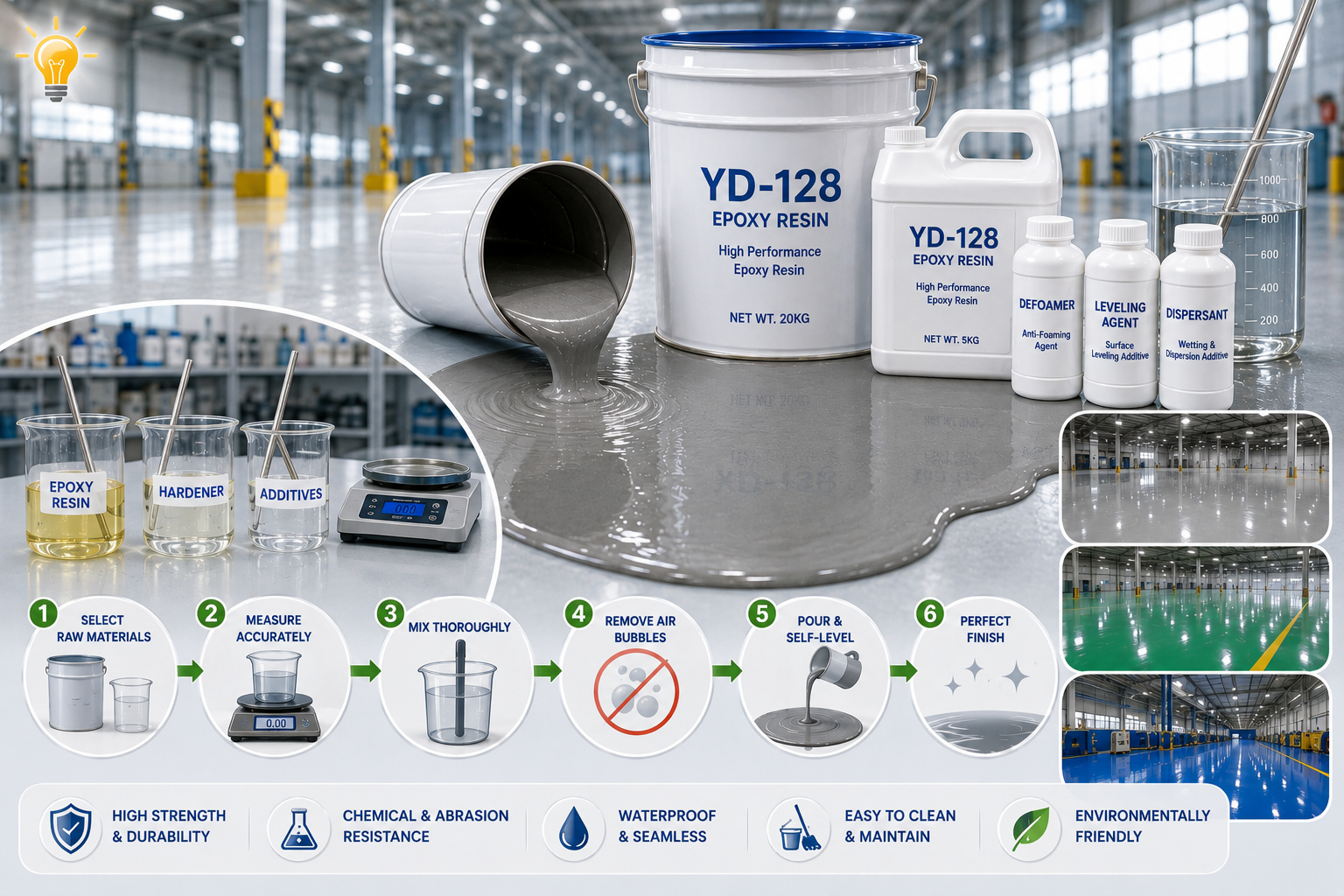
- Industrial & Manufacturing Flooring: 100% solids Bisphenol A/F coatings protect concrete slabs from fork-truck traffic, impact, and chemical spills.
- Chemical Processing & Refineries: Novolac resins coat storage tanks, secondary containment bunds, and piping subjected to concentrated acids.
- Electronics & Electrical Engineering: Low-viscosity casting resins encapsulate delicate circuitry, protecting components from moisture, thermal shock, and vibration.
- Aerospace & Automotive: High-modulus epoxies serve as matrix resins for carbon fiber reinforced polymers (CFRP) to reduce structural weight while maximizing tensile strength.
5. Step-by-Step Selection Process
Follow this practical roadmap when specifying epoxy resins for industrial projects:
- Define Operating Parameters: Document temperature range, chemical contact list, and mechanical loads.
- Review Technical Data Sheets (TDS): Check values for tensile strength, compressive strength, Tg, elongation at break, and shore hardness.
- Verify Curing Conditions: Match the product’s cure profile (room temperature vs. heat cure) with your production facility capabilities.
Conduct Pilot Testing: Perform coupon adhesion tests, lap-shear testing, or chemical immersion tests under real working conditions before full-scale deployment.
Contact JM ENTERPRISE for Technical Consultation
Is your factory currently operating a production line and looking for the optimal epoxy solution for coating, electronic component encapsulation, surface protection, or structural bonding?
Contact the application engineering team at JM ENTERPRISE today to receive in-depth technical consultation and request samples for direct testing at your facility.
- Hotline / Zalo:
- +84 933 706 351 – Mr. Cha (English & Korean Support)
- +84 913 390 054 – Ms. Ngan (Vietnamese Support)
- Email: jhcha@jmentchemical.com