HCM HEAD OFFICE: Room S15, Saigon Pearl, 92C Nguyen Huu Canh, Thanh My Tay Ward, Ho Chi Minh City
HANOI BRANCH: N45-TT4 Do Dinh Thien Street, My Dinh – Song Da Urban Area, Tu Liem Ward, Hanoi
24/7
Call Now
+84 933 706 351
JMENTERPRISE CO., LTD.
Mail Now
jhcha@jmentchemical.com
How to Fix PU Foam Expansion Failure, Poor Expansion & Density Deficit Issues

How to Fix PU Foam Expansion Failure, Poor Expansion & Density Deficit Issues

1. Overview of Cellular Architecture in PU Foam

In Polyurethane (PU) technology, controlling the cellular structure plays a decisive role in determining the physical properties and overall quality of the final product. Depending on the formulation (Polyol, MDI, Catalysts & Additives), PU Foam is classified into three main categories:

  • Flexible Foam: Open-cell structure. Allows flexible air displacement, increasing elasticity and energy absorption. Key application: Automotive Seat Pads.
  • Semi-Rigid Foam: Mixed cell structure. Optimizes flowability to fill complex molds with high surface adhesion. Key application: Automotive Dashboards & Steering Wheels.
  • Rigid Foam: Closed-cell structure (> 90%). Traps low-conductivity gases to deliver superior thermal insulation and mechanical load bearing. Key application: Refrigerators, cooling appliances, and building insulation panels.
​​​​​​​
 

2. Standard Industrial Flexible Foam Production Process

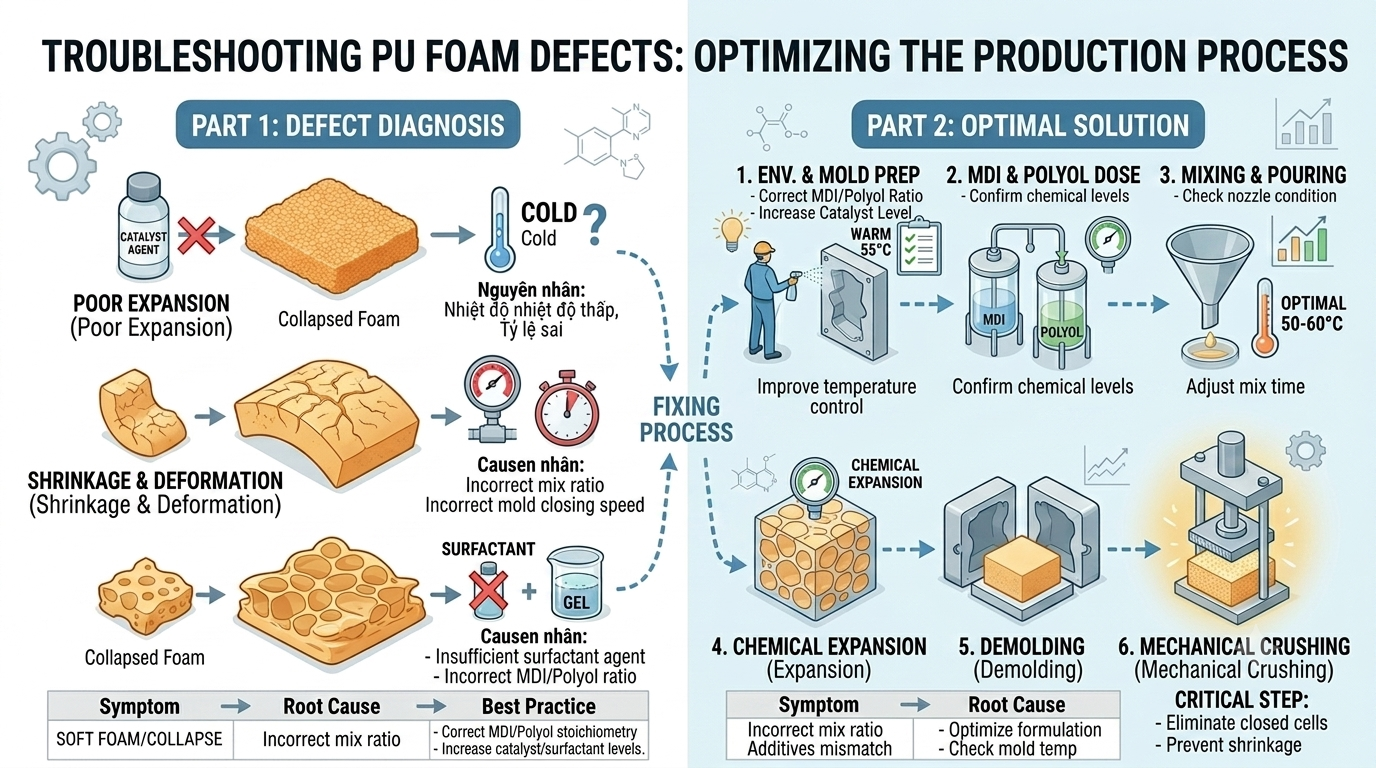
To ensure optimal density and durability for demanding applications like automotive seat pads, the manufacturing line follows a 6-step technical process:

  1. Step 1: Prep & Release Agent: Clean mold and optimize release agent spray.
  2. Step 2: Metering & Mixing: Precisely meter Polyol and MDI injection ratios.
  3. Step 3: Pouring: Pour the mixture into molds under strictly controlled temperatures (50–60°C).
  4. Step 4: Mold Closing: Chemical reaction triggers foam expansion.
  5. Step 5: Demolding: Carefully extract the product after a curing time of 3–5 minutes.
  6. Step 6: Mechanical Crushing (Critical Step): Apply mechanical force to forcibly break closed cells and prevent future shrinkage after cooling.
3. Root Causes & Solutions for PU Foam Defects

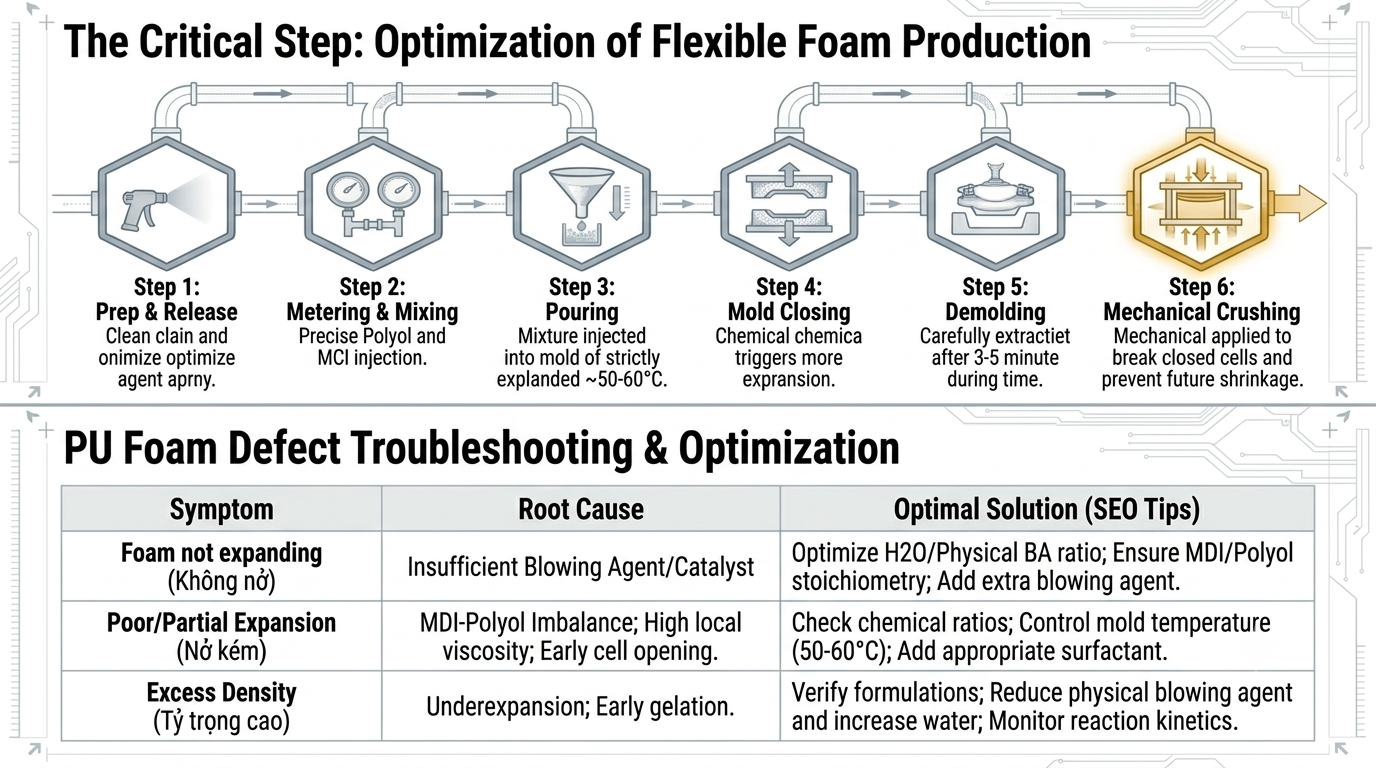
Issues such as PU foam non-expansion, poor expansion, or density deficit usually stem from imbalances in chemical reactions or operational parameters:

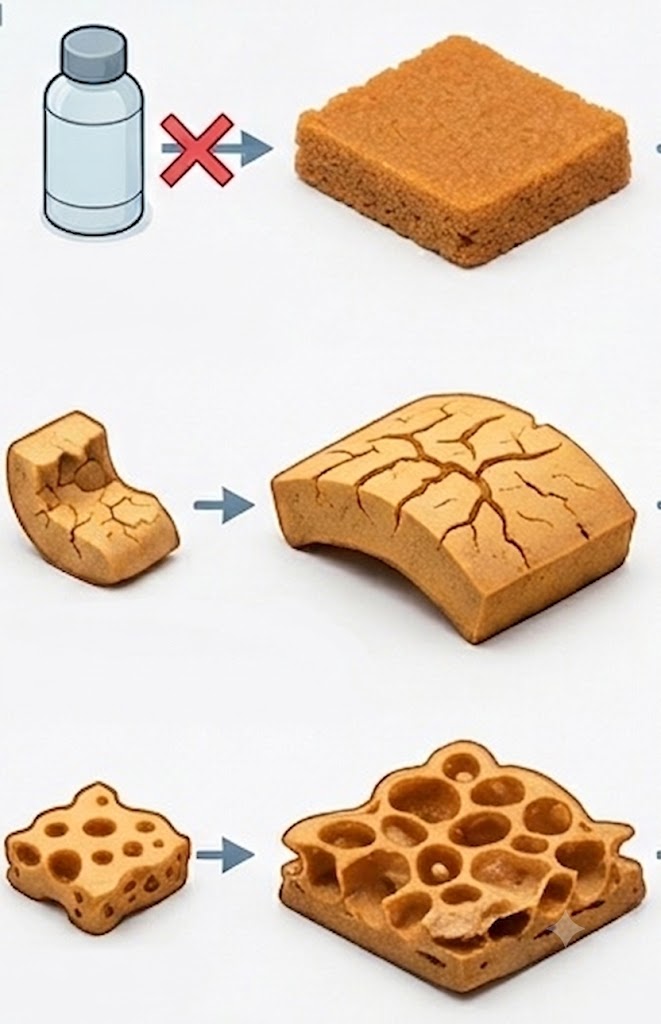
  • Imbalance Between Gelling & Blowing Reactions: Improper ratios of catalysts (Tertiary Amines / Organotin) or blowing agents (Water) can cause foam collapse or prevent full expansion.
  • Incorrect Mold Temperature: Mold temperatures below the required range (50–60°C) hinder the exothermic reaction.
  • Ineffective Surfactants & Additives: Poor surface tension control causes premature cell collapse before the foam can fully form and set.

Contact JM ENTERPRISE Today For Technical Support

If your production line is facing PU foam expansion failure, poor expansion, or product density deficit, contact us today for support from top industry experts and receive sample test batches of our advanced additives.

  • Hotline / Zalo:
    • +84 933 706 351 – Mr. Cha (English & Korean Support)
    • +84 913 390 054 – Ms. Ngan (Vietnamese Support)
  • Email: jhcha@jmentchemical.com
  • Website: https://jmentchemical.com/

 

Newest Blogs

Polyurethane (PU) Foam Cellular Architecture: The Core Factor Driving Product Quality

Explore the cellular architecture of PU Foam in detail: Open-Cell, Mixed-Cell, a...

How to Fix PU Foam Expansion Failure, Poor Expansion & Density Deficit Issues

Experiencing PU foam expansion failure, poor expansion, or density deficit? Disc...

PU Foam Fails to Expand

An in-depth technical analysis of why polyurethane (PU) foam fails to expand or...

PU Foam Shrinkage: Advanced Technical Analysis & JM ENTERPRISE Solutions

An in-depth technical analysis of polyurethane (PU) foam shrinkage from chemical...

Air Bubbles in Polyurethane (PU): Causes, Effects, and Effective Solutions

Learn the main causes of air bubbles in Polyurethane (PU), their impact on produ...

Reducing MDI Consumption in Polyurethane Production: A Comprehensive Guide to Corporate Cost Savings

Discover ways to reduce MDI consumption in Polyurethane production. Optimize for...

Most Viewed Blogs

Eco-Friendly PU Adhesive for Sustainable Packaging

Durable PU laminating adhesive – solvent resistant, internationally certified....

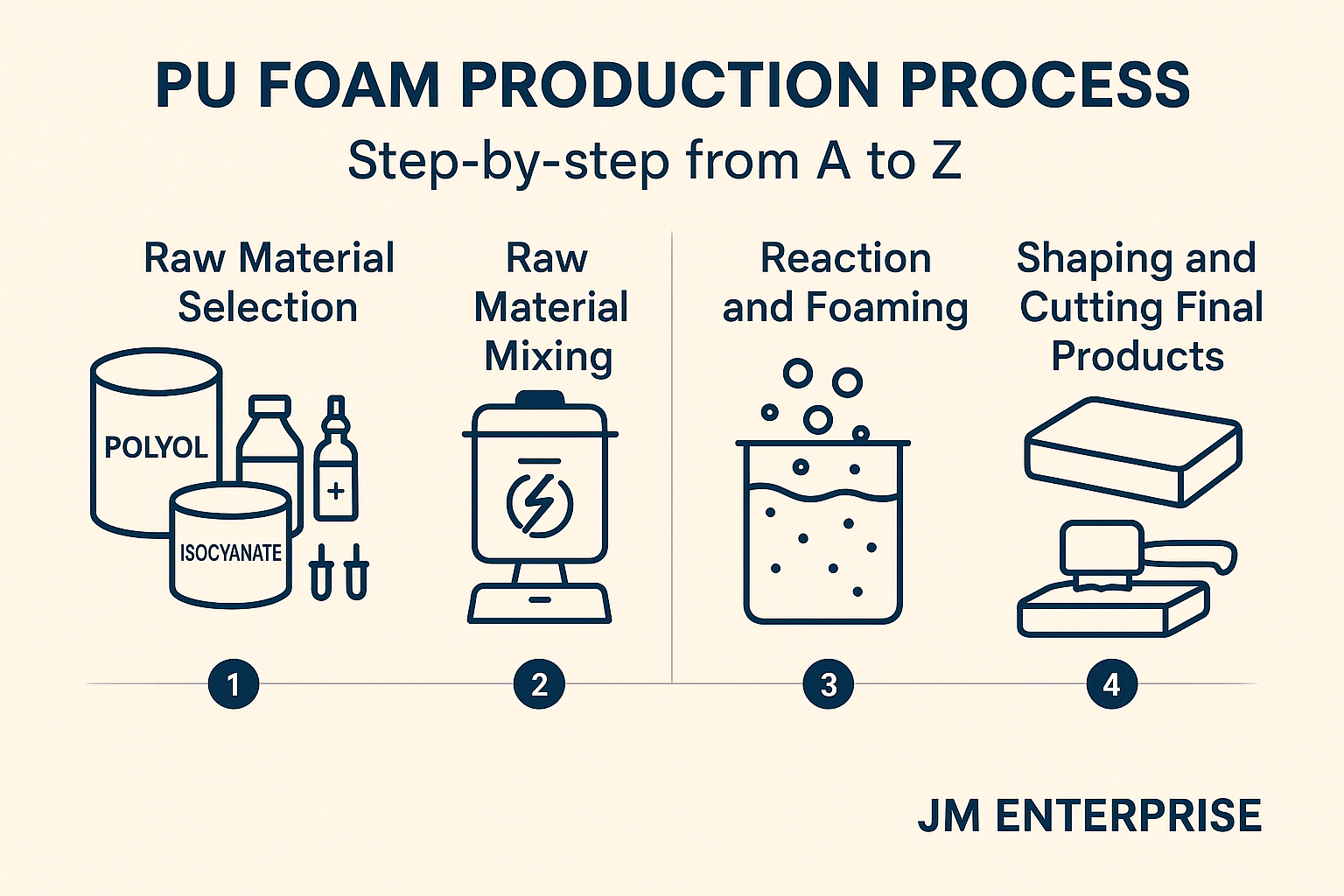
PU Foam Production Process: A Step-by-Step Guide from A to Z

Explore the complete PU foam production process from A to Z and discover how sou...

TPU and Sustainability: Is It an Eco-Friendly Material?

Discover whether TPU is truly eco-friendly, its recyclability, product life cycl...

Hydroxy and Oxygen Content in Polyol – The Key to High-Quality Polyurethane Production

How OH and oxygen content in polyol affect polyurethane performance. Learn how t...

TDI/MDI – Complete Solutions for Your PU Production Needs

JM Enterprise supplies high-quality MDI and TDI for PU production in Vietnam. Co...

SONGWON Anti-Oxidants for Plastic Compounding – Thermal & Oxidative Stabilization Solutions

Discover SONGWON's high-performance Anti-Oxidants for plastic compounding

Related Blogs

SONGWON Anti-Oxidants for Plastic Compounding – Thermal & Oxidative Stabilization Solutions

Discover SONGWON's high-performance Anti-Oxidants for plastic compounding

PU Foam Production Process: A Step-by-Step Guide from A to Z

Explore the complete PU foam production process from A to Z and discover how sou...

Polyurethane (PU) Foam Cellular Architecture: The Core Factor Driving Product Quality

Explore the cellular architecture of PU Foam in detail: Open-Cell, Mixed-Cell, a...

Applications of PU Foam in Interior Design – A Booming Niche Market

PU Foam is becoming a key material in modern interior design: lightweight, durab...

TPU and Sustainability: Is It an Eco-Friendly Material?

Discover whether TPU is truly eco-friendly, its recyclability, product life cycl...

Hydroxy and Oxygen Content in Polyol – The Key to High-Quality Polyurethane Production

How OH and oxygen content in polyol affect polyurethane performance. Learn how t...

Zalo Zalo