HDPE, LDPE, and LLDPE Comparison: Choosing the Right Grade for Optimal Mechanical Properties
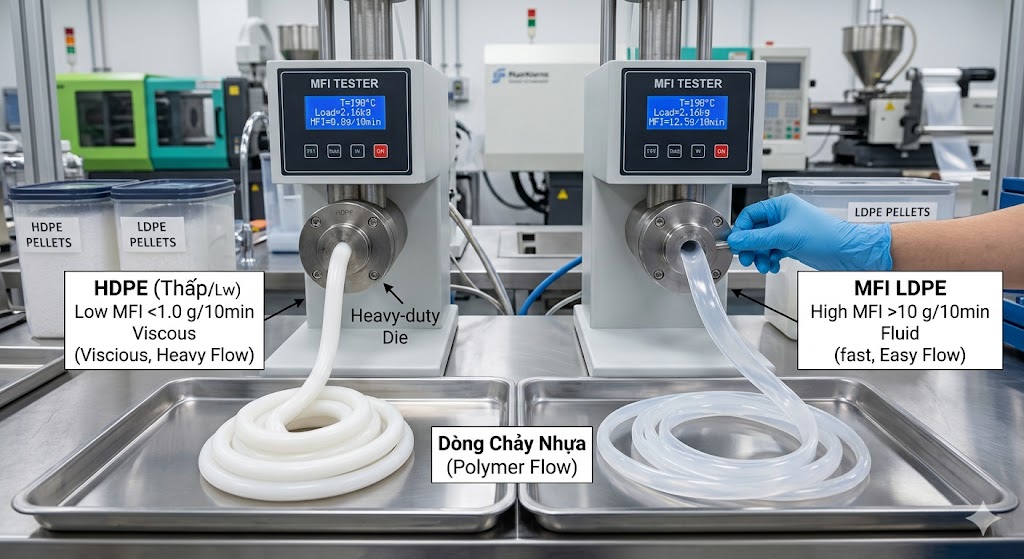
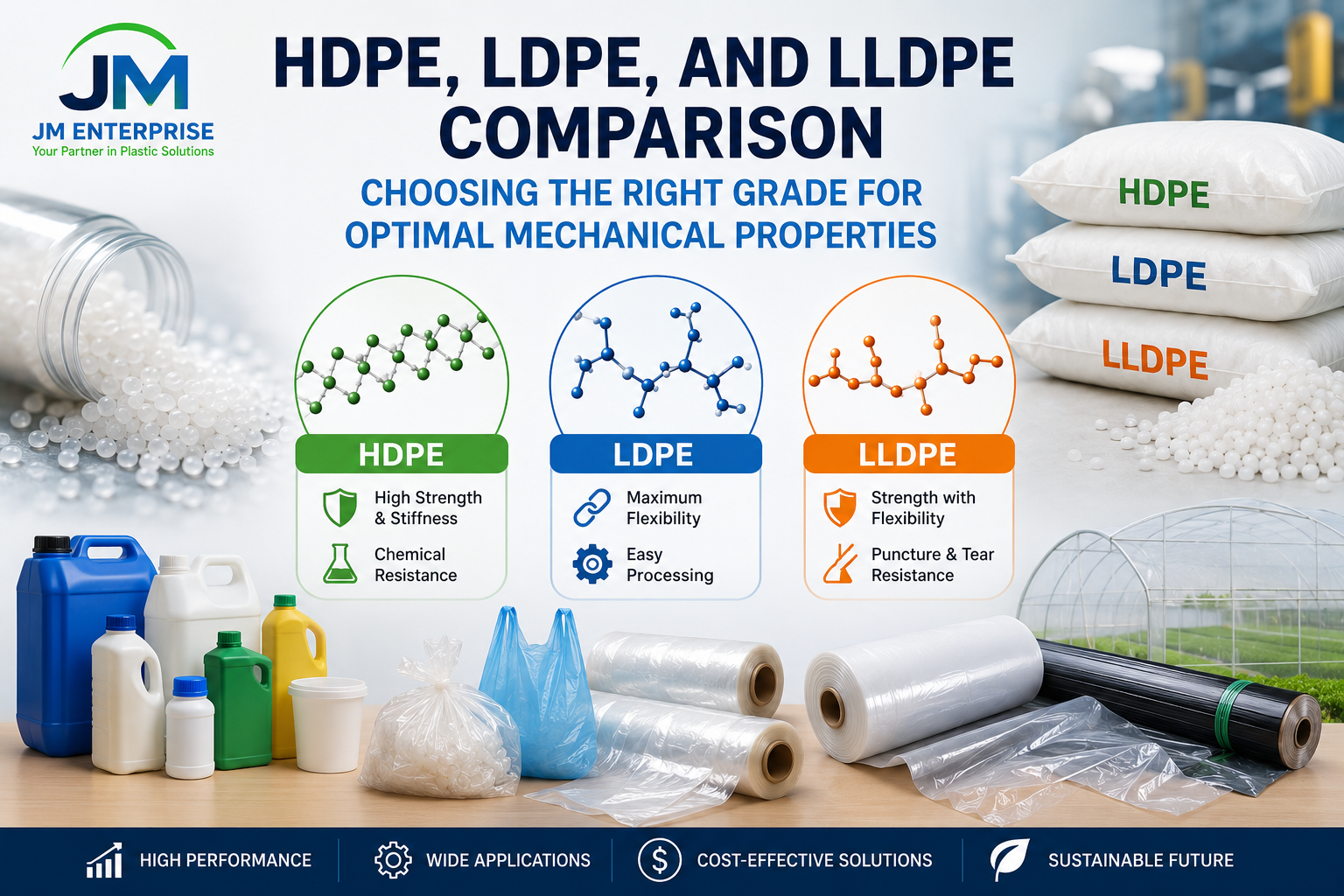
In the polymer industry, understanding the nuances between HDPE, LDPE, and LLDPE is the key to balancing product quality and production costs. While they all belong to the Polyethylene (PE) family, their distinct molecular structures result in vastly different physical performances.
At JM ENTERPRISE, we provide a diverse range of grades to ensure your end-products meet international standards. This guide will help you determine which material fits your specific manufacturing needs.
1. Technical Breakdown: Molecular Differences
The performance of PE resins is dictated by their branching.
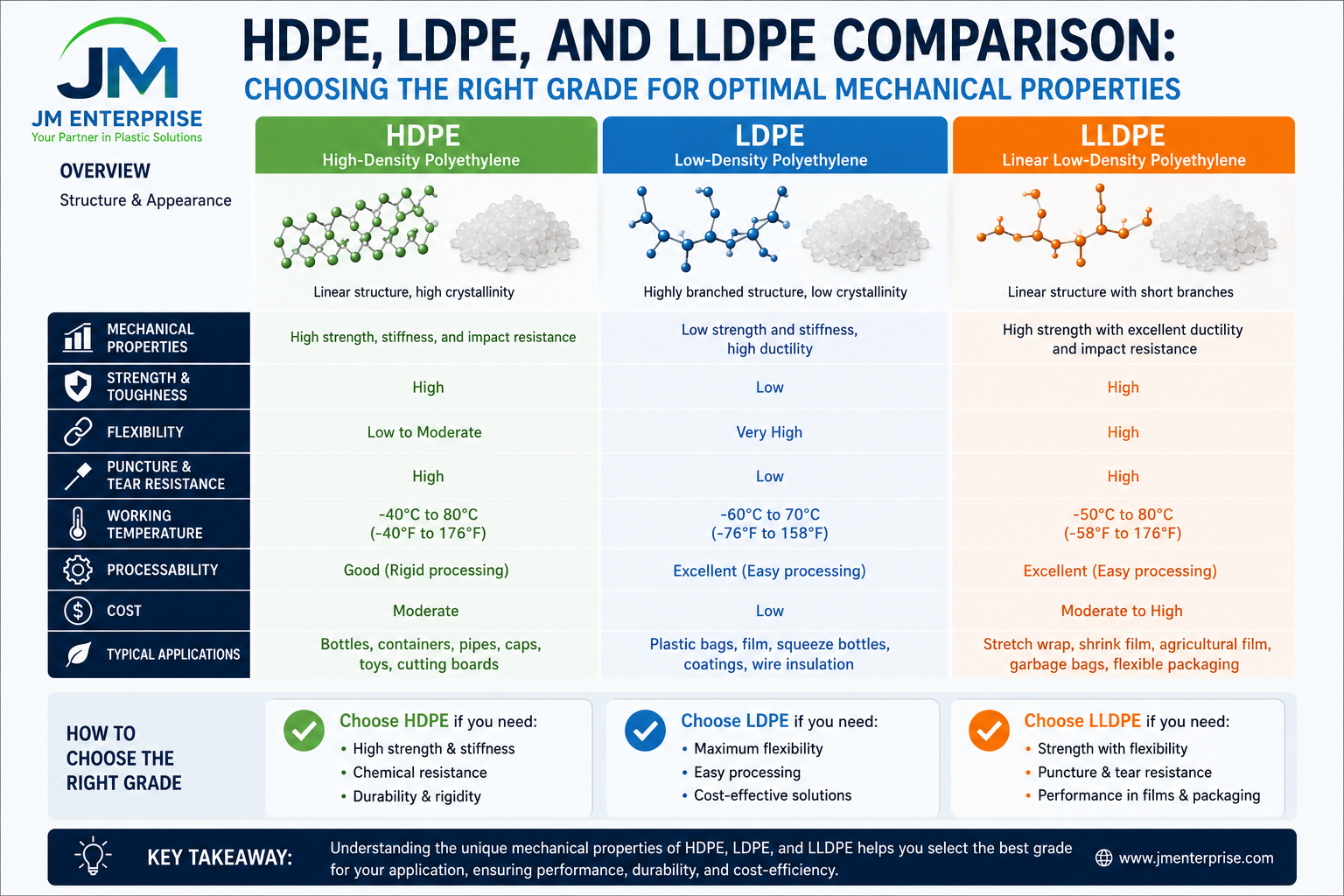
- HDPE (High-Density Polyethylene): Has minimal branching, allowing polymer chains to pack tightly. This results in high crystallinity and a rigid, strong structure.
- LDPE (Low-Density Polyethylene): Features long and short-chain branching, which prevents the molecules from packing closely. This makes it flexible and highly transparent.
- LLDPE (Linear Low-Density Polyethylene): Contains short, uniform branches. It combines the flexibility of LDPE with the strength of HDPE, offering exceptional puncture resistance.
2. Comparative Analysis of Physical Properties
To optimize your production, consider the following mechanical benchmarks:
|
Property
|
HDPE
|
LDPE
|
LLDPE
|
|
Stiffness/Rigidity
|
Very High
|
Low
|
Moderate
|
|
Clarity/Transparency
|
Opaque/Translucent
|
Excellent (Clear)
|
Translucent
|
|
Puncture Resistance
|
Moderate
|
Low
|
Excellent
|
|
Tensile Strength
|
High
|
Moderate
|
High
|
|
Heat Sealability
|
Difficult
|
Very Easy
|
Excellent
|
|
Chemical Resistance
|
Excellent
|
Good
|
Good
|
3. Application Guide: When to Use Which?
Selecting the right resin grade is crucial for reducing defect rates and enhancing product lifespan.
Choose HDPE for Strength and Rigidity
HDPE is the heavyweight of the group. Use it when your product requires structural integrity and resistance to high pressure.
- Applications: High-pressure water pipes, gas pipes, chemical containers, and heavy-duty agricultural nets.
Choose LDPE for Flexibility and Aesthetics
LDPE is ideal for products where clarity and squeeze-ability are more important than strength.
- Applications: Food packaging wraps, squeeze bottles, coating for paper/cartons, and high-clarity laundry bags.
Choose LLDPE for Toughness and Stretch
LLDPE is the preferred choice for thin-gauge applications that must resist tearing.
- Applications: Industrial stretch films (pallet wrap), heavy-duty trash bags, and agricultural mulch films that must resist punctures from weeds.
4. Why Choose JM ENTERPRISE?
Navigating the complexities of resin selection requires a partner who understands the chemistry behind the plastic. JM ENTERPRISE offers a turnkey solution for manufacturers:
- High-Quality Materials: We supply international standard resins from world-renowned producers, ensuring consistent performance across every batch.
- Professional Technical Team: Our expert Korean and Vietnamese engineers provide on-site production support to help you calibrate your machinery for specific MFI and density requirements.
- Competitive Pricing: We offer cost-effective solutions tailored to maximize your profit margins in a competitive global market.
- Formula Consulting: Gain access to specialized expertise in Polyurethane (PU) foam and plastic additives for insulation, acoustics, and high-end automotive interiors.
- End-to-End Support: From raw material sourcing to comprehensive after-sales technical service, we are your global chemical and plastic solution partner.
📞 CONTACT US TODAY
Optimize your production with the right resin grade. Reach out to our experts for technical consultation and competitive quotes.
JM ENTERPRISE – Your Global Chemical & Plastic Solution Partner
- Hotline/Zalo:
- +84 933 706 351 (Mr. Cha - English & Korean)
- +84 913 390 054 (Ms. Ngan - Vietnamese)
- Email: jhcha@jmentchemical.com
- Website: https://jmentchemical.com/