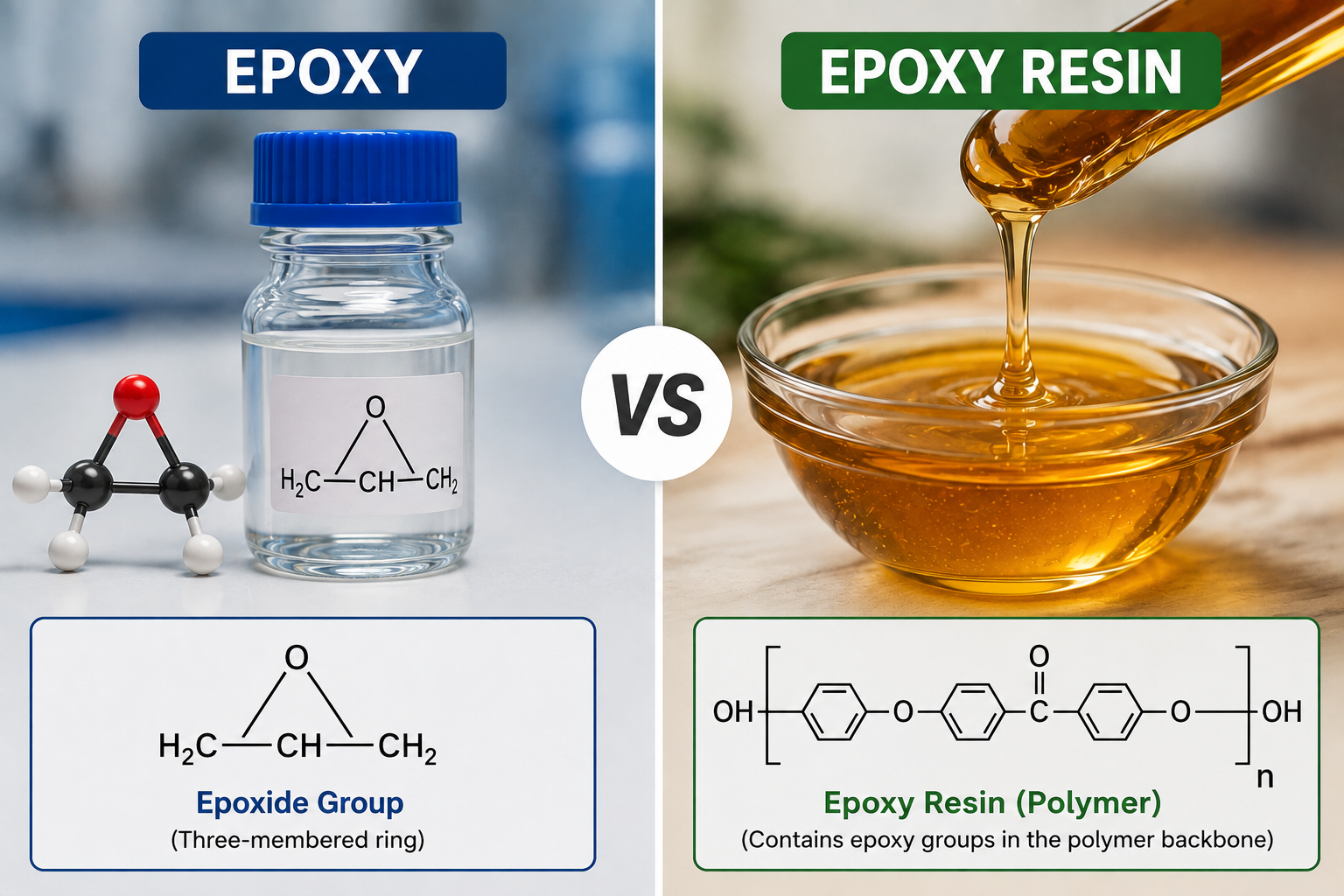
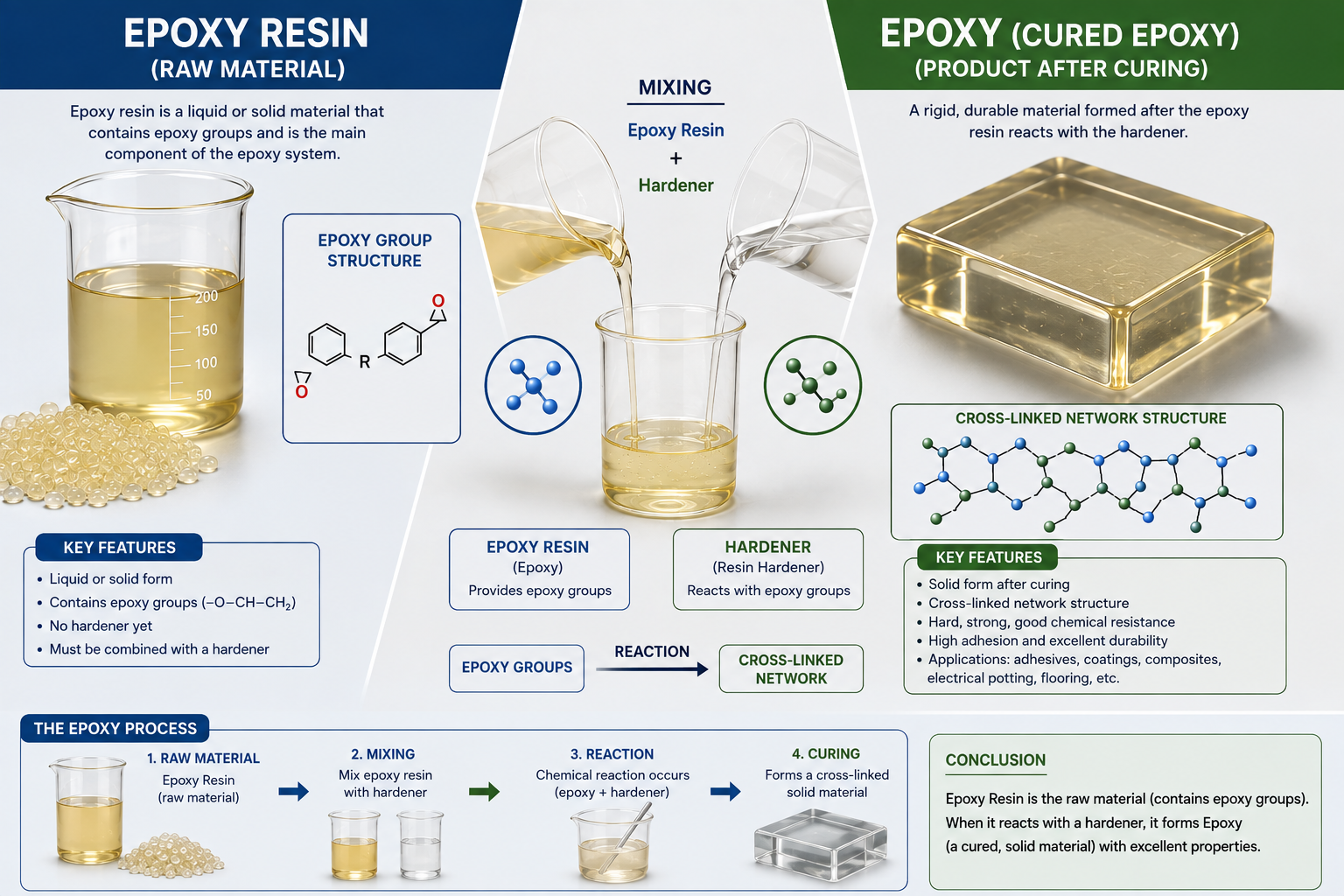
In materials science and surface engineering, the terms Epoxy and Epoxy Resin are frequently used interchangeably. However, from a chemical synthesis and manufacturing standpoint, they represent two distinctly different physical states. Confusing the base prepolymer (resin) with the cured polymer system (completed epoxy) can lead to improper material selection, inaccurate stoichiometric mixing, and catastrophic technical failures in industrial applications.
This technical article clarifies the fundamental distinction between Epoxy and Epoxy Resin, analyzing cross-linking reaction mechanisms, core physical properties, and optimal industrial deployment strategies.
1. Distinguishing Epoxy Resin from Epoxy: A Chemical & Engineering Perspective
To ensure precise application on the factory floor, engineers and facility managers must understand the core chemical distinction between these two states:
[ Epoxy Resin (Part A) ]  +  [ Curing Agent / Hardener (Part B) ]
                                    │
                                    ▼
                 [ Cross-Linking Polymerization Reaction ]
                                    │
                                    ▼
               [ Epoxy (Cured Thermoset Polymer Network) ]
-
Epoxy Resin (Part A): Refers to the uncured prepolymer or monomer compound containing at least two reactive epoxide functional groups (a three-membered ring consisting of one oxygen atom bonded to two carbon atoms). In its raw state, Epoxy Resin exists as a liquid or low-melting solid with varying viscosities, possessing limited structural strength and an inability to harden on its own.
-
Epoxy (The Cured Polymer System): Refers to the fully reacted end-product obtained after Epoxy Resin (Part A) undergoes a chemical cross-linking reaction with a Curing Agent or Hardener (Part B). This reaction forms a rigid, three-dimensional molecular network, permanently converting the liquid mixture into an infusible, insoluble thermosetting polymer that cannot be melted or re-molded by heat.
2. The Chemical Curing Mechanism
The reaction between Epoxy Resin and a hardener is an exothermic addition reaction that liberates zero reaction byproducts (such as water or volatile gas), resulting in exceptionally low volumetric shrinkage during cure.
Depending on the functional groups present in the curing agent, cross-linking occurs via specific chemical pathways:
-
Amine Systems (Aliphatic, Cycloaliphatic, Aromatic): Reactive hydrogen atoms on the amine group (-NH_2) attack and open the epoxide ring, forming strong C-N covalent bonds and secondary hydroxyl groups (-OH). These polar hydroxyl groups significantly enhance mechanical adhesion to metals, concrete, and mineral substrates.
-
Anhydride Systems: React at elevated temperatures to form ester linkages with exceptionally high cross-link densities, yielding superior electrical insulation and high heat resistance.
Epoxide Ring + Hardener (Amine/Anhydride) Exothermic Reaction Cross-Linked Polymer Matrix (Epoxy)
3. Major Industrial Epoxy Resin Classifications
The ultimate performance of cured epoxy materials depends 50\% on the molecular structure of the initial Epoxy Resin (Part A):
| Epoxy Resin Classification |
Characteristic Molecular Structure |
Key Technical Advantages |
| Bisphenol A (DGEBA) |
Diglycidyl Ether of Bisphenol A |
Most widely used; provides balanced mechanical strength, strong adhesion, and cost efficiency. |
| Bisphenol F (DGEBF) |
Diglycidyl Ether of Bisphenol F |
Lower viscosity than DGEBA, superior crystallization resistance, and enhanced solvent resistance. |
| Epoxy Novolac (Multi-functional) |
Phenol / Cresol Novolac Backbone |
High epoxide functionality per molecule; extreme heat resistance ($>180^\circ\text{C}$) and resistance to concentrated acids. |
| Cycloaliphatic Epoxy |
Saturated aliphatic ring structures |
Exceptional resistance to outdoor UV radiation, non-yellowing, and high tracking resistance. |
4. Superior Physical & Technical Properties of Cured Epoxy
When Epoxy Resin and Hardeners are mixed at precise stoichiometric ratios, the cured polymer delivers outstanding industrial-grade performance parameters:
-
High Mechanical Strength: Tensile strength ranging from 60 - 80MPa, compressive strength exceeding 100 MPa, and high resistance to dynamic impact and rolling friction.
-
Minimal Volumetric Shrinkage (<1%): Maintains precise geometric dimensions without generating internal stresses that cause micro-cracking or delamination from substrates.
-
Broad Spectrum Chemical Resistance: Resists degradation from dilute acids, alkalis, hydrocarbon solvents, fuels, industrial detergents, and salt water.
-
Exceptional Adhesion: Polar hydroxyl groups along the polymer chain form strong hydrogen and van der Waals bonds with concrete, steel, aluminum, glass, ceramics, and carbon fibers.
-
Electrical Insulation: High surface and volume resistivity with high dielectric breakdown voltage resistance.
5. Industrial Application Sectors
                                          ┌── 1. Floor Coatings & Protective Anti-Corrosion Linings
                                          │
Industrial Applications of Epoxy Systems ─┼── 2. Structural Adhesives & Mechanical Bonding
                                          │
                                          ├── 3. Electrical Potting & Electronic Encapsulation
                                          │
                                          └── 4. High-Performance Composites (CFRP / GFRP)
-
Industrial Flooring & Anti-Corrosion Coatings: Self-leveling epoxy flooring for GMP/FDA cleanrooms, zinc-rich epoxy primers protecting structural steel, and chemical storage tank linings.
-
Structural Bonding: Replaces mechanical fasteners and welds when bonding metal-to-metal, hardened concrete, and carbon fiber reinforced polymer (CFRP) plates in bridge and civil engineering projects.
-
Electronic Potting & Encapsulation: Encapsulates PCBs, sensors, and transformers to shield delicate electronics against moisture, dust, vibration, and thermal shock.
-
Advanced Composites Manufacturing: Combines high-grade Epoxy Resin with carbon or glass fibers to produce wind turbine blades, aerospace components, automotive racing chassis, and sporting goods.
6. Summary
Understanding the chemical distinction between Epoxy and Epoxy Resin allows materials engineers to optimize formulation stoichiometry, select the correct curing agent, and eliminate potential application defects. Specifying the appropriate epoxy system ensures long-term structural integrity, asset protection, and operational safety across demanding industrial environments.
Contact JM ENTERPRISE For Technical Support
Is your facility seeking high-performance structural adhesives, protective surface coatings, electronic encapsulation resins, or imported Epoxy Resin & Hardener raw materials?
Contact the application engineering team at JM ENTERPRISE today for expert technical advice, custom formulation support, and to request direct on-site testing samples: