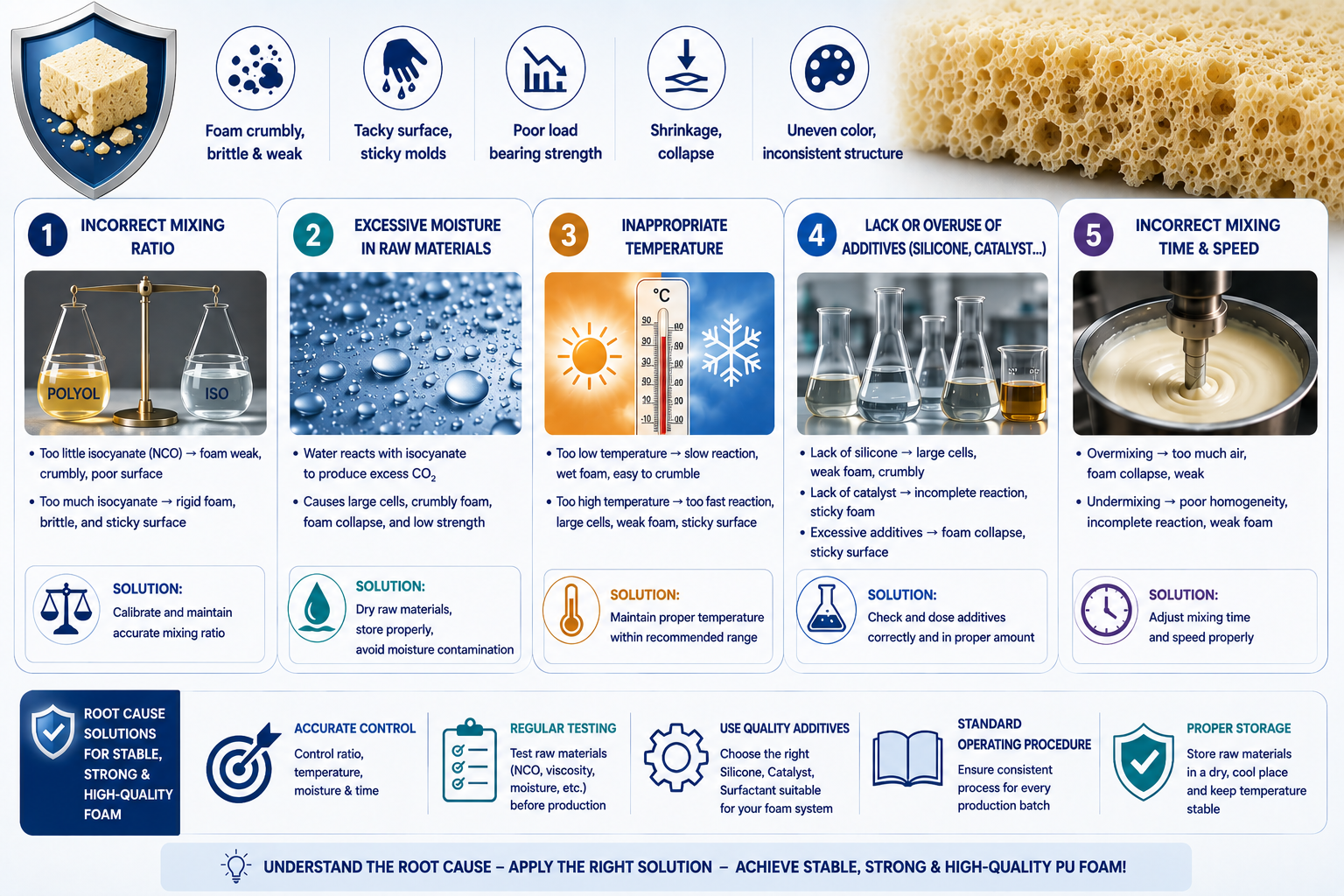
1. The Aging Phenomenon: Why Does PU Foam Crumble, Degradation, and Turn Sticky?
Have you ever encountered a situation where automotive seat cushions, footwear insoles, synthetic leather, or Polyurethane (PU) insulation panels suddenly crumble into dust, become sticky like melting glue, or snap upon light contact after a short period of use?
This is a very common Polymer Degradation phenomenon in the PU industry. This failure mode not only causes the product to completely lose its elasticity and mechanical load-bearing capacity, but also severely damages the brand reputation of textile, footwear, automotive, and construction manufacturers.
Join the chemical experts at JM ENTERPRISE as we uncover the Top 5 root causes behind this degradation and explore permanent corrective solutions.
2. Top 5 Leading Causes of PU Foam Crumbling & Degradation
┌────────────────────────────────────────┐
│ TOP 5 CAUSES OF PU DEGRADATION │
└────────────────────────┬───────────────┘
│
┌─────────────────┬─────────────────┼─────────────────┬─────────────────┐
▼ ▼ ▼ ▼ ▼
[ 1. Hydrolysis ] [ 2. Wrong Index] [ 3. UV Radiation ] [ 4. Mixing Error ] [ 5. Mold Moisture ]
(Polyester Polyol) (Low -NCO) (Thermal/UV) (Excess Catalyst) (Excess Water)
Cause 1: Hydrolysis in Polyester Polyol Systems
This single cause accounts for up to 70% of all cases where PU turns sticky and crumbles.
- Mechanism: Unlike Polyether Polyols, Polyester Polyols contain ester linkages (-C=O-O-
 ). When exposed to hot and humid environments (typical of tropical climates), water molecules (H2O
 ) attack and sever these ester bonds.
- Consequence: Macromolecular chains are chopped into short segments containing carboxylic acid groups. Once the polymer backbone is broken, the PU foam loses its structural integrity, causing it to crumble into powder or feel sticky to the touch.
Cause 2: Imbalanced Isocyanate Index (Incorrect -NCO/-OH Ratio)
- Mechanism: The Isocyanate Index reflects the stoichiometric ratio between Isocyanate (-NCO
 ) groups and Polyol Hydroxyl (-OH
 ) groups (typically targeting 100-105
 ).
).
- Consequence:
- Under-indexing (Index < 95): Insufficient cross-linking density leaves unreacted free -OH groups. The resulting foam remains soft, sticky, fails to cure completely, and degrades up to 5 times faster than normal.
- Over-indexing (Index > 115): The polymer network becomes excessively rigid and brittle, leading to premature cracking under mechanical stress.
Cause 3: UV Radiation & Thermal Degradation
- Mechanism: PU products formulated with aromatic isocyanates (such as MDI or TDI) are highly sensitive to sunlight. UV light carries enough energy to break down aromatic rings and urethane linkages.
- Consequence: The foam surface undergoes yellowing, embrittlement, micro-cracking, and structural loss of its original toughness.
Cause 4: Over-dosing Catalysts (Amines/Organotins)
- Mechanism: Overusing organotin catalysts (Stannous Octoate - T9, T12) or amine catalysts to accelerate demold times leaves unreacted catalyst residues trapped inside the foam matrix.
- Consequence: When exposed to heat and humidity, these residual catalysts act as reverse catalysts, accelerating the self-degradation of the PU backbone.
Cause 5: Moisture Condensation or Mold Dampness During Processing
- Mechanism: Uncontrolled moisture in the system (from un-dried compressed air, high raw material humidity, or mold condensation) reacts violently with Isocyanates to generate flexible urea clusters.
- Consequence: Distorts the Gelation/Blowing reaction balance, creating non-uniform foam zones prone to delamination and surface peeling.
3. Failure Mode Analysis & Corrective Actions
|
Observed Symptom
|
Primary Cause
|
Short-Term Technical Fix
|
Long-Term Solution
|
|
Sticky glue-like surface, crumbling powder
|
Polyester Polyol Hydrolysis
|
Add Anti-Hydrolysis Additives.
|
Switch to Polyether Polyol or reinforce with Carbodiimides.
|
|
Cracking foam, rapid loss of resilience
|
Imbalanced Isocyanate Index
|
Recalibrate MDI/TDI metering pump ratios.
|
Verify OH value of incoming Polyol batches.
|
|
Yellowing foam, surface embrittlement
|
UV & Thermal Aging
|
Incorporate UV Absorbers / HALS.
|
Substitute with Aliphatic Isocyanates (HDI/IPDI) for outdoor applications.
|
4. Anti-Hydrolysis Additive Solutions From JM ENTERPRISE
To permanently prevent exported goods from being returned due to crumbling and degradation, JM ENTERPRISE provides an advanced suite of anti-aging additive solutions:
- Carbodiimide-Based Anti-Hydrolysis Additives:
- Mechanism: Acts as an acid scavenger. As soon as water attacks ester bonds and generates carboxylic acid groups, Carbodiimide immediately reacts with and neutralizes these acid species, shutting down the chain reaction that causes foam degradation.
- Dual-Action UV Anti-Aging Package (UVA + HALS):
- Protects polymer chains against UV degradation, preventing yellowing and embrittlement in outdoor foam and PU synthetic leather.
- Hydrophobic & Crosslinking Additives:
- Increases crosslinking density, improving foam compressive and tear strength by 30-40%
 .
.
Contact JM ENTERPRISE Today For Technical Support
Are your Polyurethane products experiencing crumbling, degradation, stickiness, yellowing, or cracking after short storage periods?
Contact the expert technical team at JM ENTERPRISE today for a root-cause diagnostic, customized Anti-Hydrolysis Additive solutions, and complimentary sample testing directly at your plant:
- Hotline / Zalo:
- +84 933 706 351 – Mr. Cha (English & Korean Support)
- +84 913 390 054 – Ms. Ngan (Vietnamese Support)
- Email: jhcha@jmentchemical.com
- Website: https://jmentchemical.com/