1. Post-Demold Shrinkage — The Plant Engineer's Operational Nightmare
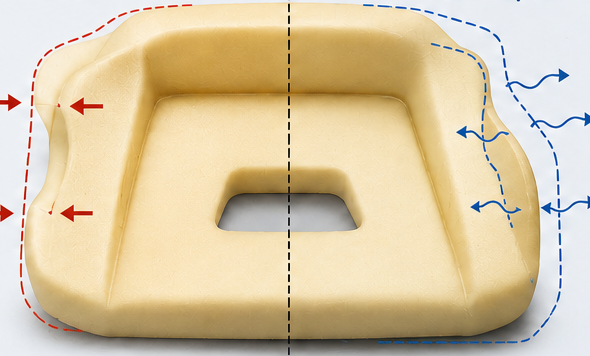
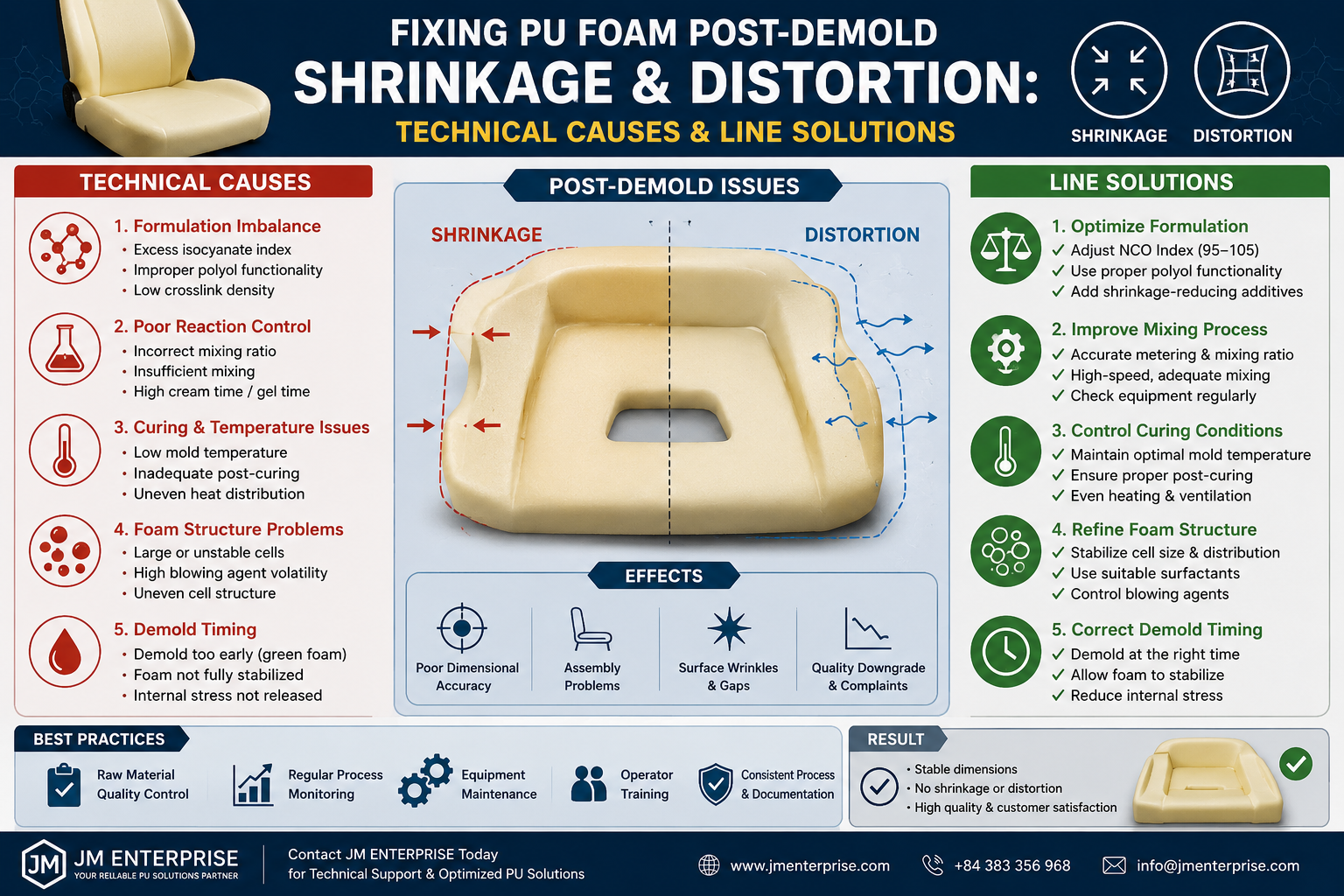
In Polyurethane (PU) Molded Foam production lines (automotive seating, motorcycle saddles, premium sofa cushions, memory foam pillows), few technical defects are as frustrating as post-demold shrinkage and dimensional distortion.
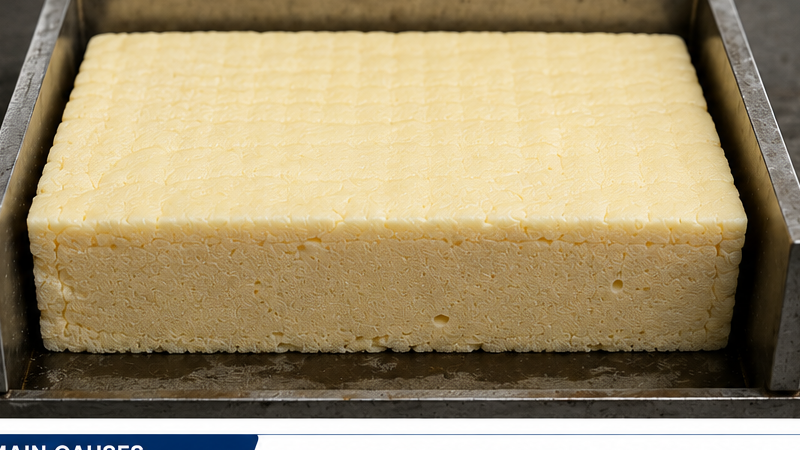
Products removed from the mold initially appear sharp, geometrically precise, and fully formed. However, within just 3-10 minutes of cooling down, the foam block begins to deform, wrinkle, sink in the center, or warp at the corners, destroying geometric tolerances and turning finished parts into scrap.
This guide from the application engineering team at JM ENTERPRISE analyzes the physical and chemical root causes of this failure mode and provides a standardized operational procedure to permanently eliminate shrinkage.
2. Technical Root Cause: Why Does PU Foam Shrink During Cooling?
Foam shrinkage is not caused by raw material under-dosing; rather, it stems from a drastic internal gas pressure drop within Closed-Cells.
┌────────────────────────────────────────┐
│ PHYSICAL MECHANISM OF FOAM SHRINKAGE │
└────────────────────────┬───────────────┘
│
[ In-Mold Expansion ] ──► [ High Closed-Cell Ratio (> 20%) ]
│
[ Internal CO2Gas Cools Down ] ──► [ Internal Pressure Plummets ]
│
[ Internal Pressure < Atmospheric Pressure ] ──► [ Thin Cell Walls Collapse Inward ]
- Exothermic Reaction & Gas Expansion: Inside the sealed mold, the exothermic reaction between Isocyanate and Water/Polyol generates intense heat (110∘C-150∘C
 ), causing generated CO2
 gas to expand rapidly and fill every intricate mold contour.
- Intact Cell Wall Structure (Closed-Cells): If the formulation possesses excessive cell-wall stabilizing power (due to surplus Silicone Surfactant or a lack of Cell Openers), expanding gas bubbles remain trapped as 100% airtight closed-cells.
- Pressure Differential Upon Cooling: Upon demolding, the foam block cools rapidly toward ambient room temperature. According to the Ideal Gas Law (PV=nRT
 ), as temperature T
 drops, the internal pressure P
 of the trapped CO2 gas plummets significantly.
- Structural Collapse: When internal cell pressure falls well below external atmospheric pressure (1 atm
 ), this differential pressure crushes the thin, un-opened cell walls inward, causing the entire PU foam matrix to shrink and warp.
3. Mechanical Crushing — The Golden Time Window for Cell Wall Rupture
For PU Molded Foam manufacturing, the primary operational intervention required directly on the production line is Mechanical Crushing.
┌──────────────────────────────────────────────────────────────────────┐
│ GOLDEN MECHANICAL CRUSHING WINDOW: 1 - 3 MINUTES POST-DEMOLDING │
└──────────────────────────────────────────────────────────────────────┘
- Mechanism: The foam block is passed through a system of crushing rollers or a hydraulic press to compress it to 10%-30%
 of its original thickness 1-3
 times immediately after mold release. This mechanical force forcibly ruptures the closed-cell walls, transforming the polymer network from a Closed-Cell to an Open-Cell structure.
- The Critical Time Window:
- Too Early (Immediately after pour / in-mold): The polymer network lacks sufficient gel strength; pressing will cause complete, irreversible foam collapse.
- Too Late (5 - 10 minutes post-demold): The foam block has cooled completely, fixing the polymer chains in place. Crushing at this stage causes permanent structural tearing and internal cracking instead of clean cell opening.
- Optimal Window: Perform crushing within 1-3 minutes immediately post-demolding, while the foam remains warm (70∘C-90∘C
 ) and the polymer backbone exhibits ideal elasticity.
4. Cell Opener Additive Solutions for Complex Mold Geometries
While Mechanical Crushing is highly effective, products featuring complex geometries, deep recesses, or intricate undercuts (such as automotive steering wheels, molded headrests, or custom motorcycle seats) present dead zones where crushing rollers cannot apply uniform mechanical force.
In these scenarios, incorporating Cell Opener Additives into the chemical formulation is the ultimate, definitive solution.
Operating Mechanism of Cell Openers
Cell Openers (typically incompatible high-molecular-weight polyether polyols or dispersed polymer particles) introduce controlled micro-instabilities into the expanding cell membranes. As the foam reaches peak rise at the end of the reaction stroke, the cell walls at these unstable sites rupture automatically, forming a highly breathable open-cell network (>90% Open-Cell content) without triggering bulk foam collapse.
|
Comparison Parameter
|
Optimized System + Cell Opener
|
No Cell Opener (Crushing Only)
|
|
Open-Cell Content
|
92%-98% (Uniform throughout matrix) (Uniform throughout matrix)
|
70%-85% (Open only in directly crushed zones) (Open only in directly crushed zones)
|
|
Corner Shrinkage Risk
|
Near 0%
|
High in deep recesses & tight folds
|
|
Air Permeability
|
Exceptionally high; soft, breathable feel
|
Moderate
|
|
Dimensional Stability
|
Superior and consistent
|
Highly dependent on operator timing and technique
|
5. Quick Troubleshooting Checklist for Line Engineers
If your production line is currently experiencing post-demold shrinkage, execute these 4 diagnostic steps immediately:
- Step 1: Verify the crushing line timing (Has the time elapsed beyond 3 minutes post-demold before entering the Mechanical Crusher?).
- Step 2: Reduce the Silicone Surfactant dosage by 0.1-0.2% to lower excessive cell-wall stabilization force.
- Step 3: Increase the Cell Opener Additive loading in the Polyol blend by 0.5%-1.5% until airflow/permeability tests meet specification.
- Step 4: Inspect mold temperature controls (Maintain a stable 55∘C-65∘C). Cold mold surfaces increase high-density closed skin formation.
Contact JM ENTERPRISE Today For Technical Support
Is your Molded Foam production line struggling with shrinkage, post-demold distortion, un-yielding closed-cell feel, or internal cracking during mechanical crushing?
Contact the application engineering team at JM ENTERPRISE today for specialized Cell Opener Additive solutions, process parameter calibration support, and complimentary trial samples directly at your plant:
- Hotline / Zalo:
- +84 933 706 351 – Mr. Cha (English & Korean Support)
- +84 913 390 054 – Ms. Ngan (Vietnamese Support)
- Email: jhcha@jmentchemical.com
- Website: https://jmentchemical.com/