HCM HEAD OFFICE: Room S15, Saigon Pearl, 92C Nguyen Huu Canh, Thanh My Tay Ward, Ho Chi Minh City
HANOI BRANCH: N45-TT4 Do Dinh Thien Street, My Dinh – Song Da Urban Area, Tu Liem Ward, Hanoi
24/7
Call Now
+84 933 706 351
JMENTERPRISE CO., LTD.
Mail Now
jhcha@jmentchemical.com
Optimizing Injection Molding Performance with LLDPE MI 7-8: Technical Analysis & Cost Solutions

Optimizing Injection Molding Performance with LLDPE MI 7-8: Technical Analysis & Cost Solutions

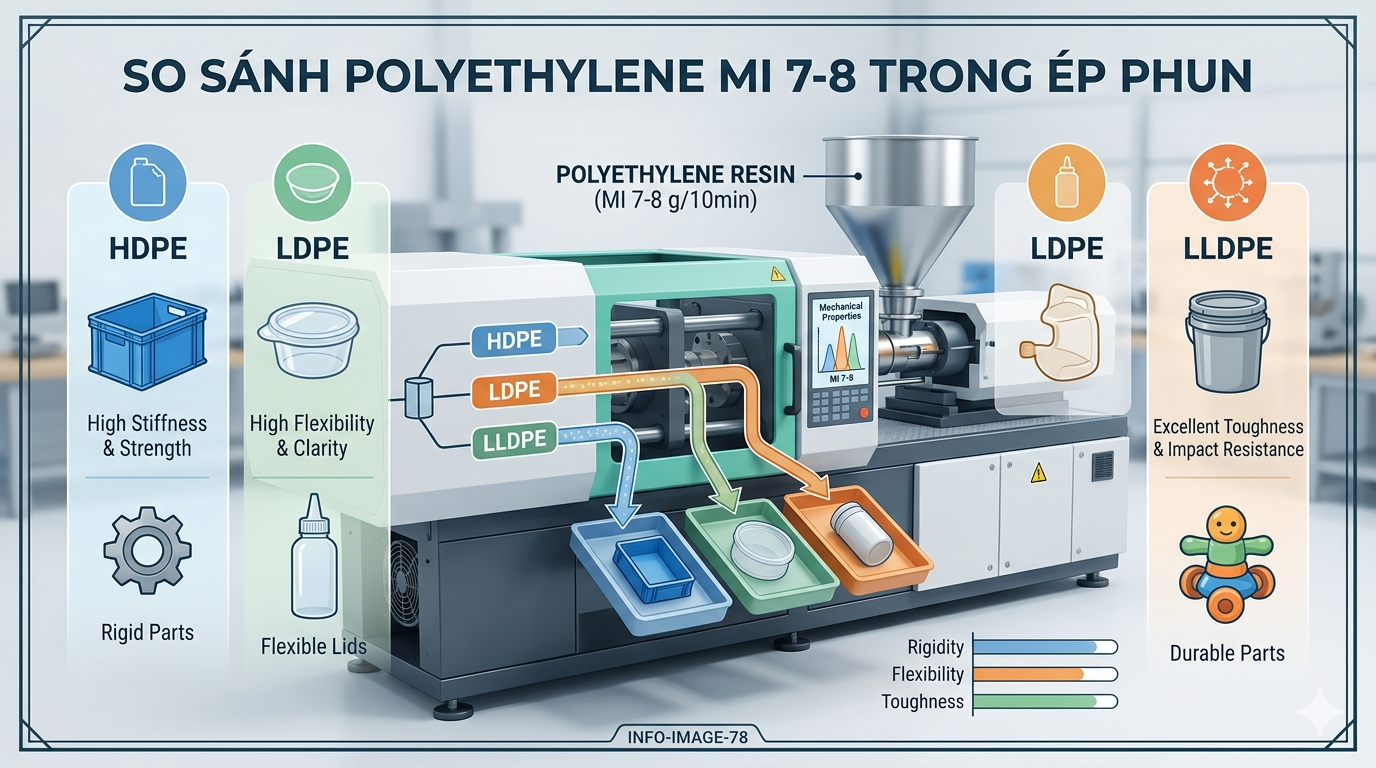
In the plastic manufacturing industry, Cycle Time is the vital factor determining profitability. Selecting LLDPE (Linear Low-Density Polyethylene) with a Melt Index (MI) of 7-8 is becoming a dominant trend thanks to its perfect balance between mechanical properties and processing speed.

1. Impressive Technical Specifications of LLDPE MI 7-8

At JM ENTERPRISE, our LLDPE MI 7-8 range is strictly controlled with standard technical parameters:

Properties

Typical Value

Unit

Test Method

Melt Flow Index (MI)

7.0 - 8.5

g/10 min

ASTM D1238

Density

0.918 - 0.924

g/cm^3

ASTM D1505

Tensile Strength

10 - 15

MPa

ASTM D638

Elongation at Break

> 500

%

ASTM D638

Melting Temperature

120 - 125

°C

DSC

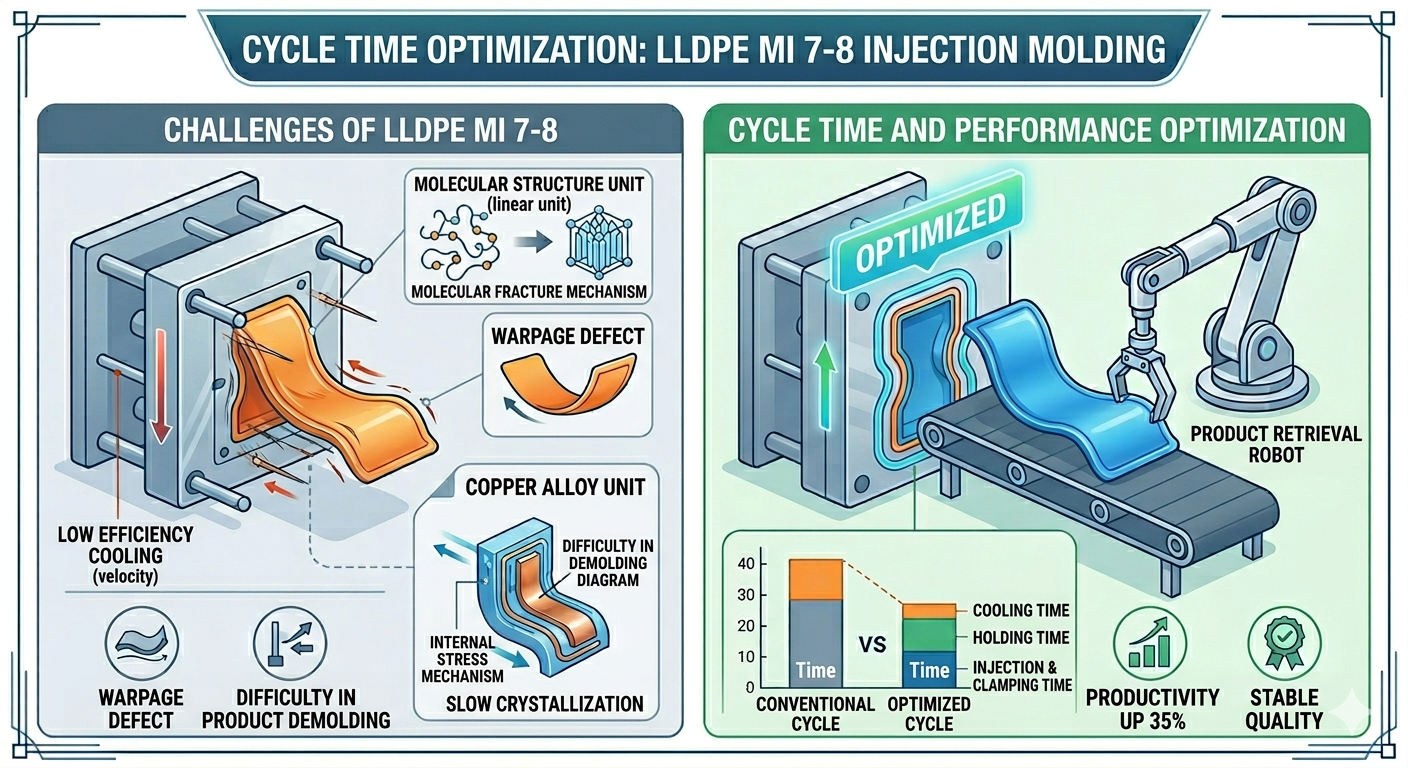
2. Why is MI 7-8 the Key to Shortening Cycle Time?

Accelerated Filling Speed

With a high Melt Index ($7 - 8$ g/10 min), the resin's viscosity decreases during the melting phase. This allows the molten plastic to flow effortlessly into complex mold cavities or thin-walled sections ($< 1$ mm) without requiring excessive machine temperatures.

Reduced Thermal Stress & Cooling Time

By allowing processing at lower temperatures compared to low-MI grades (such as MI 1-2), the product reaches dimensional stability faster. This significantly shortens the cooling phase—which typically accounts for 60-70% of the total cycle time.

Controlled Shrinkage

LLDPE MI 7-8 provides uniform shrinkage (typically 1.5% - 3% depending on thickness), which helps minimize warpage and reduces the rejection rate (NG rate) to below 1%.
3. Practical Applications: From Household to Industrial

The combination of LLDPE's inherent flexibility and the high flowability of MI 7-8 makes this material ideal for:

  • Masterbatch Production: Acting as a carrier resin for better pigment dispersion.
  • Premium Housewares: Plastic baskets and food containers requiring a glossy, smooth surface.
  • Thin-wall Injection Molding: Technical components that demand elasticity alongside high productivity.

4. Economic Analysis: How Much Can You Save?

Using LLDPE MI 7-8 from JM ENTERPRISE helps businesses:

  • Save 10-15% on Energy: By lowering heater band setpoints and reducing injection pressure.
  • Increase Output by 20%: By shaving off 2-5 seconds from every cycle.

5. Why Choose JM ENTERPRISE?

We don't just sell resin; we provide comprehensive manufacturing solutions:

  • High-Quality Materials: Directly imported, internationally certified, ensuring absolute consistency between batches.
  • Professional Technical Team: Korean & Vietnamese engineers provide on-site troubleshooting and optimize injection molding parameters.
  • Competitive Pricing: Leveraging an extensive supply network, we optimize input costs for your business.
  • Formulation Consulting: Specialized expertise in Polyurethane (PU) foam and engineering plastics, meeting strict insulation and acoustic standards.
  • Comprehensive Support: We provide free samples and 24/7 technical assistance.

Contact us today for a detailed Technical Data Sheet (TDS) and promotional quotes:

📞 Hotline/Zalo:

  • +84 933 706 351 Mr. Cha (English & Korean)
  • +84 913 390 054 Ms. Ngan (Vietnamese)

📧 Email: jhcha@jmentchemical.com

🌐 Website: https://jmentchemical.com/

Newest Blogs

Epoxy Resin vs Polyurethane Resin: Key Differences & Selection Guide

Compare Epoxy Resin vs Polyurethane Resin (PU) in detail. Explore key difference...

How to Choose the Right Epoxy Resin for Industrial Applications

Learn how to choose the right epoxy resin for industrial applications. Explore k...

Zero-Carbon Emission Reduction Solutions

Explore Zero-Carbon emission reduction solutions using PU foam insulation. Learn...

In-Depth Analysis of Epoxy vs Epoxy Resin: Chemical Nature, Technical Properties, and Industrial Applications

An in-depth technical analysis of Epoxy vs Epoxy Resin. Clarify terminology, che...

Low-VOC Trends: Comprehensive Guide to Odorless Catalysts & Additives for Export-Grade PU Foam

Discover Low-VOC additives & reactive catalysts for PU Foam: Eliminate amine odo...

Fixing PU Foam Post-Demold Shrinkage & Distortion: Technical Causes & Line Solutions

Troubleshoot PU Foam shrinkage and distortion post-demolding: Uncover closed-cel...

Most Viewed Blogs

Eco-Friendly PU Adhesive for Sustainable Packaging

Durable PU laminating adhesive – solvent resistant, internationally certified....

PU Foam Production Process: A Step-by-Step Guide from A to Z

Explore the complete PU foam production process from A to Z and discover how sou...

TPU and Sustainability: Is It an Eco-Friendly Material?

Discover whether TPU is truly eco-friendly, its recyclability, product life cycl...

Hydroxy and Oxygen Content in Polyol – The Key to High-Quality Polyurethane Production

How OH and oxygen content in polyol affect polyurethane performance. Learn how t...

TDI/MDI – Complete Solutions for Your PU Production Needs

JM Enterprise supplies high-quality MDI and TDI for PU production in Vietnam. Co...

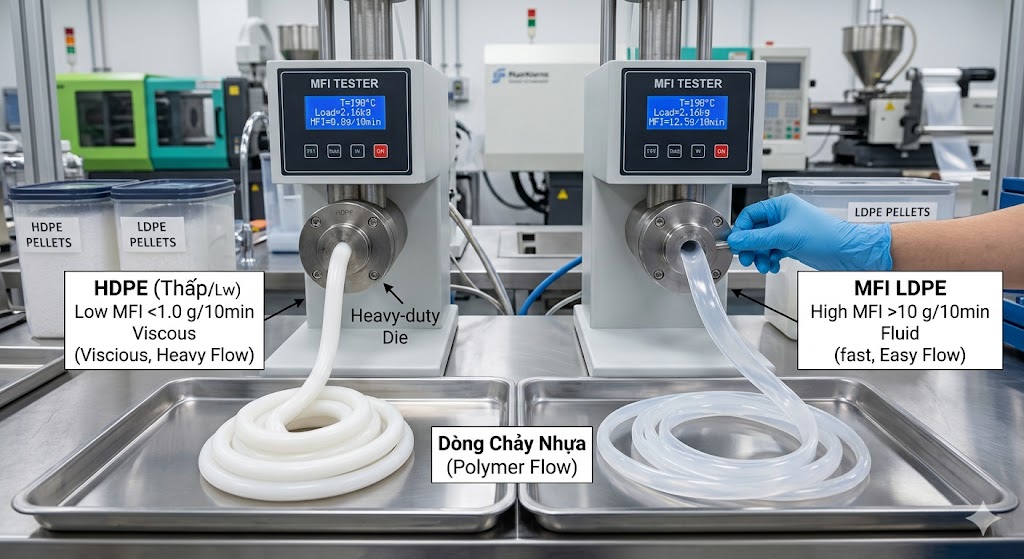
Impact of Melt Flow Index (MFI) on HDPE/LDPE Extrusion & Film Blowing | JM ENTERPRISE

Understand how MFI affects the production of HDPE and LDPE. Expert technical ins...

Related Blogs

In-Depth Analysis of Epoxy vs Epoxy Resin: Chemical Nature, Technical Properties, and Industrial Applications

An in-depth technical analysis of Epoxy vs Epoxy Resin. Clarify terminology, che...

Fixing PU Foam Post-Demold Shrinkage & Distortion: Technical Causes & Line Solutions

Troubleshoot PU Foam shrinkage and distortion post-demolding: Uncover closed-cel...

The Role of Plasticizers (DBP, DINP, DOP, DOTP) in the Hardness and Flexibility of PU Plastic

Discover the crucial roles of DBP, DINP, DOP, and DOTP plasticizers on the hardn...

Reducing MDI Consumption in Polyurethane Production: A Comprehensive Guide to Corporate Cost Savings

Discover ways to reduce MDI consumption in Polyurethane production. Optimize for...

Top 5 Best Mold Release Agents for EVA Shoe Soles in 2026

Discover the Top 5 mold release agents for EVA shoe soles in 2026. JM Enterprise...

HDPE, LDPE, and LLDPE Comparison: Choosing the Right Grade for Optimal Mechanical Properties

Compare HDPE, LDPE, and LLDPE technical properties and applications. Learn how t...

Zalo Zalo