HCM HEAD OFFICE: Room S15, Saigon Pearl, 92C Nguyen Huu Canh, Thanh My Tay Ward, Ho Chi Minh City
HANOI BRANCH: N45-TT4 Do Dinh Thien Street, My Dinh – Song Da Urban Area, Tu Liem Ward, Hanoi
24/7
Call Now
+84 933 706 351
JMENTERPRISE CO., LTD.
Mail Now
jhcha@jmentchemical.com
Polyurethane (PU) Foam Cellular Architecture: The Core Factor Driving Product Quality

Polyurethane (PU) Foam Cellular Architecture: The Core Factor Driving Product Quality

1. What Is PU Foam Cellular Architecture?

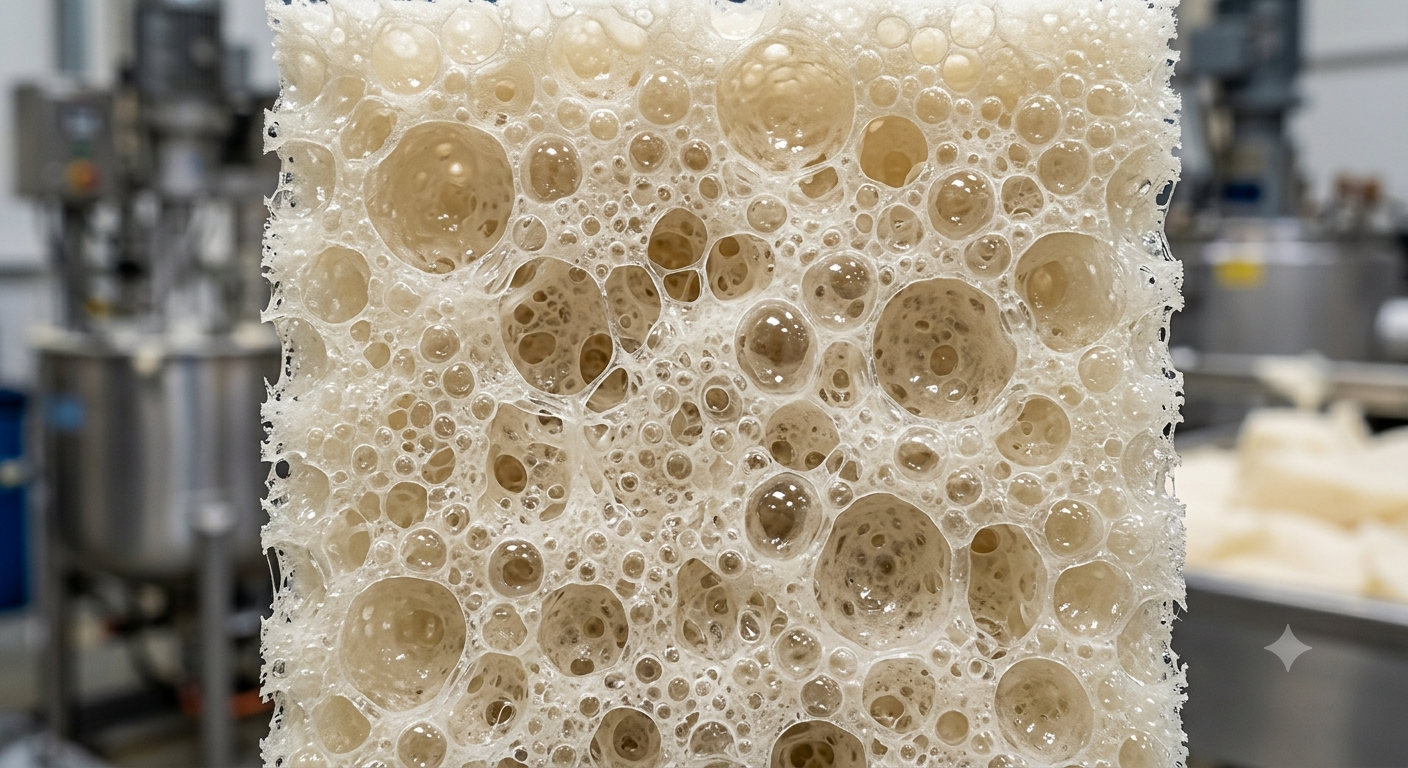
In Polyurethane (PU) technology, cellular architecture refers to the complex matrix of gas cells formed during the chemical reaction between Polyols, Isocyanates (MDI/TDI), water, and functional additives. This microscopic structure not only defines the physical appearance of the foam but also determines 100% of its mechanical properties: resilience, load-bearing capacity, thermal conductivity, tear strength, and density.

Controlling cell size, cell wall thickness, and the open-to-closed-cell ratio is the ultimate key to mastering industrial PU foam formulations.

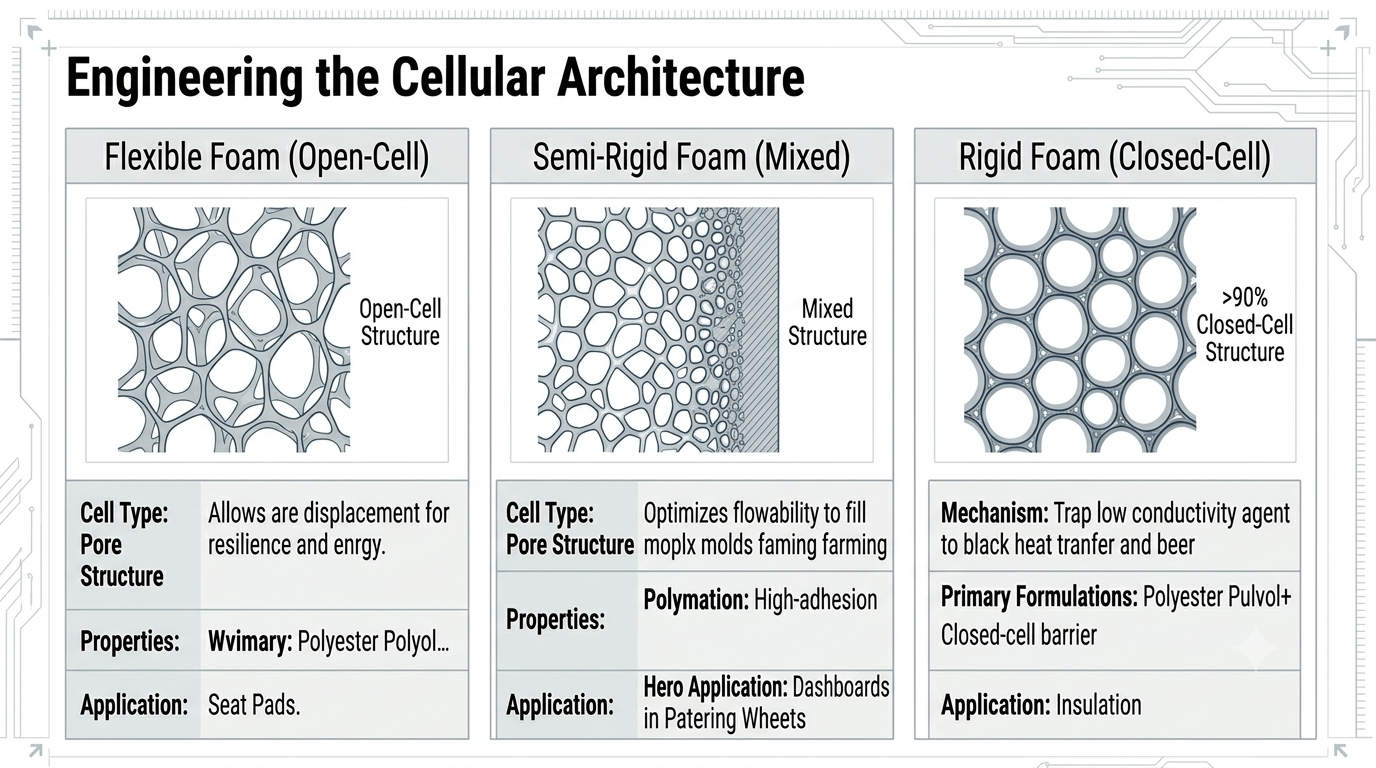
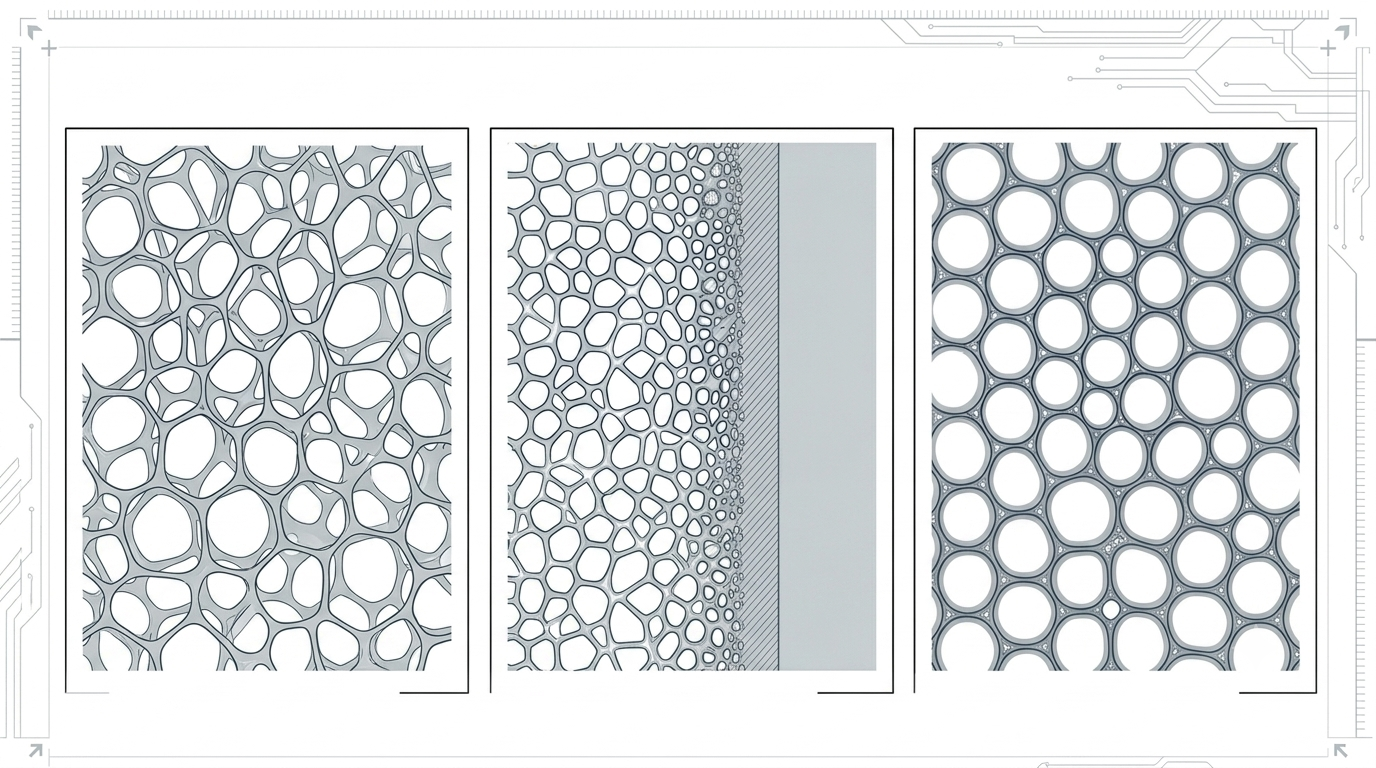
2. Classification of 3 Technical PU Foam Cellular Architectures

Based on their structural matrix, PU foams are categorized into three primary cellular types:

Foam Type

Cellular Structure

Operating Mechanism

Key Applications

Flexible Foam

Open-Cell Structure

Allows free air displacement between cells, maximizing energy absorption, breathability, and resilience.

Automotive Seat Pads, mattresses, and premium furniture cushions.

Semi-Rigid Foam

Mixed Structure

Balances rigidity and flexibility, optimizing flowability to fill complex mold cavities with high surface adhesion.

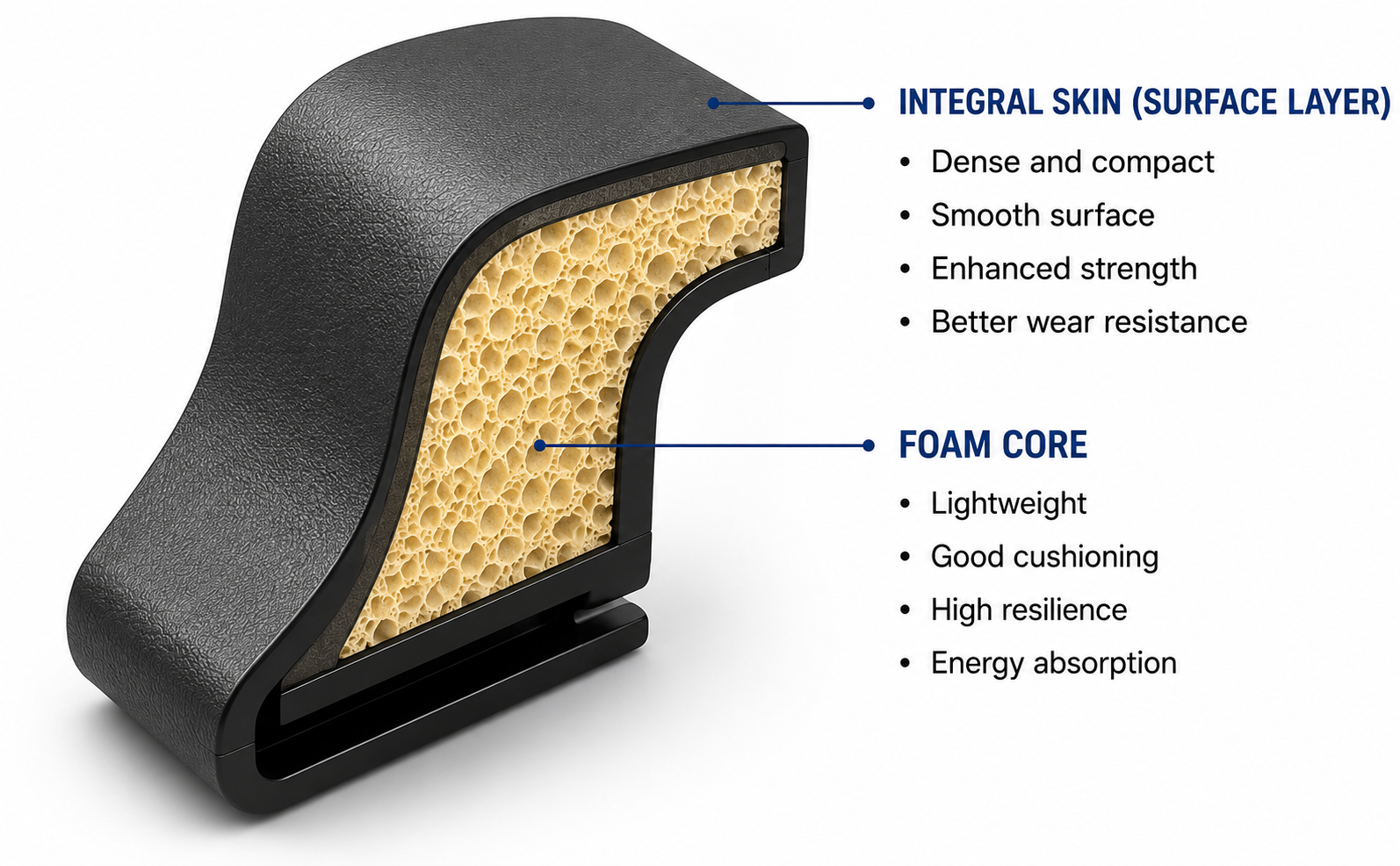
Automotive Dashboards (In-Panels), steering wheels, and armrests.

Rigid Foam

Closed-Cell Structure (> 90%)

Traps low-conductivity blowing gases inside isolated cells to deliver superior thermal insulation and high compressive strength.

Refrigerators, cold storage panels, and building insulation.

3. Cell Formation Process & Its Impact on Foam Density

The development of the cellular structure in PU foam occurs across three critical physicochemical phases:

  1. Nucleation Phase: The reaction between Isocyanate and water generates CO2 gas, which works alongside chemical blowing agents to form millions of microscopic gas bubbles.
  2. Cell Growth & Stabilization: Silicone surfactants lower surface tension, allowing gas bubbles to expand uniformly without rupturing or undergoing coalescence.
  3. Curing & Cell Opening Phase:
    • For Flexible Foam, cell walls must rupture at the end of the rise to form an Open-Cell structure. Without a post-demold Mechanical Crushing step, the foam will suffer severe shrinkage as it cools.
    • For Rigid Foam, the cell walls must maintain high structural integrity to preserve a tight Closed-Cell matrix.

4. How Cellular Defects Cause Foam Expansion Failure & Density Deficit

When cellular dynamics become unbalanced during production, severe manufacturing defects occur:

  • Foam Collapse / Expansion Failure: Imbalanced catalyst ratios (Tertiary Amines vs. Organotin) cause blowing reactions (CO2 generation) to outpace gelling reactions, destroying cell walls before structural strength is established.
  • Density Deficit: Non-uniform bubble distribution, oversized cells, or premature gas loss caused by low-performance surfactants result in inconsistent product density.
  • Product Deformation & Shrinkage: High closed-cell ratios in flexible foam that lack proper mechanical crushing lead to internal pressure drops, causing the finished part to shrink or deform.

Contact JM ENTERPRISE Today For Technical Support

If your production line is facing PU foam expansion failure, poor expansion, or product density deficit, contact us today for support from top industry experts and receive sample test batches of our advanced additives.

  • Hotline / Zalo:
    • +84 933 706 351 – Mr. Cha (English & Korean Support)
    • +84 913 390 054 – Ms. Ngan (Vietnamese Support)
  • Email: jhcha@jmentchemical.com
  • Website: https://jmentchemical.com/

 

Newest Blogs

Polyurethane (PU) Foam Cellular Architecture: The Core Factor Driving Product Quality

Explore the cellular architecture of PU Foam in detail: Open-Cell, Mixed-Cell, a...

How to Fix PU Foam Expansion Failure, Poor Expansion & Density Deficit Issues

Experiencing PU foam expansion failure, poor expansion, or density deficit? Disc...

PU Foam Fails to Expand

An in-depth technical analysis of why polyurethane (PU) foam fails to expand or...

PU Foam Shrinkage: Advanced Technical Analysis & JM ENTERPRISE Solutions

An in-depth technical analysis of polyurethane (PU) foam shrinkage from chemical...

Air Bubbles in Polyurethane (PU): Causes, Effects, and Effective Solutions

Learn the main causes of air bubbles in Polyurethane (PU), their impact on produ...

Reducing MDI Consumption in Polyurethane Production: A Comprehensive Guide to Corporate Cost Savings

Discover ways to reduce MDI consumption in Polyurethane production. Optimize for...

Most Viewed Blogs

Eco-Friendly PU Adhesive for Sustainable Packaging

Durable PU laminating adhesive – solvent resistant, internationally certified....

PU Foam Production Process: A Step-by-Step Guide from A to Z

Explore the complete PU foam production process from A to Z and discover how sou...

TPU and Sustainability: Is It an Eco-Friendly Material?

Discover whether TPU is truly eco-friendly, its recyclability, product life cycl...

Hydroxy and Oxygen Content in Polyol – The Key to High-Quality Polyurethane Production

How OH and oxygen content in polyol affect polyurethane performance. Learn how t...

TDI/MDI – Complete Solutions for Your PU Production Needs

JM Enterprise supplies high-quality MDI and TDI for PU production in Vietnam. Co...

SONGWON Anti-Oxidants for Plastic Compounding – Thermal & Oxidative Stabilization Solutions

Discover SONGWON's high-performance Anti-Oxidants for plastic compounding

Related Blogs

Applications of PU Foam in Interior Design – A Booming Niche Market

PU Foam is becoming a key material in modern interior design: lightweight, durab...

TPU and Sustainability: Is It an Eco-Friendly Material?

Discover whether TPU is truly eco-friendly, its recyclability, product life cycl...

Hydroxy and Oxygen Content in Polyol – The Key to High-Quality Polyurethane Production

How OH and oxygen content in polyol affect polyurethane performance. Learn how t...

Impact of Melt Flow Index (MFI) on HDPE/LDPE Extrusion & Film Blowing | JM ENTERPRISE

Understand how MFI affects the production of HDPE and LDPE. Expert technical ins...

New ABS Plastic Battery Casings Reduce EV Weight by 10%

Discover how next-generation engineering ABS plastic granules help reduce EV bat...

PU Foam Production Process: A Step-by-Step Guide from A to Z

Explore the complete PU foam production process from A to Z and discover how sou...

Zalo Zalo