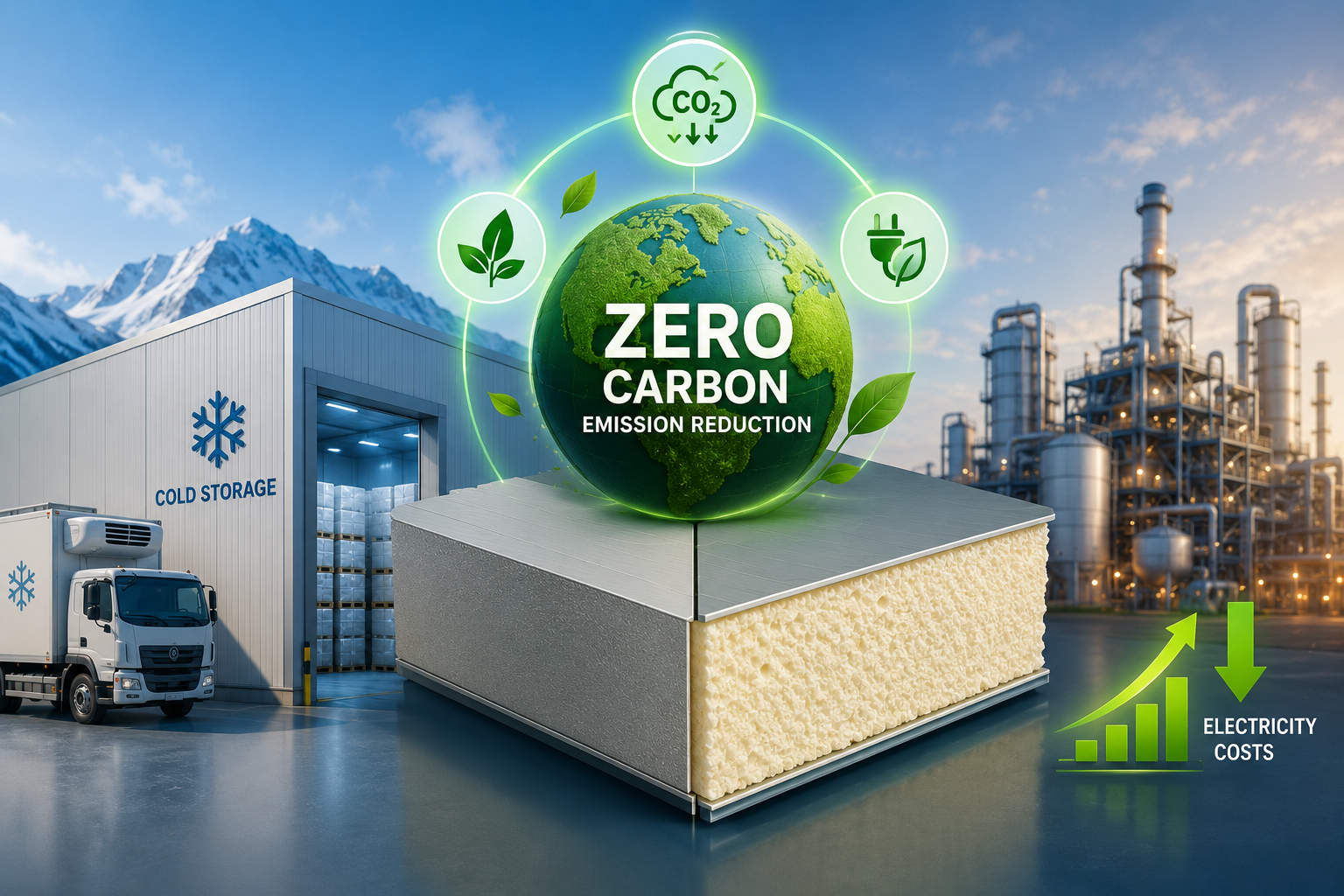
Achieving Net-Zero carbon targets (Zero-Carbon) is rapidly transforming from a corporate sustainability goal into a mandatory global operating standard. Commercial cold storage, freezing facilities, and industrial manufacturing plants consume immense amounts of electricity. Poorly insulated roofs, walls, and building envelopes cause severe thermal losses—triggering massive indirect Scope 2 carbon emissions (CO2) driven by overworked cooling infrastructure.
To address two critical challenges simultaneously—slashing monthly operating expenses and meeting strict ESG carbon reduction targets—adopting Zero-Carbon emission reduction solutions using PU foam insulation has emerged as a primary strategic pathway for facility managers and industrial investors worldwide.
1. The Direct Link Between Heat Loss, Energy Costs, and Carbon Footprints
In cold storage warehouses preserving food or pharmaceuticals, industrial refrigeration compressors and HVAC units run continuously 24/7. When building envelopes (roofs, wall panels, and doors) lack high-performance insulation, rapid conductive and convective thermal transfer occurs:
External Heat Penetration Refrigeration Units Overwork Spike in Electricity Demand Increased Indirect Carbon Emissions CO
                      ┌── Thermal leakage through under-insulated roofs and wall panels
                      │
Mechanism of Scope 2  ──┼── Refrigeration compressors running at 130% - 150% overload
Indirect CO2 Emissions│
                      ├── Escalating monthly energy utility bills
                      │
                      └── Elevated corporate Carbon Footprint metrics
By deploying high-efficiency Closed-Cell Rigid Polyurethane (PU) Foam, facilities create an airtight thermal barrier that completely eliminates thermal bridges. This directly reduces refrigeration power consumption by 30% to 50%.
2. Why PU Foam Insulation is Central to Zero-Carbon Strategies
Compared to legacy insulation materials like expanded polystyrene (EPS), glass wool, or PE foam, rigid Polyurethane (PUR/PIR) foam offers superior technical parameters engineered for low-carbon performance:
| Technical Criteria |
Rigid PU / PIR Foam |
Legacy EPS Foam |
Glass Wool Insulation |
| Thermal Conductivity ($\lambda$) |
Ultra-Low (0.018 - 0.022 W/mK) |
High (0.035 - 0.040 W/m K) |
High (0.038 - 0.045 W/m K) |
| Cell Microstructure |
Closed-Cell (>90%) |
Partially Open |
Open Fibrous Mesh |
| Moisture Resistance |
Superior / Hydrophobic |
Prone to water absorption |
Highly absorptive (leads to thermal degradation) |
| Thermal Performance Retention |
Uncompromising (>30 years) |
Degrades within 3 - 5 years |
Sags and compacts over time |
| Green Building Contribution |
Optimizes LEED / BREEAM points |
Low |
Moderate |
Technical Advantages of PU Foam in Carbon Reduction:
-
Highest Thermal Resistance (R-Value): Provides maximum insulation efficiency with a thinner profile than any alternative material.
-
Next-Generation Hydrofluoroolefin (HFO) Blowing Agents: Modern eco-friendly PU/PIR formulations utilize HFO technology featuring a Global Warming Potential (GWP) < 1 and Ozone Depletion Potential (ODP) = 0, aligning perfectly with international Zero-Carbon initiatives.
-
Elimination of Surface Condensation: Prevents under-roof sweating and moisture accumulation, protecting underlying steel structures against rust and corrosion.
3. Industrial Applications of PU Insulation in Cold Storage & Plants
Facilities can deploy rigid PU insulation flexibly across various structural applications:
                                          ┌── 1. PIR / PUR Sandwich Panels for Walls & Roofs
                                          │
Applications of PU Foam Thermal Insulation ──┼── 2. Direct Spray PU Foam on Existing Roofs
                                          │
                                          ├── 3. Cryogenic Pipeline & Storage Vessel Insulation
                                          │
                                          └── 4. Injected Insulation for Cold Room Doors & Frames
-
PIR/PUR Insulated Sandwich Panels: The industry standard for walls, ceilings, and floors in deep-freeze cold storage ($0^\circ\text{C}$ to $-40^\circ\text{C}$), ensuring complete thermal enclosure and cleanroom hygiene compliance.
-
Direct Spray PU Foam Roofing: Applied directly onto existing metal roof sheets without interrupting plant production, immediately lowering under-roof interior temperatures by $5^\circ\text{C}$ to $15^\circ\text{C}$.
-
Pipeline & Chiller Insulation: Encapsulates cold refrigerant pipelines, chiller barrels, and pressure vessels, stopping thermal gains along distribution loops.
4. Dual Benefits: Slash Utility Budgets and Enhance Brand Value
Investing in high-performance PU insulation systems delivers long-term financial and operational value:
-
Drastic Energy Bill Savings: Cuts monthly electricity bills by 30% to 50%, yielding rapid capital payback periods (typically within 1.5 to 3 years).
-
Extended Equipment Lifespan: Reducing continuous compressor overload minimizes mechanical wear and tear, lowering long-term maintenance overhead.
-
Global Green Compliance & Export Readiness: Controlling energy consumption and carbon metrics ensures exported goods comply with international carbon regulations like Europe's Carbon Border Adjustment Mechanism (CBAM).
5. Conclusion
Transitioning to green manufacturing and Net-Zero carbon operations is an essential requirement for modern industrial competitiveness. Implementing Zero-Carbon emission reduction solutions using PU foam insulation represents an intelligent strategy that combines financial returns—through significant energy cost reductions—with meaningful environmental stewardship.
Contact JM ENTERPRISE For Technical Support & Chemical Supply
Is your enterprise upgrading cold storage insulation, renovating factory roofing, or sourcing high-grade PMDI and Polyol systems engineered for Zero-Carbon compliance?
Contact the application engineering team at JM ENTERPRISE today for expert technical advice, energy savings ROI calculations, and to request direct on-site testing samples: