1. The Critical Role of Silicone Surfactants in PU Foam Technology
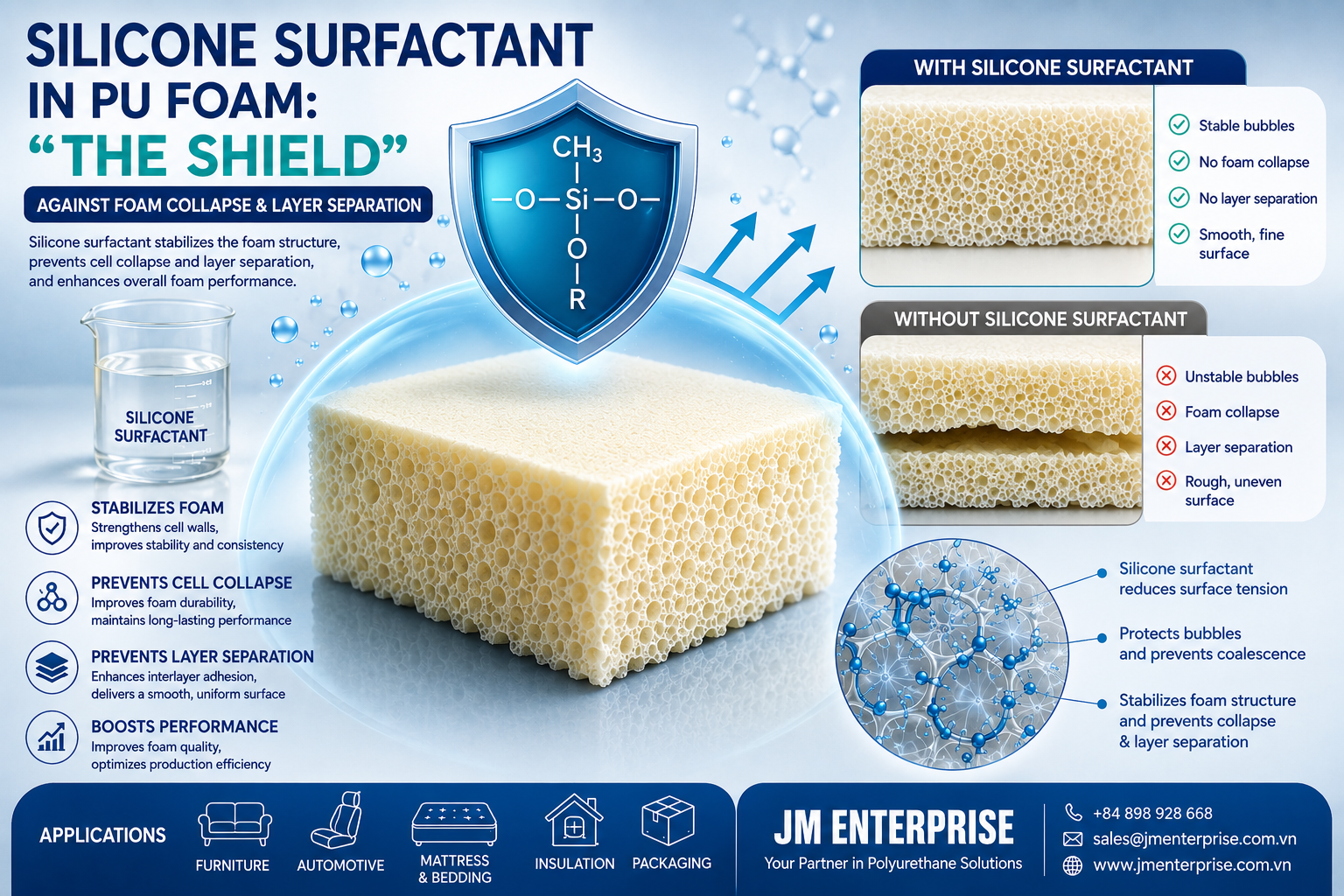
In Polyurethane (PU) Foam formulations, Silicone Surfactants (silicone-based surface-active agents) account for only a small dosage (∼0.5-2.5% ), yet they act as the vital shield that determines the structural survival of the foam matrix.
Without a Silicone Surfactant, CO2 gas generated from the reaction between Isocyanate and Water would immediately escape or coalesce into giant gas bubbles, resulting in total foam collapse, lamination/splitting defects, or severe surface voiding.
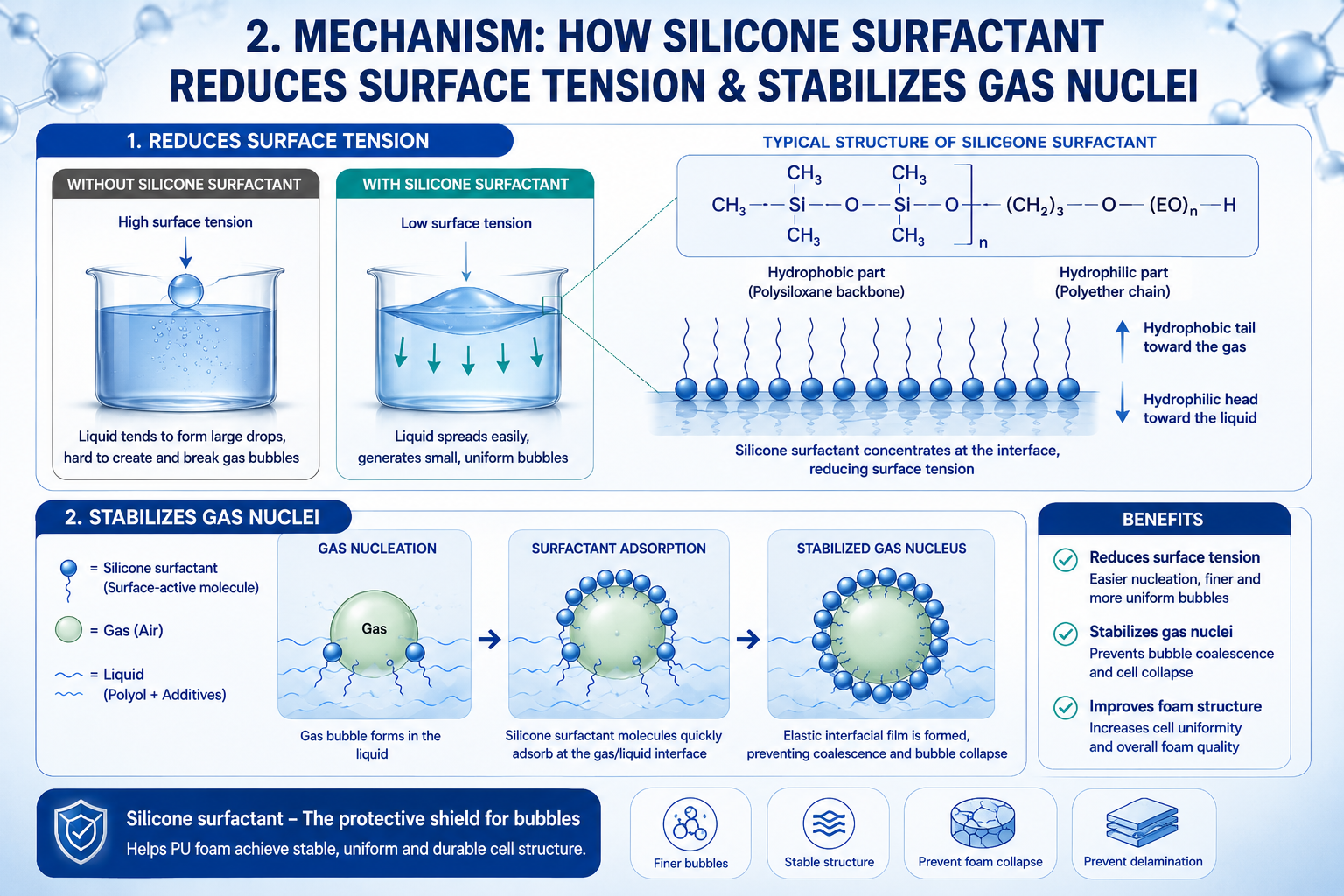
2. Surface Tension Reduction & Cell Nucleation Mechanisms
To understand how Silicone Surfactants prevent foam collapse, we must analyze the 3 core physico-chemical mechanisms taking place during the first few seconds of the reaction:
- Surface Tension Reduction:
The initial Polyol/Isocyanate reaction mixture possesses high surface tension. Silicone Surfactants rapidly lower this surface tension, allowing generated CO2 gas to easily disperse and form millions of micro-scale nucleation sites.
- Prevention of Coalescence:
As bubbles expand, the cell walls become extremely thin. The amphiphilic structure of the Silicone Surfactant (a surface-orienting polysiloxane backbone combined with polyether chains compatible with the polyol phase) generates surface elasticity (the Marangoni effect), preventing small bubbles from rupturing and coalescing into large voids.
- Cell Wall Stabilization Until Gelation:
The surfactant acts as temporary scaffolding that maintains cell structure during the critical window—from initial cream/rise until the gelling reaction builds a self-supporting polymer network.
3. Comparative Analysis: Molded Foam vs. Slabstock Foam Surfactants
Different manufacturing technologies demand Silicone Surfactants with distinct Hydrophilic-Lipophilic Balance (HLB) values and molecular weight distributions. Utilizing the wrong surfactant grade is a primary cause of mass production defects.
|
Technical Parameter
|
Molded Foam (Automotive Seating, Molded Cushions)
|
Slabstock Foam (Continuous Block Foam)
|
|
Operational Environment
|
Reacts inside a closed mold with high pressure and complex geometry.
|
Free-rise expansion on a flat conveyor line at high volume.
|
|
Cell Wall Requirement
|
High open-cell content required to prevent post-demold shrinkage.
|
High temporary cell wall stability required to support tall foam blocks.
|
|
Surfactant Characteristics
|
Moderate Stabilizing Power. Ensures complete mold filling while allowing self-cell-opening at the end of the rise.
|
High Stabilizing Power. Holds a 1-2m tall foam block without center collapse or sagging. tall foam block without center collapse or sagging.
|
|
Impact of Misapplication
|
If Slabstock grade is used: Molded foam becomes tight/closed-cell, causing severe shrinkage and deformation.
|
If Molded grade is used: Slabstock foam suffers center collapse, splits, or horizontal lamination failure.
|
4. Consequences of Under-Dosage and Over-Dosage of Silicone Surfactant
Precision in Silicone Surfactant dosing is a mandatory requirement for every R&D engineer and plant operator.
┌────────────────────────────────────────┐
│ DOSAGE EFFECTS OF SURFACTANT │
└────────────────────────────────────────┘
[ UNDER-DOSAGE ] [ OPTIMAL ] [ OVER-DOSAGE ]
* Total/Partial Collapse * Fine, Uniform Cells * Closed-cell Structure
* Splits / Lamination Failure * Optimal Density * Shrinkage / Deformation
* Large Voids & Surface Pin * High Resilience * Surface Tacky / Poor Adhesion
🛠️ Scenario 1: Surfactant Under-Dosage
- Symptoms: The foam rises partially and then collapses, exhibiting large pinholes on the surface, bottom lamination, or internal voids.
- Root Cause: Surface tension remains too high, causing fragile cell walls to rupture before the polymer network achieves sufficient gel strength.
- Corrective Action: Gradually increase the Silicone Surfactant ratio (0.1-0.3%
 ) and verify the mixing efficiency of the dispensing head.
🛠️ Scenario 2: Surfactant Over-Dosage
- Symptoms: The foam expands well initially, but suffers severe shrinkage within 3-5
 minutes post-demolding, or exhibits a sticky surface with poor fabric/leather bonding strength.
- Root Cause: Cell walls become excessively stable, pushing the closed-cell ratio beyond acceptable limits (>15-20%
 in flexible foam). As internal gas cools, internal negative pressure causes the entire foam block to collapse inward.
- Corrective Action: Reduce the surfactant loading or add a Cell Opener, combined with post-demold Mechanical Crushing.
Contact JM ENTERPRISE Today For Technical Support
Is your production line experiencing foam collapse, lamination defects, cell rupture, or post-demold shrinkage?
Contact the chemical engineering team at JM ENTERPRISE today for root-cause diagnostic support, customized Silicone Surfactant solutions, and complimentary testing samples:
- Hotline / Zalo:
- +84 933 706 351 – Mr. Cha (English & Korean Support)
- +84 913 390 054 – Ms. Ngan (Vietnamese Support)
- Email: jhcha@jmentchemical.com
- Website: https://jmentchemical.com/