1. The Transition Trend of Plasticizers in the Polyurethane (PU) Industry
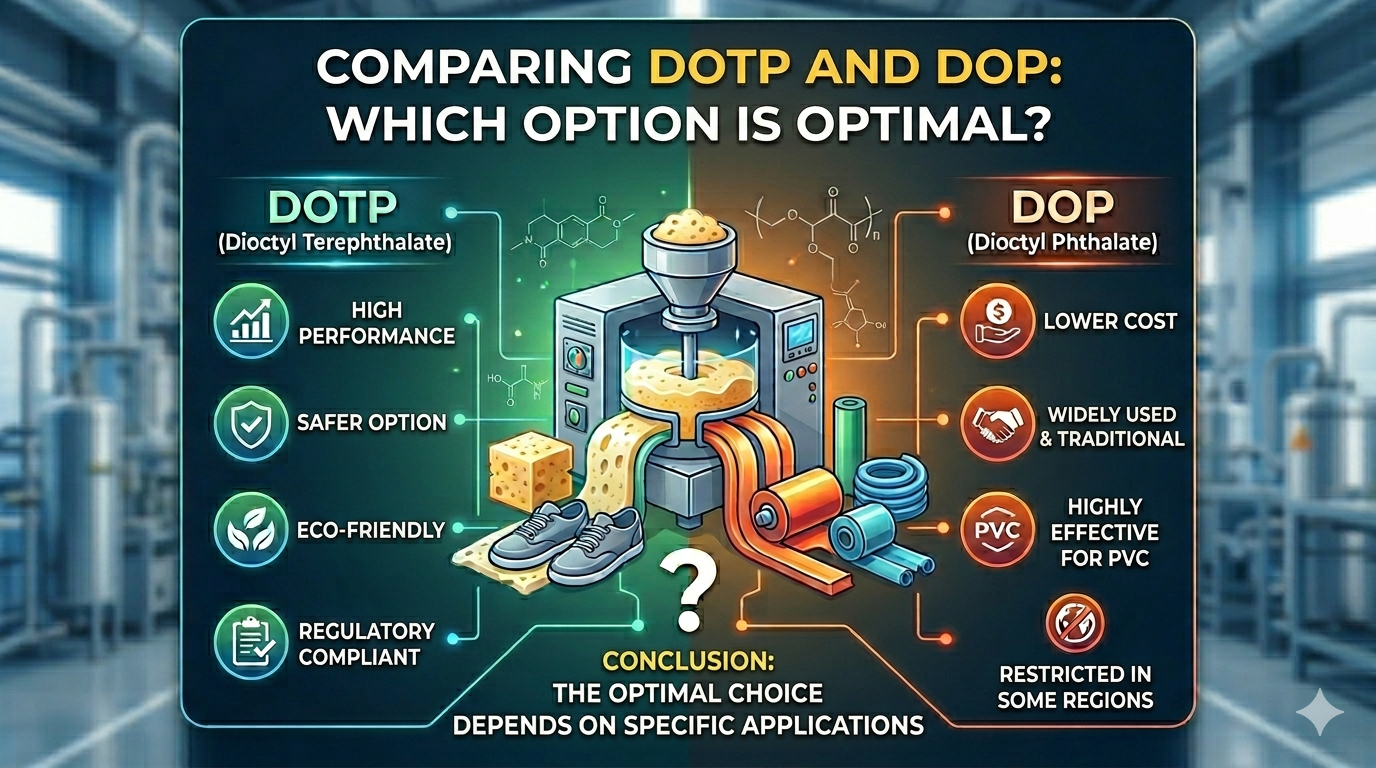
In Polyurethane (PU) processing technology, plasticizers play a critical role in determining the Shore hardness, elasticity, and tensile strength of the final product. For decades, DOP (Dioctyl Phthalate) has reigned as the dominant plasticizer due to its excellent softening efficiency and low cost.
However, under the pressure of increasingly stringent global health and safety regulations (such as Europe's REACH and RoHS standards), DOTP (Dioctyl Terephthalate) has emerged as the perfect alternative. For manufacturers of PU resin systems—including synthetic leather, protective films, adhesives, and molded rubber—comparing DOTP and DOP to find the most efficient solution for their production lines is now a top priority.
2. Technical Analysis: The Key Differences Between DOTP and DOP
Even though they share the exact same chemical formula and a similar molecular weight, the spatial differences in their molecular configurations give DOTP significantly superior physical and chemical properties over DOP when blended into PU matrices.
Chemical Structure: Phthalate vs. Non-Phthalate
- DOP: Belongs to the Phthalate family, featuring two ester groups positioned in the ortho (adjacent) configuration on the benzene ring. This structure is more prone to breakdown, releasing compounds flagged as potential endocrine disruptors in humans.
- DOTP: Is a structural isomer categorized as a Non-Phthalate. It features two ester groups positioned in the para (opposite/symmetrical) configuration on the benzene ring. This linear, symmetrical structure grants DOTP much higher bond stability, making it completely eco-friendly and safe for human health.
Volatility and Migration Resistance
Within the polymer matrix of Polyurethane, plasticizers do not form permanent chemical bonds but instead occupy spaces between linear chains. Consequently, oil bleeding (the migration of plasticizers to the surface followed by evaporation) is a frequent issue.
- Thanks to its rigid, symmetrical structure, DOTP exhibits a lower vapor pressure and far less volatility compared to DOP. PU finished products utilizing DOTP experience minimal plasticizer loss over time. This effectively prevents dry hardening, allowing products to retain their original flexibility.
Heat Resistance and Anti-Aging Properties
- DOP: Tends to degrade and volatilize heavily when processing temperatures cross moderate thresholds, which inherently limits the thermal performance of the PU compound.
- DOTP: Possesses superior thermal stability. PU plastic plasticized with DOTP can withstand higher processing and environmental temperatures. This enhances overall weather resistance, preventing outdoor PU films or automotive components from yellowing or becoming brittle under direct sunlight.
Mechanical Properties of the PU Compound
- When tested in PU resin systems, DOTP delivers equivalent or slightly superior tensile strength and elongation at break compared to DOP, especially during long-term heat-aging trials.
- While DOTP's initial plasticizing efficiency at low temperatures may be marginally slower than DOP's due to its rigid molecular structure, the long-term overall mechanical durability of the PU-DOTP system is substantially higher.
3. Comparative Summary: DOTP vs. DOP in PU Resin Systems
|
Technical Property
|
DOP Plasticizer
|
DOTP Plasticizer
|
|
Molecular Configuration
|
Ortho position (Less stable)
|
Para position (Stable, symmetrical)
|
|
Safety Standards
|
Contains Phthalates (Restricted/Banned in EU)
|
Non-Phthalate (Fully REACH/RoHS compliant)
|
|
Volatility Rate
|
High
|
Low (Superior product form retention)
|
|
Thermal Stability
|
Moderate
|
Excellent
|
|
Migration Resistance
|
Prone to surface bleeding
|
Highly resistant to migration
|
|
Optimal Application
|
Low-cost domestic PU goods
|
Premium PU leather, export PU films, medical devices
|
4. Which is the Optimal Choice for Your Business?
The answer depends heavily on your target market and the technical requirements of your end product:
- Choose DOP if: You are manufacturing entry-level, mass-market Polyurethane goods for domestic consumption where environmental certifications are not heavily enforced, and your primary goal is minimizing raw material costs.
- Choose DOTP if: You are targeting high-performance PU products, exporting to strict international markets (USA, EU, Japan), or manufacturing outdoor-rated components, medical equipment, and high-end automotive synthetic leather. DOTP represents the optimal, future-proof choice for sustainable manufacturing.
5. Why Do Manufacturers Choose JM ENTERPRISE?
To precisely control the technical performance and longevity of Polyurethane, the quality of input chemicals and resins must be completely stable. JM ENTERPRISE proudly serves as a leading strategic partner, delivering comprehensive material solutions to manufacturers through our outstanding competitive advantages:
- Reputable Global Supply: Beyond offering next-generation plasticizers (DOTP, DINP, DOP) with full international quality certifications, all of our new-generation ABS, flame-retardant ABS, and impact-reinforced ABS products at JM ENTERPRISE originate from world-renowned manufacturers.
- Perfect Fit for Technical Requirements: We supply engineering plastics and plastic chemicals with highly stable specifications and low shrinkage rates. This ensures that the molding process for intricate parts—up to large-sized electric vehicle (EV) battery packs—takes place with absolute precision, entirely free from warping.
- Competitive Pricing: Leveraging an extensive distribution network and long-term partnerships with global material giants, we guarantee the most optimized input costs for our clients.
- Professional Technical Support: We offer free technical consultations from a seasoned team of experts, assisting businesses in choosing the exact resin grades, proper plasticizers, and optimizing production lines to achieve maximum output efficiency.
6. Contact Us Today for a Free Consultation & Quotation!
Embrace the sustainable material movement and lightweight engineering solutions for the electric vehicle epoch with JM ENTERPRISE. Contact us today to secure the optimal material solution and the best quote for your business:
- Hotline/Zalo:
- +84 933 706 351 Mr. Cha (English)
- +84 913 390 054 Ms. Ngan (Vietnamese)
- Email: jhcha@jmentchemical.com
- Website: jmentchemical.com