In the formulation and application of Polyurethane (PU) adhesive systems, curing time is a core technical parameter that directly dictates production line efficiency and the ultimate bonding quality of the finished product. To adjust hardness, enhance elongation, and control the vulcanization reaction rate, formulation engineers frequently incorporate plasticizers, with Dibutyl Phthalate (DBP) being among the most widely utilized choice.
However, controlling the DBP mixing ratio so that it does not disrupt the curing kinetics of the PU structure is a complex technical challenge that requires a precise quantitative analysis from a materials science perspective.
1. Mechanism of DBP within the Polyurethane Matrix
Polyurethane adhesives are formed via a polycondensation reaction that creates a crosslinked network between the Isocyanate groups (-NCO) and the Hydroxyl groups (-OH) of the Polyol. Within this matrix, DBP ($C_{16}H_{22}O_{4}$) functions as an external plasticizer. The DBP molecules intersperse between the PU polymer chains, weakening the intermolecular electrostatic forces and hydrogen bonds.
[PU Polymer Chain] <─── Interrupted by DBP Molecules ───> [PU Polymer Chain]
│ │
▼ ▼
Reduced hydrogen bond density ───────────────> Increased free volume & mobility
The presence of DBP molecules increases the free volume between the chains, rendering the adhesive system more mobile and theoretically lowering the initial viscosity of the resin matrix. However, this dispersion simultaneously alters the probability of effective collisions between the reactive functional groups within the resin matrix.
2. Technical Evaluation: How the DBP Ratio Governs Curing Time
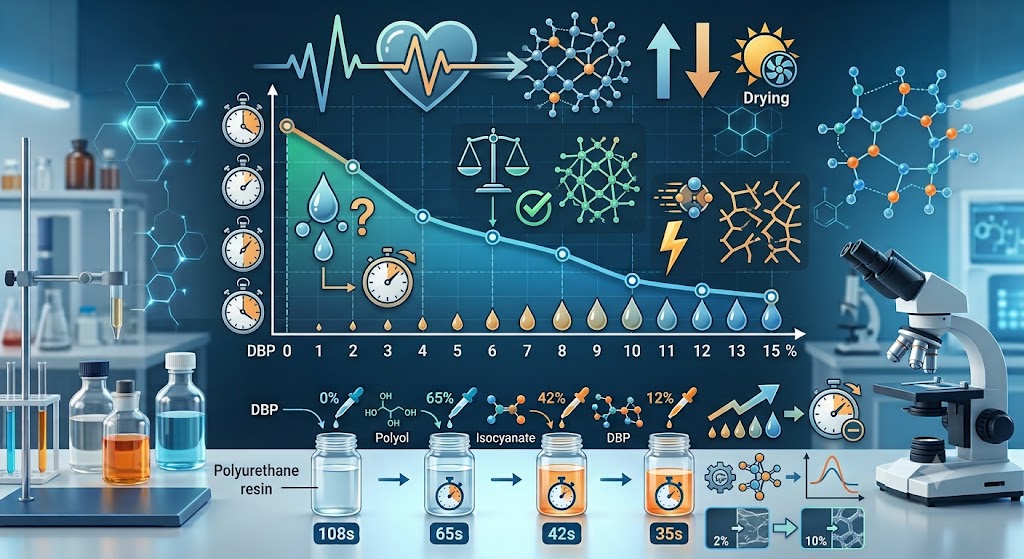
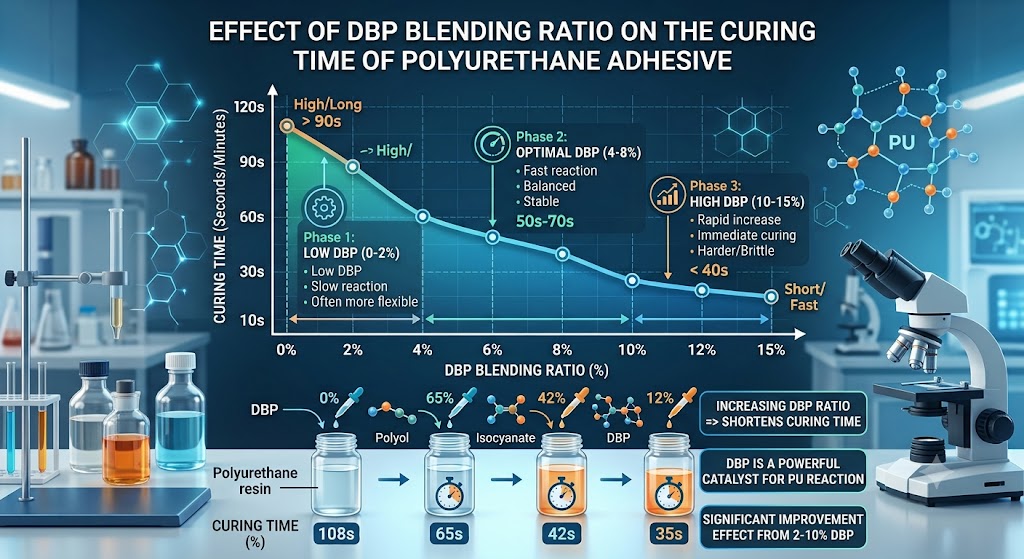
The curing time of PU adhesives shifts along a curve proportional to the blended DBP content, moving through specific empirical concentration phases as shown below:
Curing Time
▲
│ / (Severe Reaction Delay Phase)
│ /
│ /-----------' (Extended Plateau Phase)
│ /---------' (Ideal Plasticization Phase)
│ /--------' (Pristine PU)
└────────────────────────────────────────► DBP Mixing Ratio (wt%)
0% 5% 10% 15% >20%
2.1. Low Concentration Phase (1% – 5% wt)
At this ratio, DBP primarily operates to reduce the viscosity of the adhesive system. The thinned adhesive allows the Polyol and Isocyanate molecules to easily diffuse mutually during the initial stage. The tack-free time remains virtually unchanged or may even exhibit a slight reduction due to the accelerated molecular diffusion rate.
2.2. Standard Plasticization Phase (5% – 15% wt)
As the DBP ratio continues to rise, the dilution effect begins to dominate the system. The density of the reactive functional groups (-NCO and -OH) per unit volume drops significantly.
- DBP molecules surround the polymer chains, creating steric hindrance.
- Mechanical Result: The full curing time is extended by 1.5 to 2 times compared to the reference pristine polymer matrix.
2.3. Excess Phase (> 20% wt)
The adhesive system enters an over-plasticized state. Excess DBP severely blocks the chain propagation and crosslinking processes, dampening the exothermic reaction temperature. The adhesive exhibits a persistent failure to fully cure, leaves a long-term sticky surface, and suffers a drastic decline in mechanical properties (such as tensile and tear strength) due to an unacceptably low crosslinking density.
3. Technical Matrix: Correlation Between DBP Ratio and PU Adhesive Properties
|
DBP Ratio (%)
|
Impact on Curing Time
|
Mechanical State of Post-Cured Adhesive
|
|
0% (Reference)
|
Standard per technical datasheet
|
Rigid, brittle, higher shrinkage, high tensile strength.
|
|
5% - 10%
|
Minor extension (15% - 30% increase)
|
Moderate flexibility, lower internal stress, excellent adhesion.
|
|
10% - 15%
|
Distinct delay (50% - 100% increase)
|
High elasticity, decreased Shore A hardness, superior vibration damping.
|
|
> 20%
|
Severe delay / Incomplete curing
|
Plasticizer migration (leaching), crumbly matrix, loss of load-bearing capacity.
|
4. Formula Optimization Solutions for Manufacturers
To control and master the curing time when using DBP plasticizers, process engineers should adopt concurrent calibration measures:
- Catalyst Compensation: When increasing the DBP ratio to achieve targeted flexibility, a small fraction of a suitable catalyst (such as organotin compounds or tertiary amines) must be added to pull back the chain vulcanization rate.
- Processing Temperature Regulation: Curing processes involving plasticizers become more sensitive to ambient temperatures. Applying mild heat ($40^\circ\text{C} - 50^\circ\text{C}$) can accelerate the curing progress without causing thermal degradation of the resin system.
5. JM ENTERPRISE – Your Premier Supply Partner for Polyurethane Raw Materials and Additives
In the Vietnamese manufacturing market, precise chemical balancing demands raw materials with absolute purity and batch-to-batch stability. JM ENTERPRISE proudly stands as a leading strategic partner, specializing in supplying premium Polyurethane raw materials and structural matrix additives.
Why Choose Materials Supplied by JM ENTERPRISE?
- Official Imported Source: Our entire portfolio of Polyols, Isocyanates, plasticizers, and dispersing agents is imported directly from world-renowned chemical corporations, fully backed by international CO/CQ certifications.
- Deep Technical Support: Our technical experts are ready to consult and assist you in fine-tuning your blending formulas and optimizing additive ratios, ensuring you achieve the ideal Curing Time for your specific applications.
- Optimized Supply Chain: Backed by modern warehousing infrastructure, steady high-volume supply capabilities, and highly competitive pricing, we help factories optimize their upfront manufacturing costs.
Contact JM ENTERPRISE Today for Technical Consultations & Quotes!
Let JM ENTERPRISE accompany your business in elevating product quality with our smart, precise, and high-performance material solutions!
- Hotline/Zalo:
- +84 933 706 351 Mr. Cha (English)
- +84 913 390 054 Ms. Ngan (Vietnamese)
- Email: jhcha@jmentchemical.com
- Website: jmentchemical.com