The global shift toward electric vehicles (EVs) is accelerating faster than ever. In an EV's architecture, the battery pack is considered the heart, requiring a protective casing that meets exceptionally stringent technical standards: it must be lightweight to maximize driving range, yet highly durable to withstand impacts, while ensuring excellent electrical insulation and flame retardancy.
To solve this engineering challenge, R&D experts have developed a golden formula: Utilizing an ABS and Polypropylene blend (ABS/PP Blend) combined with advanced injection molding technology. This article provides an in-depth analysis of this technical process and the optimal raw material solutions for your business.
1. Why Should EV Battery Casings Be Made from an ABS/PP Blend?
When used individually, ABS and Polypropylene (PP) resins each have distinct advantages and limitations. However, when compounded scientifically at a precise ratio, the ABS/PP Blend inherits the best properties of both engineering materials:
- From ABS Resin: Provides high stiffness, excellent impact resistance, superior dimensional stability (low shrinkage), and a premium, glossy surface finish that is easy to coat or post-process.
- From PP Resin: Optimizes overall weight (as PP has a lower density than ABS), enhances chemical resistance (against battery acids and solvents), offers moisture resistance, and significantly improves the Melt Flow Index (MFI) during the injection molding process.
This synergistic blend ensures that EV battery pack casings possess the rigid, load-bearing structural integrity of ABS, combined with the toughness, lightweight nature, and chemical resistance of PP.
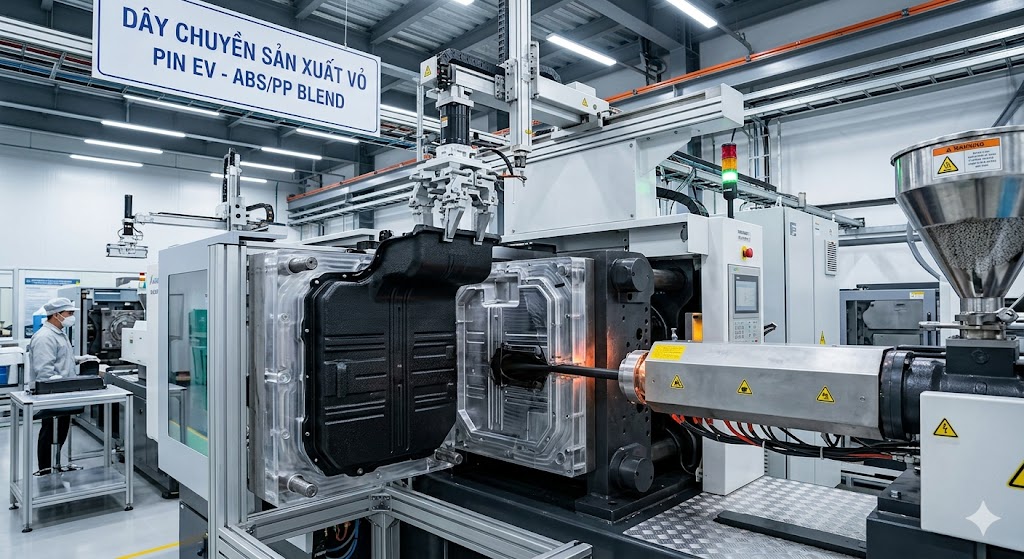
2. Step-by-Step Injection Molding Process of ABS/PP EV Battery Casings
Manufacturing EV battery casings via injection molding requires absolute precision at every stage to prevent surface defects or degradation of the structural mechanical properties.
Material Drying -> Heating & Melting -> Injection into Mold -> Packing & Cooling -> Product Ejection
Step 1: Material Drying
ABS is a hygroscopic material that readily absorbs moisture from the air. If not thoroughly dried, residual moisture will cause silver streaks on the surface and severely compromise the mechanical strength of the battery casing.
- Recommended Drying Temperature: 80°C – 90°C.
- Drying Time: 3 – 4 hours before feeding the material into the injection molding machine hopper.
Step 2: Heating and Plasticizing
The ABS/PP blend granules are fed by a screw into the heating barrel. Under the combined effects of external heat bands and high shear friction from the screw, the plastic transitions into a fully molten state. Barrel temperatures must be strictly controlled across different zones to prevent thermal degradation of the engineering plastics.
Step 3: High-Pressure Injection
The screw acts as a hydraulic piston, forcing the molten plastic through the nozzle at high speed into the mold cavity's runner system. This phase requires high pressure and velocity to ensure the plastic completely fills the intricate vangs, ribs, and thin-walled structures of the battery pack design.
Step 4: Packing and Cooling
- Packing (Holding Pressure): Once the cavity is filled, the machine maintains a specific holding pressure to feed additional material into the mold. This compensates for volumetric shrinkage as the plastic cools, preventing sink marks.
- Cooling: A water-cooling system running through channels within the mold lowers the plastic's temperature until the battery casing solidifies completely and retains its structural form.
Step 5: Product Ejection and Post-Processing
The mold opens, and the ejector pin system separates the molded plastic casing from the cavity. Operators or robotic arms retrieve the part, trim the runner/gate system, and transfer the component to the Quality Control (QC) station.
3. Recommended Technical Parameters for ABS/PP Blend Injection Molding
To help technical operators optimize the production line, here is the reference standard parameter matrix for processing ABS/PP alloys:
|
Technical Parameter
|
Recommended Range
|
Engineering Insights
|
|
Barrel Temperature
|
220°C – 250°C
|
Avoid exceeding 260°C to prevent polymer degradation.
|
|
Mold Temperature
|
50°C – 80°C
|
A warm mold improves surface gloss and minimizes internal residual stress.
|
|
Injection Pressure
|
70 – 120 MPa
|
Adjusted based on the wall thickness of the battery casing.
|
|
Shrinkage Rate
|
0.5% – 1.2%
|
Must be precisely calculated during the initial mold design phase.
|
Expert Insight: EV battery casings typically feature thick reinforcement ribs and large surface areas. If mold temperature control is inconsistent or holding pressure is insufficient, the product is highly susceptible to warpage—a critical defect that prevents the battery pack from sealing correctly during final assembly.
4. JM ENTERPRISE – Your Premium Engineering Plastics Supplier in Vietnam
To achieve peak efficiency in your EV battery casing injection molding process and minimize defect rates, the quality of your raw materials is paramount. Consistency in the Melt Index and flame-retardant properties of your resin is the key to maintaining a stable manufacturing line.
If you are looking for high-performance raw materials for industrial applications, JM ENTERPRISE is your trusted partner. With years of experience supplying plastic resins, we are committed to delivering international-standard products that meet the most demanding requirements of the modern electric vehicle industry.
Why Choose JM ENTERPRISE?
- Trusted Supply Chain: All of our plastic granules (including ABS, PP, and customized flame-retardant compound resins) are sourced from world-renowned manufacturers and carry full international quality certifications.
- Meeting Strict Technical Demands: We supply specialized flame-retardant ABS grades (achieving UL94 V-0 standards) and glass-fiber-reinforced PP resins, engineered perfectly for EV battery packs and electronic components.
- Competitive Pricing: Thanks to our extensive distribution network and long-term strategic partnerships with global producers, we deliver optimized cost solutions for your business.
- Professional Technical Support: Our dedicated team provides free technical consultation, helping clients fine-tune machine parameters to optimize production yields and minimize material waste.
Contact Us Today for a Free Consultation & Quote!
Do not let inconsistent raw materials disrupt your project timeline or product quality. Contact JM ENTERPRISE today to secure the ultimate material solutions for your EV battery casing production lines.
- Hotline/Zalo: * +84 933 706 351 Mr. Cha (English)
- +84 913 390 054 Ms. Ngan (Vietnamese)
- Email: jhcha@jmentchemical.com
- Website: jmentchemical.com